
How to Choose an ANPR System: 8 Features to Evaluate
- Posted On: October 15, 2026
- Post Comments: 0
Every truck that enters a terminal carries a plate, and every plate is a record waiting to be captured. An ANPR system turns that plate into searchable data the moment a vehicle reaches the gate. Yet not every solution suits a busy port, a container freight station or an inland depot. This guide walks through the eight features operations and IT teams should test before they buy, so the system you choose fits your gates, your cameras and your terminal software stack.
Key Takeaways
- A good ANPR system is judged on plate read accuracy, all condition performance and how cleanly its data reaches your TOS, VBS or ERP.
- Automatic number plate recognition delivers the most value when each read is enriched with vehicle type, colour, direction, time and location.
- Ask vendors for proof on your own plates and lighting, not brochure numbers, before you sign.
Why the Choice of ANPR System Matters at Port Gates
Gates are where terminal congestion starts. Heavy vehicle volume, manual logbooks and late identification of flagged trucks all slow the queue and weaken security.
Manual recording is slow and prone to error, and searching hours of CCTV footage for one vehicle wastes staff time. Cameras across several gates often run in silos with no central view. Automatic number plate recognition addresses these gaps by reading plates from live camera feeds and logging each event without manual monitoring. The right platform reduces gate processing time and frees security staff for exceptions. The wrong one creates a new stream of misreads that people must correct by hand. That is why feature fit matters more than price on the first pass. Teams already planning gate automation should treat plate reading as part of the same workflow, not a separate security add on.
The cost of a poorly matched ANPR system shows up quickly. Each misread can mean a truck waiting at the barrier, a clerk keying the plate by hand or a dispute over who entered the yard and when. Across hundreds of moves a day, those small delays add up to longer queues, overtime and weaker audit records.
Common Mistakes When Buying Automatic Number Plate Recognition
Most failed projects share a few avoidable mistakes. Spotting them early saves months of rework.
The first is buying on headline accuracy alone, without testing on local plates and lighting. The second is treating ANPR as a standalone security tool instead of linking it to gate, booking and yard workflows. The third is skipping a fallback plan for unreadable plates, which leaves guards improvising at the busiest moment. The fourth is ignoring data ownership and retention until after go live. Avoid these and automatic number plate recognition becomes a dependable source of gate data rather than another screen for staff to watch.
The 8 Features Every ANPR System Should Offer
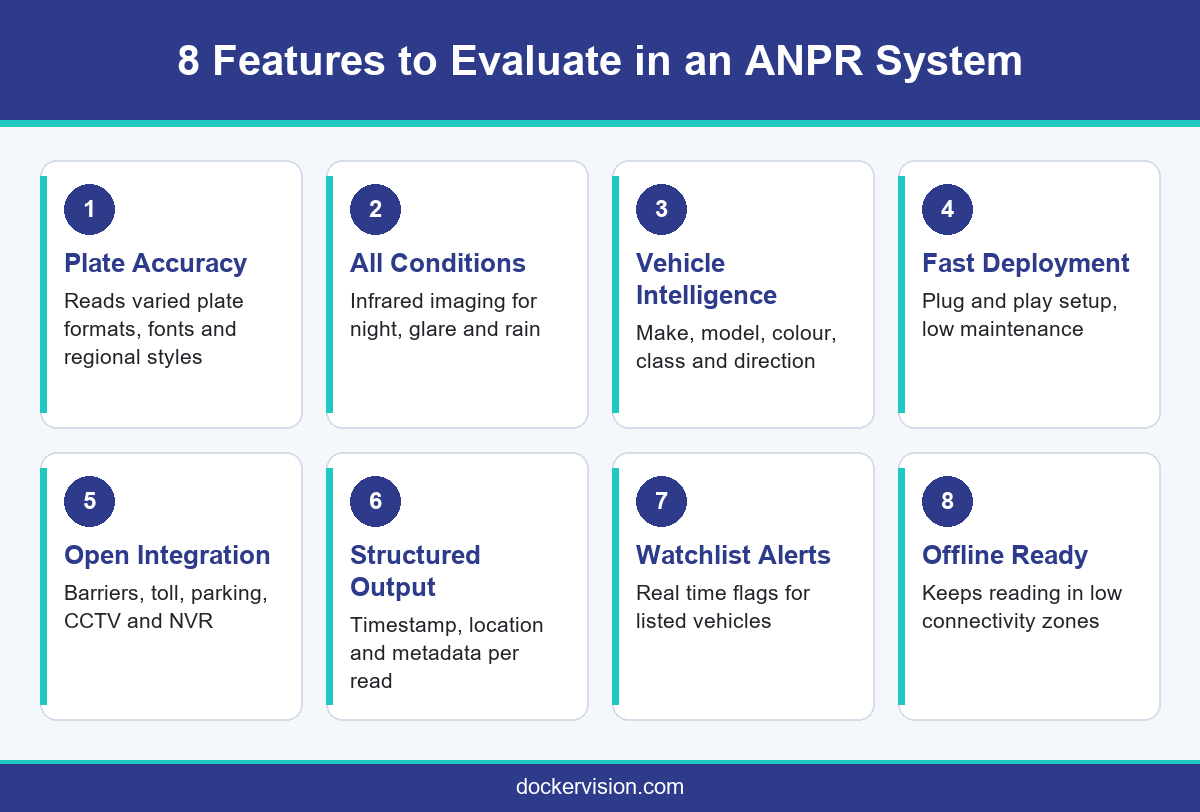
Use these eight features as a scoring sheet. Each one maps to a real operational pain point at gates, yards and parking areas.
Recognition accuracy across varied plate formats, fonts and regional styles. Docker Vision designs its ANPR for more than 98% plate read accuracy across varied formats, though results always depend on camera placement and site conditions.
All condition vision, using infrared assisted imaging for darkness, harsh glare and monsoon rain.
Vehicle intelligence, capturing make, model, colour, class and direction of travel alongside the plate.
Fast deployment, with plug and play setup and low maintenance overhead.
Open integration with barrier controllers, toll systems, parking software and existing CCTV or NVR equipment.
Structured output, logging every capture with a timestamp, location tag and vehicle metadata.
Watchlist matching with real time alerts for flagged or unauthorised vehicles.
Offline operation, so reads continue in low connectivity zones and sync later.
Not every feature carries equal weight at every site. A rail terminal may value direction of travel and offline operation most, while a CFS near a city may care more about watchlist alerts and fast deployment. Rank the eight features against your own gate problems before you compare vendors, so the scoring reflects your priorities.
How License Plate Recognition Software Works Step by Step
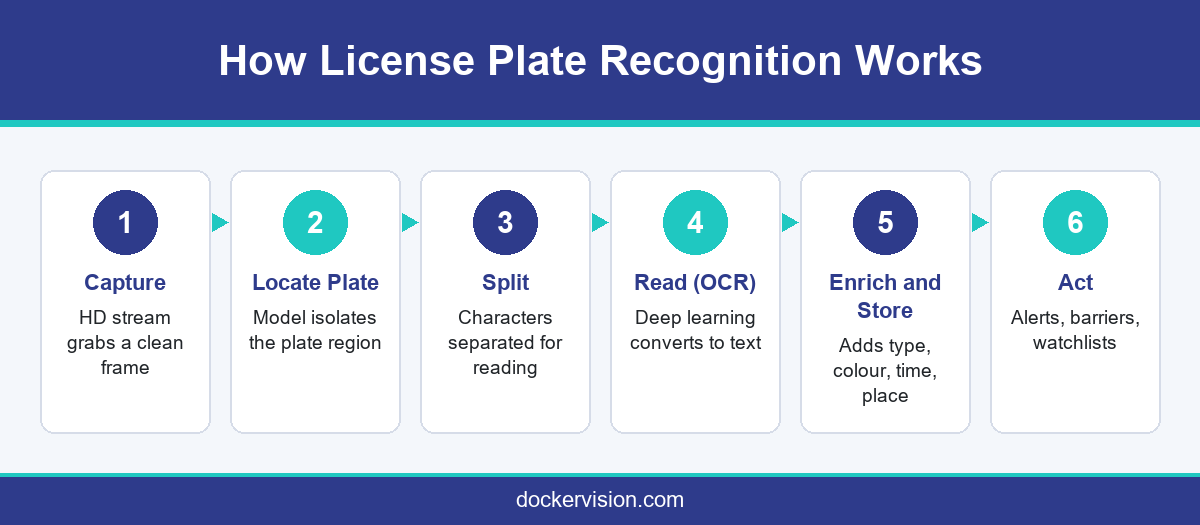
Understanding the pipeline helps you ask sharper questions in a demo. Most modern license plate recognition software follows six stages from camera frame to action.
First, a high definition stream captures a clean frame of the approaching vehicle. A vision model then locates the plate region, even when it is dirty, angled or partly obscured. Next, the characters are split and read by deep learning OCR that adapts to regional plate styles. The plate is enriched with vehicle type, colour, location, timestamp and direction, then stored in a database. Finally, the system acts by raising alerts, opening barriers or matching against watchlists. Ask each vendor where these stages run. Systems that process at the edge keep working when the network drops, a point covered in our guide to edge computing in port automation.
Timing also matters. A read that arrives in the TOS after the truck has already reached the yard adds little value. Ask for end to end latency figures from camera frame to system action, measured on a live lane rather than a lab bench.
Integration: Connecting Your Vehicle Identification System to TOS and VBS
A vehicle identification system only pays off when its data reaches the systems that make gate decisions. Integration should be tested, not assumed.
At a container terminal, plate reads should link to truck appointments in the Vehicle Booking System and to container moves in the Terminal Operating System. When a plate matches a booked slot, the gate can move the truck forward with fewer manual checks. When it does not match, staff see the exception immediately. Ask vendors which interfaces they support, how they handle duplicate reads and how quickly an event reaches your TOS. Docker Vision builds its platform to integrate with existing TOS, VBS and ERP platforms, and pairs ANPR with Gate OCR for container numbers so the truck and the box are verified together.
Ask how events are matched when several cameras see the same truck. Without clean de duplication, one vehicle can appear as several entries and distort yard counts. A strong vehicle identification system links each capture to a single gate event and keeps the original images for audit and dispute handling.
Questions to Ask Before You Sign an ANPR Contract
A short list of direct questions separates proven platforms from polished demos. Put them in writing and ask for evidence.
Can the vendor run a pilot on your own gates, with your local plate formats and lighting? How is accuracy measured, and what happens when a read falls below the agreed confidence score? Which cameras are required, and can existing CCTV be reused? How long does a new lane take to go live? Where is data stored, and who owns it? Each answer should be specific and testable. Our OCR accuracy agreement guide explains how to define measurable targets, and the same approach applies to plate recognition. For background on the wider tender, this overview of plate recognition technology shows how ANPR has matured across roads and facilities worldwide.
Finally, ask about the roadmap for your ANPR system. Plate formats change, new lanes open and camera hardware ages. A partner that can retrain models on your data and support new sites without a full rebuild will protect your investment for years, not months.
Conclusion
Choosing an ANPR system comes down to accuracy on your plates, performance in every condition, rich vehicle data and clean integration with the platforms that run your gates. Score each vendor against the eight features above and insist on a pilot before full rollout. Docker Vision develops AI powered computer vision for ports and logistics infrastructure, combining ANPR with container and rail OCR in one platform. To see how plate recognition could work at your gates, talk to the Docker Vision team about a site assessment.
Frequently Asked Questions
What is an ANPR system?
An ANPR system uses cameras and AI to detect, read and log vehicle registration plates automatically. It converts plate images into searchable text and pairs each read with time, location and vehicle details for operations and security teams.
How accurate is automatic number plate recognition?
Accuracy depends on camera placement, lighting, plate condition and local plate formats. Well configured AI platforms reach high read rates, but buyers should always validate accuracy with a pilot on their own gates before committing.
Can ANPR use existing CCTV cameras?
Many modern platforms can work with existing CCTV and NVR infrastructure if the cameras offer enough resolution and a suitable viewing angle. A site survey confirms which cameras can be reused and where new ones are needed.
What data does license plate recognition software capture?
Beyond the plate number, good software captures vehicle type, colour, make, direction of travel, timestamp, camera source and location. This metadata makes records searchable and supports investigations, reporting and planning. It also keeps the original image as evidence.
Does ANPR work without internet connectivity?
Edge based ANPR can keep reading plates and storing events locally when connectivity drops. Records then sync to the central system once the link returns, which suits remote gates and depots. Buffered events are timestamped at capture, so records stay in the correct order.
How does ANPR integrate with a Terminal Operating System?
Plate reads are passed to the TOS or Vehicle Booking System through APIs or middleware. The system matches plates to appointments and container moves so gate staff only handle exceptions. See how Docker Vision connects to existing terminal software.
Where can ANPR be deployed besides port gates?
ANPR also supports toll plazas, parking facilities, gated campuses, restricted zones, bus lanes and highway monitoring. In logistics, it is common at CFS and ICD gates, weighbridges and yard checkpoints. Each site sets its own rules for who may enter.
How long does an ANPR deployment take?
Plug and play platforms with minimal site configuration can go live quickly once cameras and network are in place. Timelines depend on lane count, integrations and testing. Review the Docker Vision technology stack for deployment components.

Leave A Comment