
Gate OCR Cameras: Why Standard IP Beats Line Scan
- Posted On: August 31, 2026
- Post Comments: 1
For twenty years, gate recognition meant line scan cameras in purpose built portals. That single assumption put automation beyond the reach of most terminals, because it turned a software project into a construction project with a capital request attached. Modern AI OCR software for ports has removed the constraint. This article explains what changed, what your existing cameras can already do, and where placement still matters more than hardware.
Key Takeaways
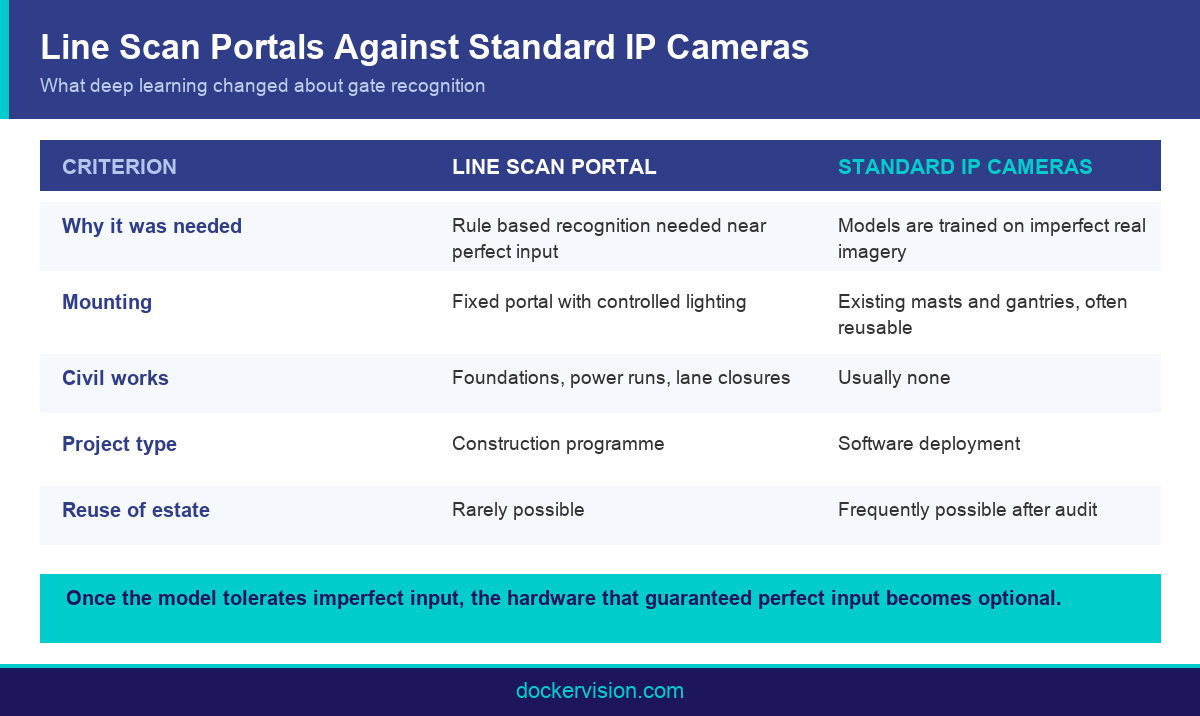
- Line scan cameras were required because older recognition needed near perfect input. Modern models are trained on imperfect imagery instead.
- Most terminals can reuse a substantial part of their existing IP and CCTV estate, which removes the largest capital line from a gate project.
- Placement, lighting and mounting angle now influence recognition quality more than camera specification does.
Why Line Scan Cameras Were Once Necessary
Early recognition systems used template matching and rule based character segmentation. Those techniques are brittle by design.
They need consistent lighting, a predictable viewing angle and a clean high contrast image, and they degrade sharply when any of those conditions slip. A shadow across a container face, a slightly different approach angle or a layer of road dirt was enough to defeat them. The engineering answer was to control the environment rather than improve the algorithm.
Line scan cameras deliver exactly that control. They build an image one line at a time as the container passes, producing consistent geometry regardless of vehicle length. The cost is that they must be mounted in a fixed portal with controlled lighting and a known vehicle speed, which means foundations, power distribution, lane closures during construction and a capital request large enough to need board approval. That is what kept automation out of mid sized terminals for two decades.
It is worth understanding this history rather than dismissing it, because line scan installations were the correct engineering answer to the problem as it stood. Terminals that invested in them were not making a mistake. The point is simply that the constraint which justified them has been removed, and a decision made on the old constraint should be revisited rather than inherited.
What Deep Learning Changed
Modern recognition does not segment characters by rule. It learns from examples instead, and that difference is what dissolved the hardware requirement.
Models are trained on large volumes of real imagery containing rain, glare, shadow, rust, dents, faded paint and partial occlusion. They learn to read despite those conditions rather than requiring their absence. The training data does the work that controlled lighting used to do, which means the expensive hardware that existed purely to guarantee perfect input becomes optional.
Docker Vision runs on standard IP and CCTV cameras and reports more than ninety five percent accuracy, with a two day implementation window because the work is software installation rather than construction. The broader technical shift is covered in the future of container number recognition, and the same underlying change is what makes retrofit projects viable on live sites.
The practical consequence for a buyer is that the question has changed. It is no longer whether you can afford the hardware that makes recognition possible, but whether your existing positions give a model enough to work with. That is a survey question rather than a capital question, and it can be answered in a day rather than a budget cycle.
Placement Rules That Matter More Than Hardware
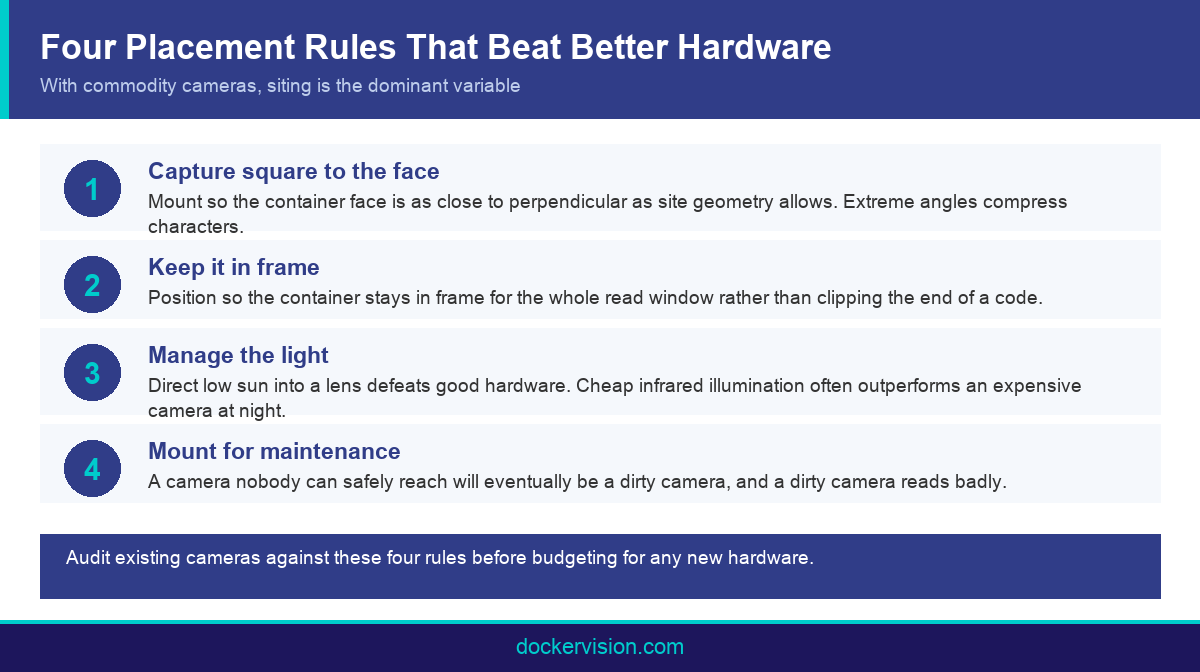
With commodity cameras, siting becomes the dominant variable in recognition quality. Four rules cover most of what matters.
Mount so the container face is captured as close to square as site geometry allows, because extreme angles compress characters and make reading measurably harder. Position so the container stays in frame for the whole read window rather than clipping the end of a code, which is a surprisingly common fault on retrofitted positions.
Manage lighting actively. Direct low sun into a lens defeats good hardware entirely, and cheap infrared illumination frequently outperforms an expensive camera at night. Finally, mount for maintenance access, because a camera nobody can safely reach will eventually be a dirty camera, and a dirty camera reads badly regardless of what sits behind it. Docker Vision keeps processing on site, and the edge computing explainer covers why capture and processing locality matter together. Industry publication Port Technology International carries regular coverage of gate installations for readers wanting wider context.
Test placement before committing to it wherever you can. A temporary mount and a few hours of real traffic will tell you more about a position than any specification will, and repositioning a bracket costs almost nothing compared with discovering the problem after commissioning. AI OCR software for ports is only ever as good as the view it is given.
Auditing the Cameras You Already Have
Before budgeting for any hardware, audit the estate you own. This is the highest return hour of work in the entire project and almost nobody does it first.
List every camera covering a gate lane with its resolution, frame rate, mounting height, viewing angle and night capability. Note which positions already have clean power and network run to them, because cabling is frequently the expensive part of adding a new position rather than the camera itself.
Most terminals find that a usable proportion of existing cameras can serve recognition directly, some need repositioning rather than replacement, and only a few positions require genuinely new hardware. That audit typically moves a project from a capital request to an operating budget item, which changes both the approval path and the timeline. Feed the findings into the nine cost variables and require every vendor to state what camera hardware their proposal assumes, using the requirements checklist.
Record the audit results in a form you can reuse. The same document supports the vendor tender, the installation plan and later maintenance scheduling, and it becomes the reference point when someone asks in two years why a particular camera sits where it does. Terminals that skip this step generally end up reconstructing it under time pressure.
When You Genuinely Do Need Better Hardware
An honest article has to say where the commodity camera argument runs out, because occasionally it does.
Very high speed lanes where vehicles do not slow appreciably can still challenge standard frame based capture. Sites with severely obstructed sightlines, where no available mounting position sees the container face at a workable angle, may need structural work regardless of the recognition technology. Lanes with extreme and uncontrollable backlighting can also warrant purpose selected hardware rather than reuse.
These cases are real but they are far less common than vendors of portal systems suggest, and they are usually specific to one or two positions rather than a whole terminal. The sensible approach is to audit first, deploy on what works, and buy hardware only for the positions the audit proves are inadequate. Industry body PEMA covers the equipment landscape in its container terminal automation information paper for readers who want the broader hardware context.
Where a position does need new hardware, treat it as a targeted purchase rather than a reason to re specify the whole project. Mixing standard cameras across most lanes with purpose selected units at two difficult positions is entirely normal, and it keeps the cost profile of the programme close to the software model rather than pushing it back toward a construction budget.
The general rule holds even in these cases. Specify the outcome you need at each position and let the survey determine the hardware, rather than selecting a camera standard first and applying it everywhere. AI OCR software for ports is designed to work with what a terminal realistically has, and a deployment that mixes reused cameras with a small number of targeted purchases is both cheaper and faster than one that standardises for its own sake.
Conclusion
AI OCR software for ports no longer depends on specialist cameras in purpose built portals. Modern models read the imperfect images that standard IP and CCTV cameras already produce, which turns gate automation from a construction project into a software deployment. Audit what you have, fix placement and lighting first, and buy hardware only where the audit proves a genuine gap. To review your camera estate against recognition requirements, contact the Docker Vision team.
Frequently Asked Questions
Do we need line scan cameras for gate OCR?
Not with modern recognition. Deep learning models are trained on imperfect imagery, so standard IP and CCTV cameras are sufficient in most gate configurations.
Can existing CCTV cameras be used for container recognition?
Frequently yes, where resolution, angle and night capability are adequate. An audit of the existing estate usually finds a usable proportion needs only repositioning.
What camera resolution is needed for container codes?
Enough that characters are clearly resolved at the read distance. Mounting angle and lighting typically influence recognition quality more than raw resolution does.
How does rain or darkness affect accuracy?
Modern models are trained on adverse conditions and cope well. Infrared illumination at night is often more valuable than upgrading the camera itself.
Where should gate cameras be mounted?
As square to the container face as geometry allows, keeping the container in frame for the whole read window, with manageable lighting and safe maintenance access.
Does avoiding line scan cameras reduce accuracy?
Not materially in practice. Docker Vision reports more than ninety five percent accuracy on standard IP cameras, because the model tolerates imperfect input rather than requiring perfect input.
What is the cost impact of using standard cameras?
It removes the largest capital line from a gate project, including the portal, foundations and lane closures that line scan installations require.
Should image processing happen at the gate or centrally?
On site processing reduces latency and keeps operational data within the terminal perimeter. This on premise deployment analysis covers the security reasoning.
How many cameras does each gate lane need?
It depends which elements you capture. Container code, ISO code, plate and damage are separate captures, so define the data elements first and let that set the count.

Comments
2027 Logistics Yard Management: Why OCR-Based Gate Automation Is Becoming Standard : Docker Vision,
14 Oct 2026[…] local server rather than sent to the cloud. Many sites can reuse existing cameras, and our guide to standard IP cameras versus line scan portals explains […]