
ANPR Parking System: Ticketless Entry for Gated Sites
- Posted On: October 28, 2026
- Post Comments: 0
Paper tickets get lost, access cards get shared and guards cannot memorise every plate. An ANPR parking system solves all three by using the vehicle’s own registration plate as its pass. The camera reads the plate, checks it against an access list and opens the barrier in seconds. For logistics parks, terminal staff car parks, CFS yards and corporate campuses, that means shorter queues and a reliable record of every entry and exit. Here is how it works and what to plan for, alongside the wider terminal automation approach many sites now follow.
Key Takeaways
- An ANPR parking system uses plate recognition instead of tickets or cards to control barriers and log every vehicle.
- Ticketless parking cuts queue time at entry and exit, and removes the cost of lost tickets and shared cards.
- Boom barrier automation works best when plate reads link to access lists, bookings and alerts in one platform.
What an ANPR Parking System Does at the Gate
The system replaces the ticket machine and card reader with a camera that recognises the vehicle itself. Entry becomes faster and every movement is recorded.
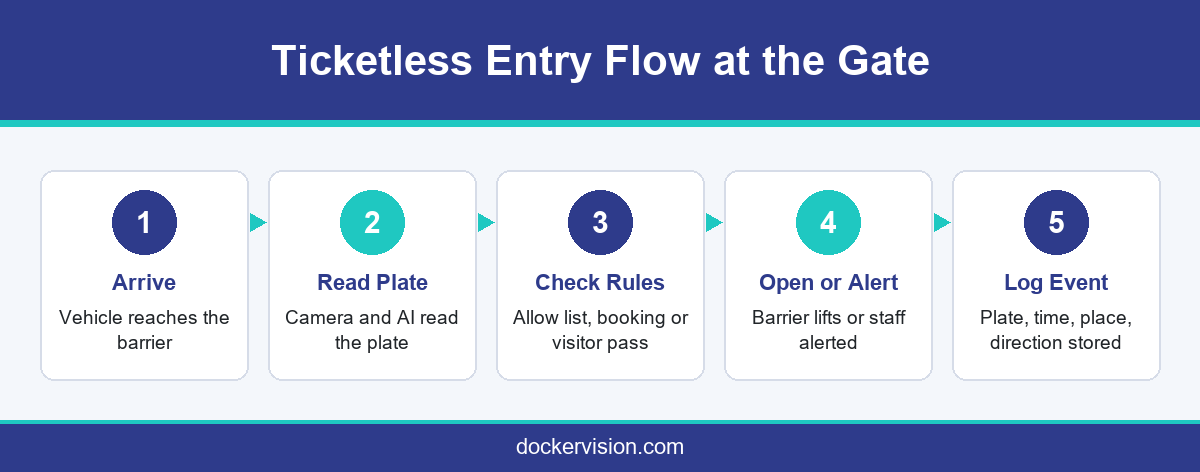
As a vehicle approaches, the camera captures its plate and the AI reads it in real time. The plate is checked against an allow list, a booking or a visitor pass. If it matches, the controller lifts the boom barrier without the driver stopping to take a ticket. If
it does not, the barrier stays down and staff receive an alert. Each event is logged with the plate, timestamp, location, direction and vehicle details. Docker Vision’s ANPR captures plates whether a vehicle is speeding past, idling at a gate or parked, which also supports occupancy checks inside the facility.
Inside larger sites, the same reads support zone level control. A truck admitted to the logistics park can be checked again at the yard entry, the weighbridge or the loading bay. Each checkpoint adds to one continuous record of where the vehicle has been.
Exit lanes work the same way. The plate is read again on the way out, the visit is closed and dwell time is calculated automatically. For paid parking, the system can compute charges from entry and exit times, and for staff areas it simply confirms the vehicle has left.
Ticketless Parking Compared With Tickets and Cards
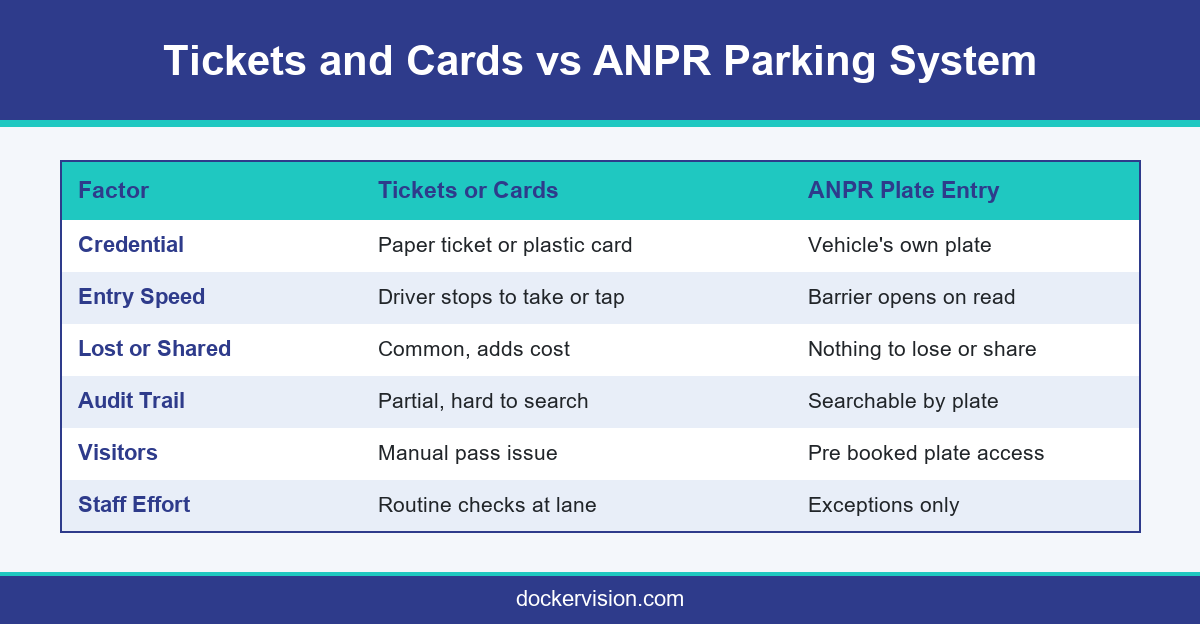
Tickets and cards add friction and cost at every lane. Ticketless parking removes the physical token and keeps the audit trail.
With paper tickets, drivers stop twice, tickets are lost and machines jam. With access cards, cards are shared, forgotten or cloned, and every new user needs a card issued. With plate based entry, the vehicle is the credential, so there is nothing to hand over or lose. Gate time drops because the barrier opens as the plate is read. Records become searchable by plate, so finding a vehicle’s history takes seconds instead of hours of footage review. Staff spend their time on exceptions rather than routine checks, a shift similar to the one described in our port automation ROI model.
The savings extend beyond the lane. Fewer ticket machines mean less hardware to service, no paper rolls to replace and fewer jams during peak hours. For operators with many sites, central plate records also make it easier to compare traffic patterns across locations.
Ticketless parking also improves the driver experience. Regular users no longer search for cards or wait behind a driver struggling with a ticket machine. Hauliers on tight delivery windows get through faster, and visitors arrive at a gate that already expects them. Small gains at each lane add up across thousands of entries a month.
Boom Barrier Automation and Gated Access Control
Boom barrier automation turns a plate read into a gate decision. Gated access control adds the rules that decide who gets in, when and where.
Docker Vision’s ANPR connects with barrier controllers, toll systems, parking software and existing CCTV or NVR infrastructure. Rules can allow permanent staff at any time, permit contractors only during set hours and admit visitors against a pre booked plate. Restricted zones can stay closed to all but listed vehicles. Watchlist matching flags stolen or barred vehicles the moment they appear. At a logistics site, the same reads can link to truck appointments in a Vehicle Booking System, so authorised hauliers move through without manual checks. Sites planning these rules can start from our port automation requirements checklist.
Clear rules also protect people. Emergency vehicles can be given priority access, and staff can see at a glance which vehicles are inside a sensitive area. Every rule change should be logged, so auditors can see who approved access and when it was granted.
Integration with existing barriers is usually simple. Most controllers accept a dry contact or network signal, so the platform can trigger the same mechanism the ticket machine used before. That keeps installation light and reduces downtime during changeover.
Access lists should be reviewed regularly. Remove vehicles of staff who have left, expire contractor permits on time and audit visitor passes each month, so the barrier only opens for vehicles that still have a reason to enter.
Where Ticketless Parking Fits in Ports and Logistics
Plate based entry is not limited to office car parks. It suits many points across a port or logistics network.
Common locations include staff and visitor parking at terminals, truck holding areas outside container gates, CFS and ICD entry lanes, warehouse docks and empty container depots. Logistics parks with many tenants use it to admit each tenant’s vehicles without a shared card system. The same platform also supports toll plazas, residential complexes and corporate parks. Because Docker Vision’s ANPR works with existing CCTV and NVR equipment, operators can often start with the cameras they already have and add dedicated units only where the survey shows a need.
For multi site operators, a single platform keeps rules and records consistent. A vehicle approved at one depot can be recognised at another, and reports cover the whole network rather than one gate at a time.
Planning an ANPR Parking System Rollout
A smooth rollout starts with a lane survey and a clean access list. Small planning steps prevent most go live issues.
Survey each entry and exit lane for camera position, lighting and vehicle speed. Decide whether existing CCTV can be reused or new cameras are needed. Build and clean the allow list, since outdated plates cause most early rejections. Define fallback steps for unreadable plates, such as an RFID reader, intercom or a guard override. Confirm where data is stored and how long records are kept. Pilot one lane first, review confidence scores and rejected reads, then extend to other lanes. Docker Vision offers plug and play setup with minimal on site configuration, and can run offline at scale for gates with weak connectivity.
Communication matters as much as technology. Tell staff, hauliers and regular visitors that entry is changing, explain how plates are registered and share the fallback process. A short notice period avoids confusion at the barrier during the first week.
After go live, measure the results against a baseline. Track average time from arrival to barrier opening, peak queue length and the number of manual overrides per shift. Monitor the share of plates read automatically and the reasons for any rejections, such as unregistered vehicles or dirty plates. Count incidents involving unauthorised vehicles before and after the change. Review these numbers monthly with security and operations teams. Over time, the data also supports better planning, such as adjusting staff rosters to real traffic peaks or adding lanes where queues persist.
Conclusion
An ANPR parking system replaces tickets and cards with the one credential every vehicle already carries. It shortens queues, strengthens gated access control and gives operations a searchable record of every movement. Start with a lane survey, a clean allow list and a single pilot lane, then scale with confidence. Docker Vision brings ANPR together with its port and logistics computer vision platform for terminals, depots and campuses.
Speak with Docker Vision to plan ticketless entry at your site.
Frequently Asked Questions
What is an ANPR parking system?
An ANPR parking system reads vehicle plates at entry and exit, checks them against access rules and controls the barrier automatically. It replaces tickets and cards and logs every movement with time and location. Records are fully searchable later.
How does ticketless parking work?
A camera reads the plate as the vehicle arrives and the system checks it against an allow list or booking. If it matches, the barrier opens. On exit, the record closes and any charges are calculated automatically.
Can ANPR open a boom barrier automatically?
Yes. The ANPR platform sends a signal to the barrier controller when a plate matches the access rules. Unmatched plates keep the barrier closed and trigger an alert for staff to review. Every decision is logged for audit.
Is an ANPR parking system suitable for logistics parks?
Yes. Logistics parks, CFS yards and ICDs use plate based entry to admit authorised trucks, staff and visitors. Reads can also link to truck appointments in a Vehicle Booking System. It also removes the need for shared access cards.
What happens if the ANPR camera cannot read a plate?
Good systems flag low confidence reads and route them to a fallback such as an RFID reader, intercom, guard override or manual entry. The barrier stays closed until the vehicle is verified. Each fallback event is logged with the reason.
Can visitors use ticketless entry?
Visitors can be pre registered by plate with a valid time window. When they arrive, the system recognises the plate and opens the barrier, then removes access automatically when the window ends. Hosts can approve guests in advance.
Does ANPR parking work with existing CCTV?
Many deployments reuse existing CCTV and NVR equipment where resolution and angles suit plate reading. A survey identifies lanes that need dedicated cameras. Learn more about
Docker Vision’s AI port solutions. Reusing hardware lowers rollout cost.
How is ANPR parking data kept secure?
Records should be stored on systems the operator controls, with role based access and defined retention periods. On premise options suit sites with strict security needs, as explained in our
on premise port automation guide.

Leave A Comment