
Automated Stacking Crane Yards: What Terminals Can Adopt
- Posted On: October 26, 2026
- Post Comments: 0
Photographs of automated yards show rows of unmanned cranes working a stack with nobody in sight, and they set an expectation that most terminals cannot meet. An automated stacking crane yard is a specific and expensive design that suits a narrow set of operators. This article explains what one actually requires, why the economics rarely work at mid scale, and which parts of the concept a conventional terminal can adopt now, drawing on what the flagship facilities actually achieved.
Key Takeaways
- An automated stacking crane yard needs a purpose designed layout, a heavy control system and civil works that a working terminal cannot easily retrofit around live operations.
- The economics turn on labour cost, land cost and throughput density, which is why adoption clusters in high wage, land constrained ports rather than following volume alone.
- The published evidence on automation productivity is mixed, and several automated terminals took years to reach the move rates their manual predecessors achieved.
- Three parts of the concept transfer cheaply to a conventional yard: accurate identity, independent position observation and disciplined allocation policy.
What an Automated Stacking Crane Yard Actually Requires
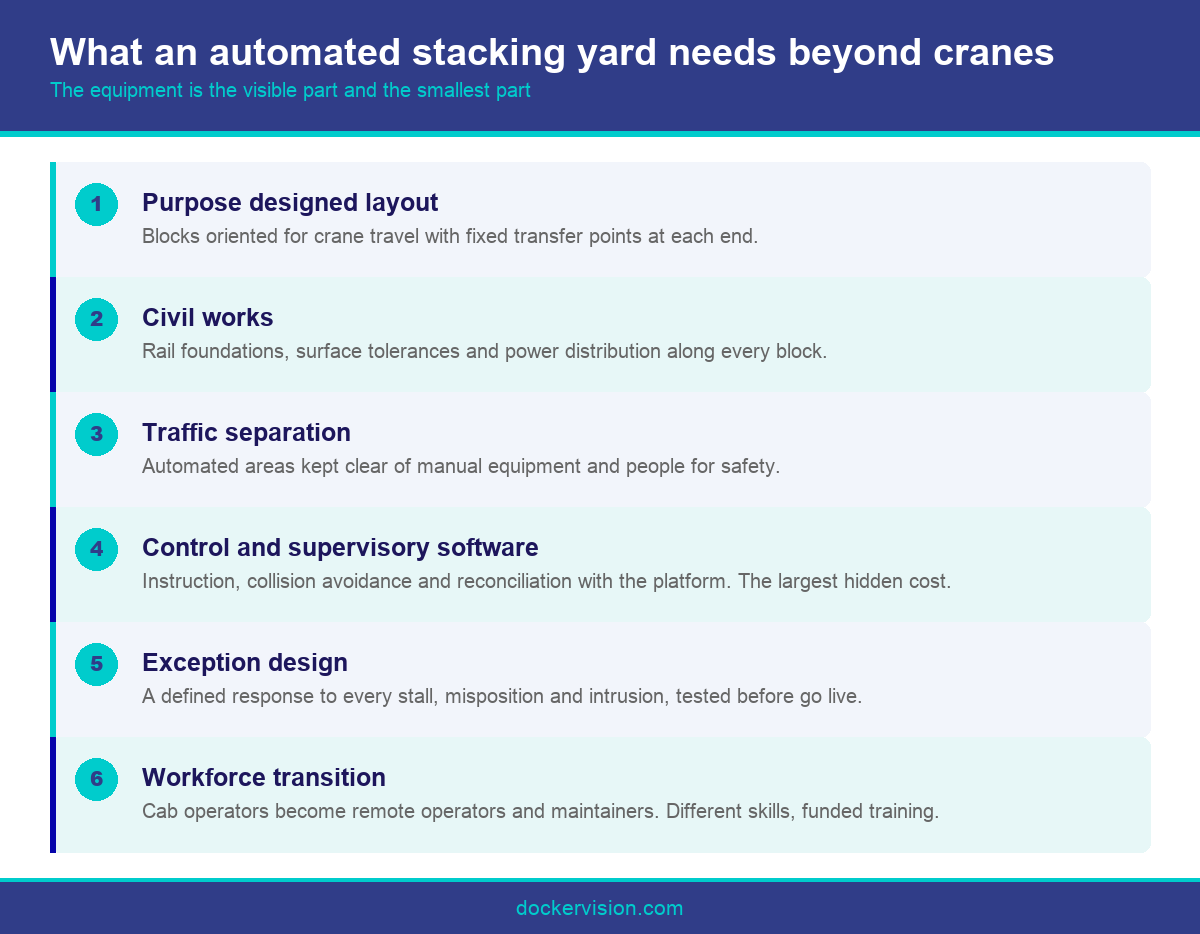
The equipment is the visible part and the least of the problem. An automated rail mounted gantry crane runs on fixed rails along a block, lifts without an operator in the cab and hands over to a manned or automated vehicle at the transfer point. The machine itself is well proven and available from several manufacturers.
The layout is where the real commitment sits. Blocks in an automated yard are typically oriented perpendicular to the quay, with fixed transfer points at each end, because that geometry lets the cranes work without crossing traffic. Reorienting an existing yard to that pattern is a rebuild rather than a modification.
Then there is the civil work. Rails need foundations, power needs distribution along every block, the surface has to meet tolerances that manual yards do not, and the whole area has to be separated from pedestrian and manual traffic for safety reasons. None of this happens while the block is handling containers.
The control system is the largest hidden cost. Automated cranes need continuous instruction, collision avoidance, exception handling and a supervisory layer that reconciles what the machines are doing with what the operating platform planned. That software layer is where most automated yard projects overrun.
Exception handling deserves particular attention because it is where the concept meets reality. A twistlock that does not release, a container that is out of position, a person who enters the block, or a machine that stops mid cycle all need a defined response, and every one of those responses has to be designed, tested and staffed.
Finally there are the people. Automated yards do not remove staff so much as move them, from cabs into remote control desks and maintenance roles, and both of those are different skill sets. Terminals that underinvest in that transition find the technology working and the operation still struggling.
Why the Economics Rarely Work at Mid Scale
Automated yards substitute capital for labour, so the case strengthens as labour gets more expensive and weakens as it gets cheaper. This is why adoption clusters in northern Europe, Australia and parts of east Asia rather than tracking container volume, and why Indian terminals with the same throughput reach a different answer entirely.
Land cost is the second driver. Automated blocks stack higher and denser than manual ones because the machine does not need the clearances a human operator does, so where land is scarce and extremely expensive, density itself can justify the investment even when labour arithmetic alone would not.
Throughput density is the third. The capital is fixed whether the block is busy or not, so the case depends on keeping the equipment working. A terminal with pronounced peaks and quiet periods spreads the same capital across fewer productive hours, which weakens the return considerably.
The published evidence on productivity is more mixed than the marketing suggests. Work by the International Transport Forum and others has found that automated terminals are not reliably more productive than well run manual ones, and that several took years to recover the move rates they had before automating.
That finding is not an argument against automation. It is an argument against assuming automation delivers productivity by itself, and for being specific about which cost you are actually trying to remove. Terminals that automated to reduce labour cost generally achieved that. Terminals that automated expecting speed frequently did not.
For a mid sized terminal in a moderate labour cost market with available land, the honest conclusion is usually that a full automated yard does not pay, and that the same capital produces a better return spent on identity, observation and equipment reliability. Our account of what the flagship yards achieved covers the evidence.
What Transfers to a Conventional Yard
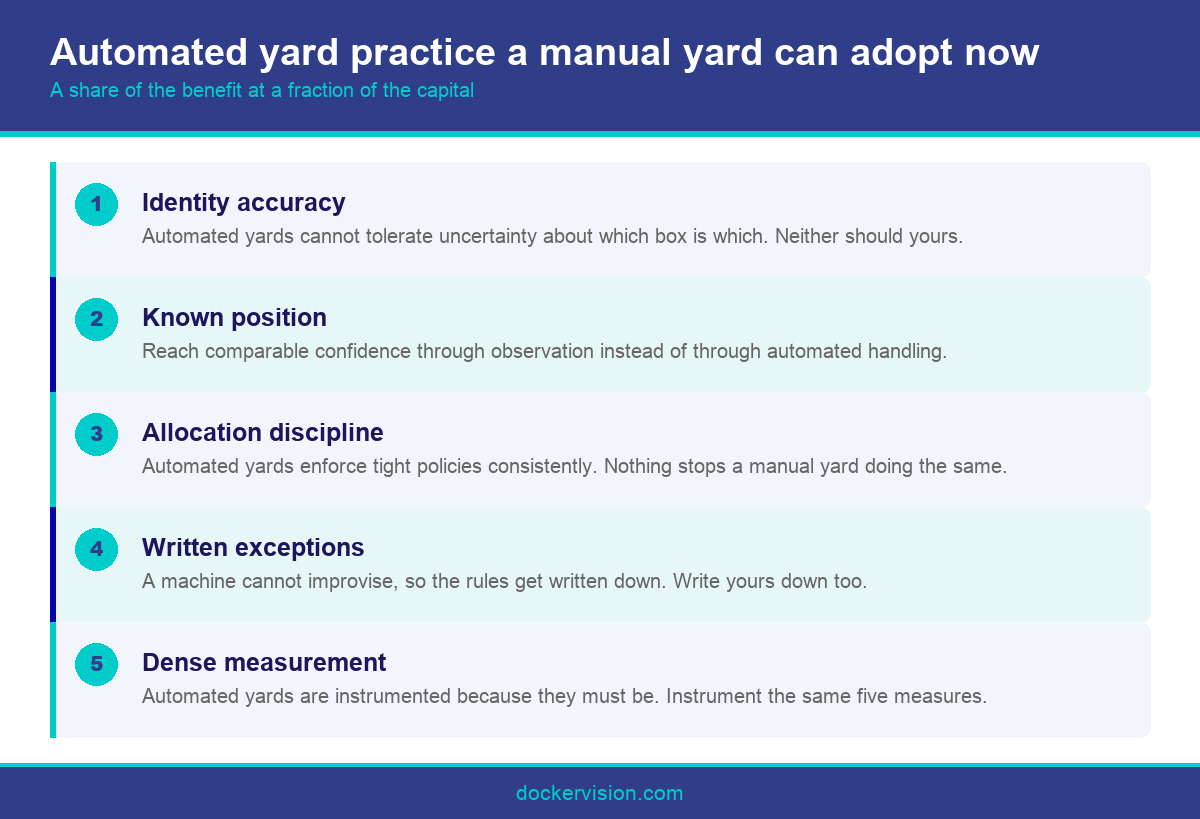
The first transferable element is identity accuracy. Automated yards depend absolutely on knowing which container is which, because no operator is present to notice that something is wrong. That discipline is valuable in a manual yard too, and it costs a fraction of what the crane does.
The second is independent position observation. An automated block knows where every box is because the machine placed it and reported. A conventional yard can approach the same confidence through observation rather than through automation, which is the cheaper route to the same underlying benefit.
The third is allocation discipline. Automated yards run tight allocation policies because the system enforces them consistently. Nothing prevents a manual yard from adopting the same policies, and the main obstacle is usually that nobody has revisited the configuration since the platform was installed.
The fourth is exception visibility. Automated operations are forced to define what happens when something is out of place, because a machine cannot improvise. Writing those definitions down for a manual yard produces most of the benefit without any of the capital, and it survives staff turnover.
The fifth is measurement. Automated yards are heavily instrumented because they have to be, and the resulting metrics drive continuous improvement. A conventional yard can instrument the same five measures using data it already holds, which is where any improvement programme should start.
Taken together, these five deliver a meaningful share of the operational benefit for a small fraction of the capital, and they are also the necessary groundwork if a genuine automated yard is ever justified. Nothing in the list is wasted if you automate later.
If You Are Genuinely Considering One
Model the labour saving against your own wage bill and your own shift pattern rather than against a vendor case study from a different country. This single substitution changes the outcome for most terminals outside the highest wage markets, and it is the number that will be challenged first by anybody reviewing the case.
Model the density gain against your actual land constraint. If you have room to expand at reasonable cost, the density argument weakens sharply, and paving additional area is frequently cheaper per slot than automating existing area. That comparison should be explicit rather than assumed.
Plan the transition around live operations honestly. A block being converted is a block not handling containers, and the sequencing of that across a working terminal is usually the hardest part of the programme. Ask any reference site what the conversion period actually cost them in lost capacity.
Budget for the control layer separately and generously. The cranes are procurable and the software that coordinates them is where schedules slip, so treat it as a major project in its own right with its own testing regime rather than as an included component of the equipment purchase.
Talk to at least two reference sites, and ask the operations manager rather than the sponsor how long it took to match the previous move rate. The answer is often measured in years, and knowing that in advance changes how the business case is framed and how expectations are set internally.
Then do the foundational work first regardless of the decision. Identity, observation, allocation discipline and measurement all pay for themselves in a conventional yard and are prerequisites for an automated one, so there is no scenario in which starting there is the wrong move. Our guide to the yard layer sets out that sequence.
Conclusion
An automated stacking crane yard is a specific answer to a specific combination of expensive labour, scarce land and dense throughput. Most mid sized terminals do not have that combination, and the published evidence does not support automating for speed alone. What does transfer is identity accuracy, position observation, allocation discipline, exception definition and measurement, all of which cost far less. Ask Docker Vision where to start.
Frequently Asked Questions
What is an automated stacking crane?
It is a rail mounted gantry crane that works a yard block without an operator in the cab, taking instructions from a control system and handing containers to vehicles at fixed transfer points at each end of the block.
Can an existing yard be converted to automated stacking?
Rarely without a rebuild. Automated blocks need a specific orientation, rail foundations, power distribution along every row, surface tolerances and separation from manual traffic, none of which can be installed while the block continues handling containers.
Does an automated yard handle more containers per hour?
Not reliably. Published research including work by the International Transport Forum has found that automated terminals are not consistently more productive than well run manual ones, and that several of them took years to regain their previous move rates.
What drives the business case for automation?
Labour cost, land cost and throughput density, in roughly that order. Adoption clusters in high wage and land constrained ports rather than following container volume, which is why two terminals with identical throughput can reach opposite conclusions.
Do automated yards remove jobs?
They move them more than remove them, from crane cabs into remote control desks, exception handling and maintenance. Both destinations require different skills, and terminals that underinvest in that transition struggle even when the technology works.
What is the most underestimated cost?
The control and supervisory software layer. Cranes are procurable from several manufacturers, but the system that coordinates them, avoids collisions and handles exceptions is where automated yard projects most often overrun on time and budget.
Which automated yard practices work in a manual yard?
Identity accuracy, independent position observation, disciplined allocation policy, written exception definitions and systematic measurement of the results. All five of them deliver real operational benefit at a very small fraction of the capital an automated block would require.
Is paving more yard cheaper than automating?
Frequently, yes, where land is available at reasonable cost. Density is one of the main arguments for automation, so if you can expand affordably that argument weakens considerably and should be tested explicitly rather than assumed.
What should we ask an automated terminal reference site?
Ask the operations manager, not the project sponsor, how long it took to match the previous move rate and what the conversion period cost in lost capacity. Our piece on AI in real terminal operations covers what the published record shows.

Leave A Comment