
Number Plate Recognition Camera or Existing CCTV? How to Decide
- Posted On: November 23, 2026
- Post Comments: 0
Before you buy a number plate recognition camera, look up at the cameras you already own. Many sites have IP cameras covering their gates that could read plates with the right software and a few adjustments. Others have cameras that will never read a moving plate at night, whatever software sits behind them. This guide gives you a practical way to tell the two apart, so you replace only what needs replacing and spend the rest of the budget where it changes results.
Key Takeaways
- A number plate recognition camera is defined by what it delivers, enough pixels on the plate, a sharp frame at speed and controlled light, not by its label.
- Existing CCTV can often do the job when it frames one or two lanes, has adequate resolution and gets help from infrared at night.
- Comparing reuse, upgrade and replace per lane is the fastest way to find the cheapest route to reliable reads.
What Makes a Camera Good at Reading Plates
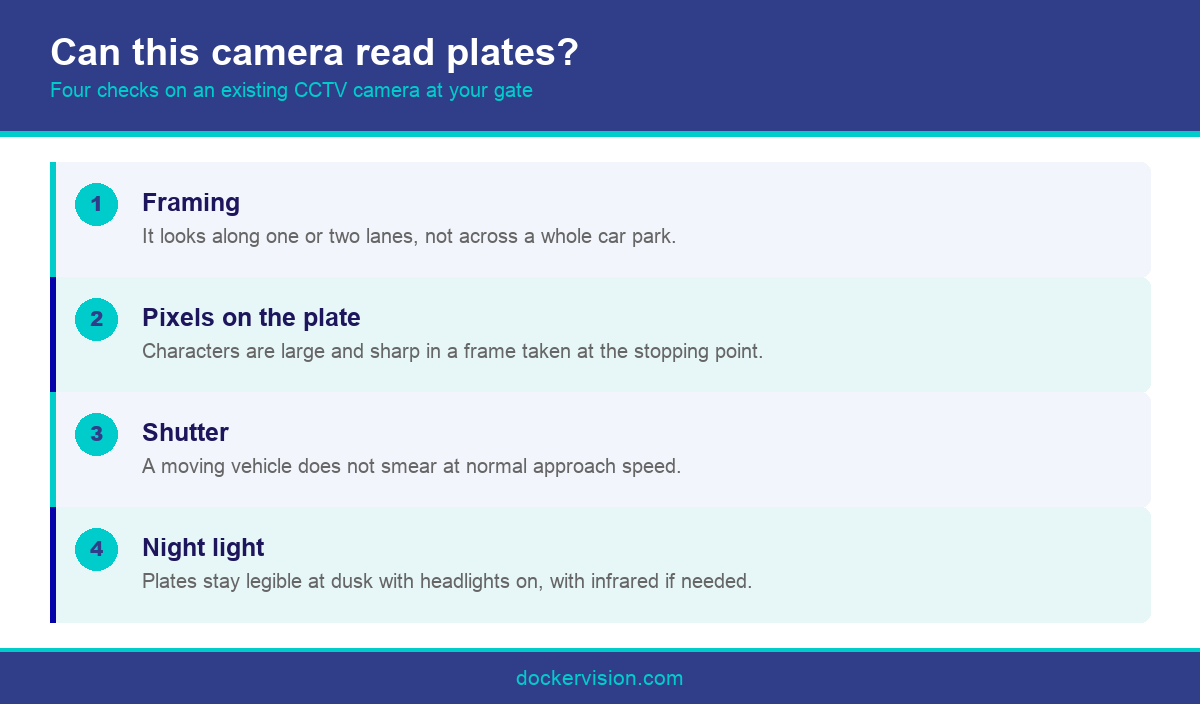
Three things decide whether any camera can read a plate. The first is pixels on the plate: the characters must be large enough in the image to be read reliably. The second is a sharp frame: a moving vehicle must not smear, which depends on shutter speed. The third is controlled light, so the plate is neither lost in shadow nor washed out by headlights.
A dedicated number plate recognition camera is tuned for all three out of the box. A general CCTV camera is tuned for watching wide scenes, so it often fails the first two unless it is reframed and reconfigured. The question is whether yours can be.
The same logic shaped Docker Vision’s container gate work, where standard IP cameras proved good enough for reading container codes once they were placed and set up for the task.
Can Existing CCTV Act as a Number Plate Recognition Camera?
Often it can, with conditions. The camera must look along the lane rather than across a wide car park, it must cover no more than one or two lanes, and it must have enough resolution for the plate size at that distance. It also needs a fast shutter setting and infrared or good lighting at night.
Walk your gates with a laptop and pull a clip from each camera at dusk. If plates are crisp and readable by eye at the point where vehicles slow down, software has a good chance. If they smear or flare, the fix may be a setting, a lens, an illuminator or a new camera, in that order of cost.
LPR Camera Price vs Upgrading the Lens and IR You Already Have
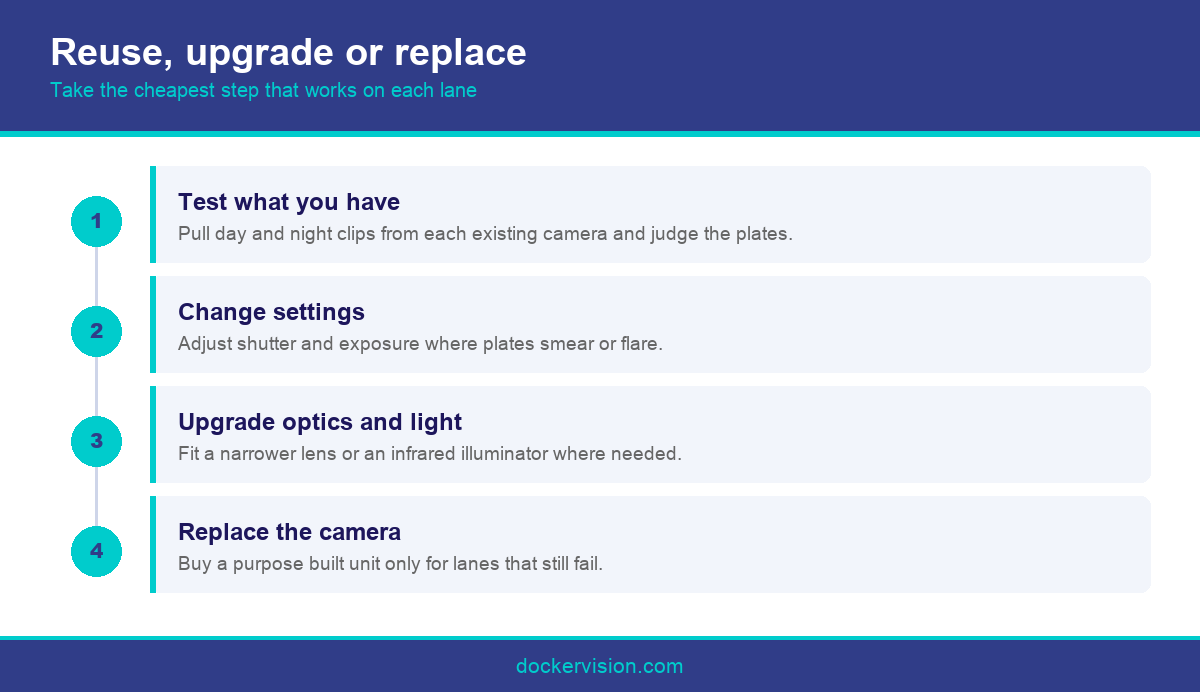
A new reader is the simplest fix and the most expensive. Before paying a full LPR camera price, price the smaller steps: a narrower lens that puts more pixels on the plate, an external infrared illuminator for night reads, or a shutter and exposure change that stops motion blur.
Each step costs a fraction of a new unit, and together they often turn a watching camera into a reading one. Where they do not, you have lost little and learned exactly what the replacement must do.
ANPR Camera Cost per Lane: Reuse, Upgrade or Replace
Compare the three routes lane by lane. Reuse costs software and setup. Upgrade adds a lens or illuminator. Replace adds a new camera, mounting and cabling. The ANPR camera cost for a site is the sum of the cheapest route that works on each lane, not one decision applied to all of them.
Pixels per Character: The Real Limit on Automatic Number Plate Recognition
Resolution figures on a datasheet mean little on their own. What matters is how many pixels each character occupies once the camera is mounted. Automatic number plate recognition fails quietly when characters shrink, so measure on a real frame rather than trusting the box.
When a Dedicated Camera Is the Right Call
Some lanes justify new hardware. High speed approaches, long distances between camera and plate, lanes facing direct sun at certain hours, and sites with no camera covering the lane at all are all good reasons to buy a purpose built unit.
Night performance is the most common deciding factor. Plates need controlled infrared light to stay legible when headlights are on, and older cameras often lack it. Docker Vision’s guide to reading plates in fog, rain, glare and darkness covers the conditions worth testing.
Entry lanes with no existing camera are the other clear case. Running new cable and power to a pole costs much the same whatever camera is fitted, so the extra spend on a purpose built unit is small compared with the installation itself, and it removes doubt about night and speed performance.
Whichever route you choose, keep the recognition software independent of the camera brand. That way a lane can be upgraded later without replacing the system behind it.
Night, Weather and Speed: Testing the Hard Cases
Daytime clips flatter every camera. The real test is the hour after sunset, a wet road, and a vehicle that does not slow down as much as the site rules say it should. Those are the moments when a watching camera and a reading camera behave very differently.
At night, headlights flare across the plate while the rest of the frame falls dark. A camera with a controlled infrared illuminator and a short exposure keeps the plate readable. One relying on street lighting often shows a bright smear where the characters should be.
Rain and dust soften the image and add reflections. A housing with a clean, angled window and a regular cleaning schedule matters more than most buyers expect. Speed adds motion blur, which only a faster shutter, and enough light to support it, will remove.
Record a week of clips across these conditions before deciding anything. If an existing camera passes all of them, it is a reading camera already. If it fails only at night, light is the answer. If it fails at speed, the shutter or the camera itself must change.
A Simple Decision Path for Each Gate
Start with the cameras you have. Pull night and day clips, judge plate sharpness and size, and note the lanes that pass. For the rest, try a setting change, then a lens or illuminator, and only then a new number plate recognition camera.
Share the clips with each shortlisted supplier and ask them to report reads lane by lane. The differences between their results are often larger than the differences between their prices.
Involve the people who will maintain the lane. Security and facilities teams know which cameras already cause trouble, which gates flood in the monsoon and which lanes carry the heaviest traffic.
Repeat the test after any change. A lens swap or new illuminator can fix one problem and create another, such as a narrower view that misses vehicles parked slightly off line. Measured results after each step stop that from slipping through unnoticed.
Keep a simple table for every lane: camera position, what was tested, what failed and what was changed. It takes an afternoon to build and it saves weeks later, because the next person to look at that gate starts from evidence instead of guesswork. It also shows suppliers that you will judge them on measured results.
Then run the software on the result for a week and count reads against vehicles. That evidence makes the purchase easy to justify, and it gives you a baseline for comparing suppliers on the features that matter.
Conclusion
A number plate recognition camera is the right purchase only for the lanes your existing cameras cannot serve. Test what you have, fix it in the cheapest order, and buy new hardware where the evidence says you must. Docker Vision’s software reads plates from standard camera feeds, so it can start on the cameras you already own. Share a clip from your gate with Docker Vision for an honest assessment.
Frequently Asked Questions
What is a number plate recognition camera?
It is a camera set up to capture vehicle plates clearly enough for software to read them, with enough pixels on the plate, a fast shutter and controlled lighting. The label matters less than those three qualities.
Is it cheaper to pay the LPR camera price or reuse existing CCTV?
Reusing CCTV is usually cheaper when the camera already frames the lane well. A lens change, an infrared illuminator or new settings often costs far less than a new unit, so try those steps first.
What is the ANPR camera cost per lane if I keep my CCTV?
Mostly software, configuration and any small upgrades such as a lens or illuminator. The camera and cabling are already paid for, which can make reuse the lowest cost route for lanes that pass a night test.
What resolution does automatic number plate recognition need?
Think in pixels per character on the mounted image rather than headline megapixels. Characters must be large and sharp enough in the frame to read reliably, so test on real footage from the actual mounting position.
Why do some CCTV cameras fail to read plates at night?
Headlights flare, plates fall into shadow and slow shutter settings smear moving vehicles. Infrared illumination and a faster shutter solve most of this, which is why night clips are the best test. Clean housings help in rain too.
Should recognition software be tied to one camera brand?
Ideally not. Software that works across brands lets you upgrade a single lane without replacing the system, and lets mixed sites run one consistent log of every vehicle. It also avoids being locked into one supplier for every future upgrade.
How many lanes can one camera cover for plate reading?
Generally one, and at most two, so each plate occupies enough of the frame. Wide shots covering a whole car park are good for watching but poor for reading plates reliably. Plan one reading camera per lane.
Can the same cameras watch for security and read plates?
Sometimes, though the two jobs pull in different directions. Docker Vision’s visual surveillance and computer vision work shows how one camera network can serve several tasks when placement is planned for each. Placement decides which job wins.

Leave A Comment