
Vizhinjam, Mundra and JNPT: India’s Automated Shipping Ports
- Posted On: November 19, 2026
- Post Comments: 0
Three Indian facilities dominate every conversation about port modernisation, and each got there by a different route. Reading them as a set is more useful than reading any one in isolation, because together they show where investment in automated shipping ports actually goes and why. This article looks at what each demonstrates and what a mid sized operator should take from them, alongside what the global flagship yards achieved.
Key Takeaways
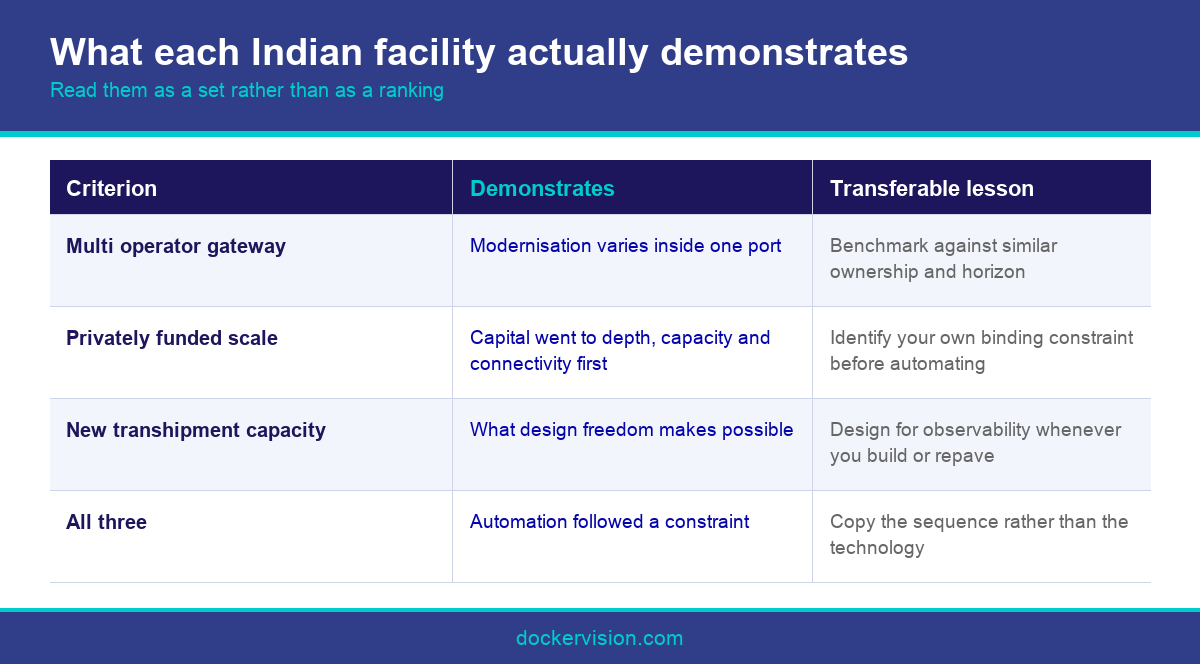
- JNPT shows how a multi operator gateway modernises unevenly, because each terminal makes its own decisions on its own concession horizon.
- Mundra shows that private capital in India went first to scale, depth and connectivity, with automation following the constraint rather than leading it.
- Vizhinjam shows what designing for automation from the start looks like domestically, and why transhipment economics justify it where gateway economics may not.
- The transferable lesson is consistent across all three: automation followed a specific binding constraint rather than a general modernisation ambition.
JNPT and the Multi Operator Gateway
Jawaharlal Nehru Port has been the reference point for Indian container handling for decades and remains the largest container gateway in the country. Its defining structural feature for this discussion is that it is not one terminal but several, run by different operators under separate arrangements.
That structure produces uneven modernisation by design rather than by accident. Each operator brings its own group standards, capital access and concession horizon, so a truck moving between berths can meet very different levels of automation on the same morning at the same address.
It also makes the port a useful natural experiment. Terminals with comparable volumes and identical external conditions have made different technology choices, and the differences in turn time and throughput between them are attributable to those choices more cleanly than in most comparisons.
The gateway characteristic matters too. A gateway terminal serves inland cargo, which means road and rail connectivity, customs processing and document flow all shape performance as much as quayside productivity does. Automation investment here has followed those constraints rather than the crane.
For a mid sized operator, the JNPT lesson is that the highest return investments at a gateway sit at the boundary rather than at the quay. Gate throughput, document processing and hinterland coordination are where the delay accumulates, and they are also the cheapest layers to address.
JNPT is also where the phrase automated shipping ports becomes least useful, because it describes an address rather than an operation. Two berths a kilometre apart can sit a decade apart in automation maturity, and any national statistic that averages them conceals more than it reveals about what a specific operator has actually built.
It is also a reminder to benchmark against the right neighbour. Comparing a mid sized independent terminal against a group owned facility with different capital access produces a misleading gap in both directions, and the useful comparison is with a terminal of similar ownership and horizon.
Mundra and Where Private Capital Went First
Mundra grew into the largest commercial port in India through sustained private investment, and what that investment prioritised is instructive. Capital went to depth, berth capacity, connectivity and land, which were the constraints limiting how much cargo could physically be handled.
Automation followed rather than led. That ordering is not a criticism, it is the correct sequence when the binding constraint is physical capacity. Automating a berth that cannot accommodate the vessels you want to attract solves a problem you do not yet have.
The broader Adani port network, including Kattupalli and other facilities, extends the same logic across multiple locations. Standardisation across a network creates its own automation case, because a system deployed once can be replicated at lower marginal cost at each subsequent site.
That network effect is worth noting by operators who are not part of one. A single site terminal cannot amortise a bespoke system across ten facilities, which is a genuine argument for choosing standard, widely supported technology rather than anything custom.
The connectivity emphasis is the other transferable point. Mundra invested heavily in rail and road links because terminal performance is bounded by what leaves the terminal, and a facility that handles containers quickly and cannot evacuate them has moved its congestion rather than removed it.
For a smaller operator, the lesson is to identify your own binding constraint honestly before automating anything. If cargo is waiting for road capacity rather than for a crane, gate automation helps and yard automation will not, and the difference is worth an afternoon of analysis.
Vizhinjam and the Transhipment Case
Vizhinjam is the most significant recent development in Indian container handling, a deep water transhipment terminal on the Kerala coast built to capture cargo that has historically been transhipped through ports outside India. It was designed with automation in mind rather than having it retrofitted.
That design decision is the interesting part. A greenfield facility can adopt the block orientation, power distribution and traffic separation that automated handling requires, none of which can be retrofitted into a working yard without taking blocks out of service for extended periods.
Transhipment economics also differ from gateway economics in ways that favour automation. Transhipment cargo moves ship to ship without a road transaction, so the volume is high, the handling is repetitive and predictable, and equipment utilisation can be kept high enough to justify fixed capital.
The competitive dimension is national rather than commercial. Cargo transhipped through an Indian terminal instead of a foreign one changes the economics of connecting services and reduces dependence on foreign hubs, which is why the facility is discussed in policy terms as much as in operating terms.
For a mid sized gateway operator, the honest reading is that Vizhinjam is not a template. Its cargo profile, its greenfield design freedom and its strategic role are all different, and copying its technology choices without its conditions would be an expensive mistake.
What does transfer is the discipline of designing for observability. Vizhinjam demonstrates that when you can choose the layout, you choose one that makes cargo easy to see and track, and any terminal expanding or repaving an area can apply that principle at almost no cost.
What All Three Have in Common
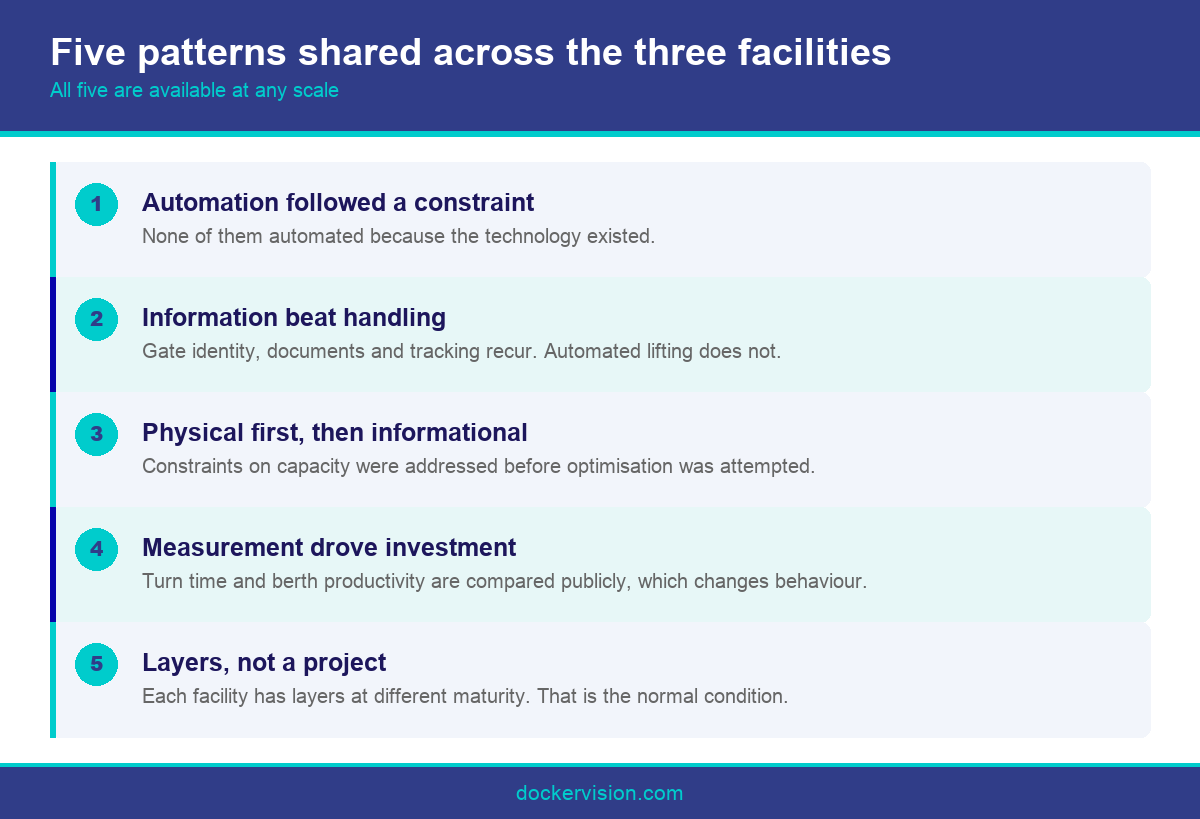
The first common thread is that automation followed a binding constraint. None of these facilities automated because the technology existed. Each identified what was limiting it, addressed that, and automated where automation was the answer rather than as a general modernisation programme.
The second is that the highest value automation sits where information is created rather than where containers are lifted. Gate identity, document processing and cargo tracking recur across all three, while automated handling appears only where the layout allowed it from the start.
The third is sequencing. In every case the physical constraints were addressed before the informational ones were optimised, and the informational ones before anything structural was attempted. That order is available to terminals of any size and costs nothing to adopt.
The fourth is measurement. All three operate in an environment where turn time, dwell and berth productivity are compared publicly, and that comparison drives investment more directly than any internal analysis does. Terminals that do not measure cannot participate in that conversation.
The fifth is that none of them treats automation as a single decision. Each has layers at different levels of maturity, which is the normal condition of a working terminal and a much healthier way to plan than treating modernisation as a project with an end date.
For a mid sized operator the practical conclusion is encouraging. The parts of these facilities that are genuinely worth copying are also the affordable parts, and our overview for competitive terminals sets out the sequence in which to copy them.
Conclusion
JNPT, Mundra and Vizhinjam are usually presented as a ranking and are more useful as a set. Together they show that Indian port investment went to binding constraints first, that information automation delivered more than handling automation for most of them, and that design freedom is what makes structural automation affordable. Copy the sequence rather than the technology. Ask Docker Vision what that means at your berth.
Frequently Asked Questions
Which Indian port is the most automated?
The newest deep water transhipment capacity was designed around automation from the outset, which makes it the most automated by design. Older gateway ports vary terminal by terminal, because each operator makes its own technology decisions.
Why does automation vary between terminals in the same port?
Because a large Indian port typically contains several terminals run by different operators under separate concessions. Capital access, group standards, customer mix and remaining concession length all differ between them, and so do the resulting technology decisions.
What did Mundra invest in before automation?
Depth, berth capacity, connectivity and land, which were the constraints limiting how much cargo could physically be handled. Automation followed rather than led, which is the correct sequence when physical capacity is the binding constraint.
Why does transhipment favour automation more than gateway traffic?
Transhipment cargo moves ship to ship without any road transaction, so volumes are high and the handling is repetitive and predictable. That keeps equipment utilisation high enough to justify the large fixed capital that automated handling requires.
Can a working terminal be converted the way a greenfield one is built?
Rarely without major disruption. Automated handling needs a specific block orientation, dedicated power distribution along each row and separation from manual traffic, none of which can be retrofitted while that block continues handling containers day to day.
What should a mid sized terminal copy from these three?
The sequence rather than the technology. Address your own binding constraint first, then automate where information is created rather than where containers are physically lifted, and treat structural handling automation as a much later and separate decision.
Is design for observability expensive?
Almost nothing, provided it is designed in from the start. Camera sightlines, slot markers and traffic separation cost very little during construction or repaving, and a great deal to retrofit into a block that is already operating.
Why does connectivity matter to a terminal decision?
Because terminal performance is bounded by what can leave the terminal. A facility that handles containers quickly and cannot evacuate them has relocated its congestion from the quay to the gate rather than removing it.
Which benchmark should a mid sized terminal use?
A facility with a similar ownership structure, concession horizon and customer mix, rather than the largest name in the same port. See our note on choosing an automation partner for how to compare vendors properly.

Leave A Comment