
Automatic Number Plate Recognition Software: How It Works
- Posted On: November 16, 2026
- Post Comments: 0
Automatic number plate recognition software turns a camera frame into a decision: open the barrier, raise an alert, or record a visit. Buyers usually meet it as a demo that works on a clean plate in daylight. This guide opens the box instead. It explains each stage between the frame and the decision, where errors creep in, and how the software hands its result to the systems around it. Read it alongside a buying checklist, because knowing how the pieces work makes every feature claim easier to test.
Key Takeaways
- Automatic number plate recognition software works in four stages: find the plate, read the characters, check the result and trigger an action.
- Most errors come from the first two stages, which is why camera placement and lighting matter as much as the model.
- The value lands in the last stage, when the read reaches a barrier, a billing system or a security log without anyone retyping it.
Number Plate Recognition Software vs Camera Firmware: Where the Intelligence Sits
Recognition can live inside the camera or on a separate machine. Firmware based readers are convenient, but they tie you to one camera maker and one model. Number plate recognition software that runs on a server or edge device can read from many cameras at once and can be updated without touching the hardware.
That choice affects cost, flexibility and data control. Software on site keeps plate data inside your network, which many operators prefer, and the same reasoning appears in why processing data on site changes everything for port operators.
Updates are the other difference. Recognition models improve as they see more plates, fonts and conditions. When the intelligence sits in software, an improved model can be rolled out to every lane at once. When it sits in camera firmware, each camera has to be updated separately, and older models may never receive the improvement at all.
Docker Vision runs its recognition as software on standard camera feeds, so a site can mix camera brands and still get one consistent stream of events.
Automatic Number Plate Recognition, Step by Step: Detect, Read, Verify, Act
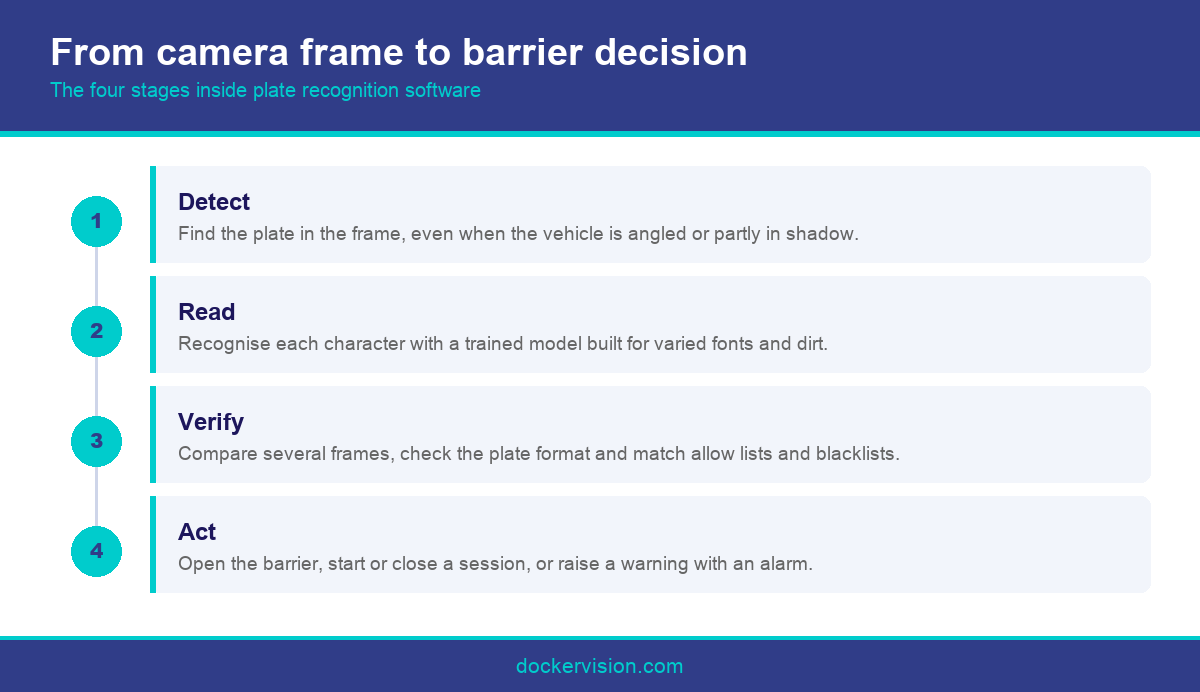
Automatic number plate recognition is a chain, and a chain is only as strong as its weakest stage. Understanding each one tells you what to test.
Detect and read
First the software finds the plate in the frame, even when the vehicle is angled or partly in shadow. Then it reads the characters, which is a specialised form of optical character recognition. Modern systems use trained neural networks for both steps, because fixed rules struggle with varied fonts, dirt and glare.
Verify and act
A raw read is checked before anyone acts on it. The software compares several frames, checks the format of the result, and matches it against allow lists and blacklists. Only then does it open the barrier, start a parking session, or raise a warning with an alarm.
Where the Software Runs: Edge, Server or Cloud
Recognition can run on a small edge device beside the lane, on a server in the site’s own network, or on a cloud service. Each choice changes latency, cost and who holds the data.
Edge devices respond fastest and keep working if the network fails, which suits remote gates. A local server can serve many lanes from one place and keeps data inside the site. Cloud processing reduces hardware on site but depends on a reliable connection for every read.
Security policy often settles the question. Sites that must keep vehicle records inside their own network, such as hospitals, government campuses and port gates, usually prefer edge or local server processing, with only summary reports leaving the site.
Many sites mix the three: reading at the edge or on a local server for speed, with records copied to a central system for reporting. Ask suppliers which arrangement they recommend for your gate count and connectivity, and why.
Connecting the ANPR System to Barriers, Billing and Security Logs
The decision is only useful if it reaches the right place. In a car park the read must open a barrier within a moment and start a timed session. At exit it must close that session and produce a charge. At a secure site it must write a record that security can search later.
Each of those is an integration, usually through an application programming interface or a direct controller signal. The cleaner the integration, the fewer places a plate can be retyped or lost. The approach is the same one Docker Vision uses when a container read reaches the terminal platform in real time.
Speed matters as much as accuracy at a barrier. A driver notices a pause of a few seconds, and a queue notices it far more. Ask how long the software takes from the vehicle stopping to the barrier lifting, and test it at peak hour, when the server is busiest and delays are most likely to show.
When you assess an ANPR system, ask to see the event that leaves the software: what fields it carries, how fast it arrives, and what happens when the network drops. That record is the product, not the screen in the demo.
Where Errors Come From, and How Good Software Handles Them
Most misreads trace back to the image, not the model. A plate that is too small in the frame, smeared by motion, half hidden by a tow bar or washed out by headlights gives the software too little to work with. Fixing camera placement and lighting removes more errors than any setting in the software.
Some errors are about characters that look alike. Zero and the letter O, eight and B, or one and I can be confused when a plate is dirty or worn. Good software uses the expected format of a plate to resolve these, because a valid Indian registration follows a known pattern of state code, district number and series.
Other errors come from timing. A read taken as the vehicle enters the frame may be partial, while one taken at the barrier is clear. Software that reads several frames and keeps the most confident result is more reliable than software that commits to the first frame it sees.
The last group is genuinely hard cases: damaged plates, handwritten plates or no plate at all. No system reads these perfectly, so the measure of good software is how it behaves when it cannot read. It should flag the event, keep the image for review and never invent a plate to fill the gap.
Testing Software Claims Before You Buy
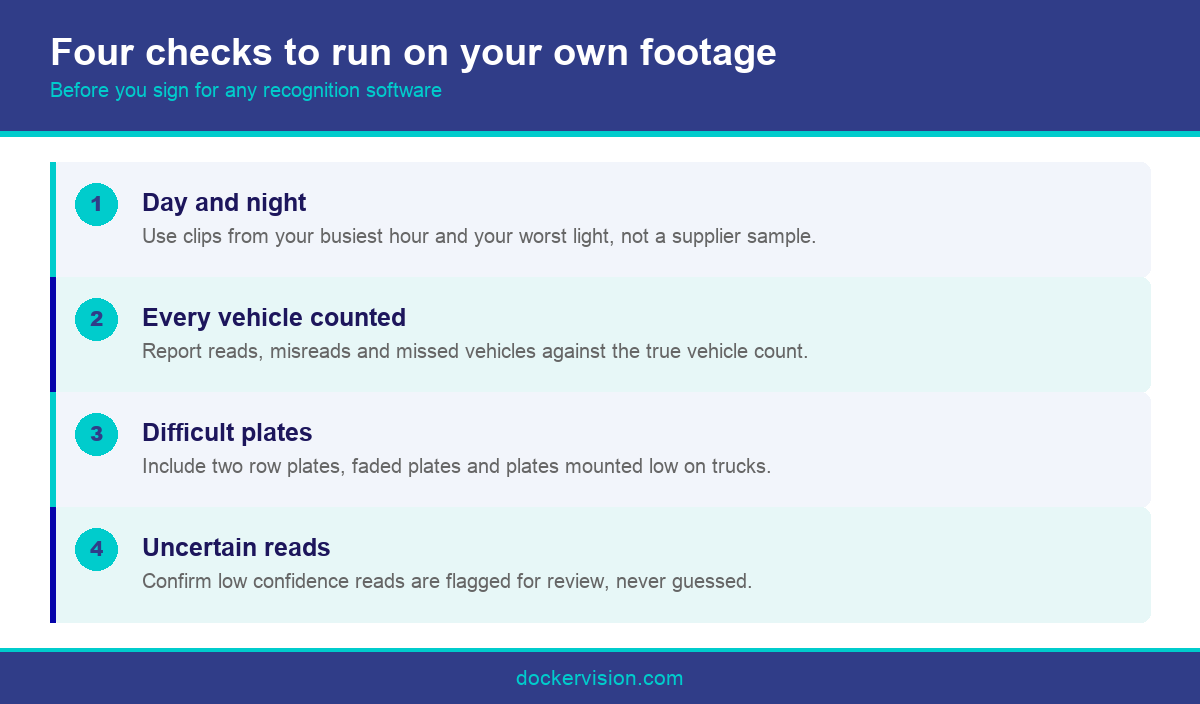
Run the software on your own footage, from your own lanes, at night as well as by day. Count reads, misreads and missed vehicles, and ask the supplier to agree an accuracy figure measured that way. The method mirrors how to write and test an accuracy agreement for container OCR.
Use footage that reflects a normal week, not a selected hour. Include a weekday peak, a quiet night and at least one rainy period if the season allows, so the result reflects the conditions the lane will actually face.
Check the edge cases your site actually sees: two row plates on two wheelers, faded older plates, commercial vehicles with plates mounted low, and glare from wet roads. Software that handles these well will handle the easy cases without trouble.
Finally, check what the operator sees when a read is uncertain. Good automatic number plate recognition software flags low confidence reads for review instead of guessing, which keeps the log trustworthy.
Conclusion
Automatic number plate recognition software is a chain of four stages, and buying well means testing each one on your own lanes. Ask where the recognition runs, how uncertain reads are handled, and exactly what event reaches your barrier, billing or security log. Docker Vision’s software reads plates from standard camera feeds and delivers clean, time stamped events to the systems a site already uses. Book a demo with Docker Vision using footage from your own gate.
Frequently Asked Questions
What is automatic number plate recognition software?
It is software that finds a vehicle plate in a camera image, reads the characters, checks the result and triggers an action such as opening a barrier, starting a parking session or raising a security alert.
Is number plate recognition software better than an ANPR camera with built in recognition?
It depends on the site. Software can read from many camera brands and be updated centrally, while built in recognition is simpler for a single lane. Larger or mixed sites usually benefit from software. Software also updates every lane at once.
How accurate is automatic number plate recognition on Indian roads?
Accuracy depends on camera placement, lighting and plate condition as much as on the model. Ask suppliers to measure accuracy on your own footage, by day and night, and to commit to that figure in writing.
Can an ANPR system integrate with my existing access control or TOS?
Usually, through an API or a controller signal. Ask which fields each event carries and how fast it arrives. Docker Vision connects to the third party platforms terminals already use in the same way. Test it with real events.
What happens when the software is unsure of a plate?
Good software flags low confidence reads for a person to review rather than guessing. That keeps the access log trustworthy and stops a misread from opening a barrier for the wrong vehicle. The image is kept for the review.
Does ANPR software need an internet connection?
Not necessarily. Software running on site can read plates and control barriers without the internet, then synchronise records when a connection returns. Ask how each supplier handles network outages before you buy. On site processing also keeps data local.
Can one ANPR server handle several gates?
Yes, software based recognition can process multiple camera feeds on one machine, subject to its computing capacity. Ask the supplier for the number of lanes a given server supports at your traffic levels. Test that figure at your peak hour.
What data does an ANPR read produce?
Typically the plate text, time, lane, a confidence score and an image of the vehicle. Treat it as personal data, keep it only as long as needed, and restrict who can search it. Log every search of that data.

Leave A Comment