
Terminal Automation System: A Complete Buying Guide
- Posted On: August 21, 2026
- Post Comments: 0
Choosing a terminal automation system is one of the largest operational decisions a container terminal will make. It touches labour, throughput, safety, IT and the experience every trucker has at your gate. Yet most published material on the subject is vendor marketing that avoids the difficult questions. This guide takes the opposite approach. It explains what a terminal automation system actually contains, what drives the price, how to build a business case you can defend internally, and where these projects most often go wrong.
Key Takeaways
- A terminal automation system is layered rather than monolithic. Gate, yard, crane and document automation can be bought and sequenced separately, and gate automation almost always delivers the fastest visible return for the least operational disruption.
- Published research is more sceptical than vendor material. The ITF and OECD found that automated ports are not automatically more productive, and that whether automation lowers total handling cost depends heavily on local labour costs.
- Cost is driven mainly by lane count, camera infrastructure and integration complexity rather than by software licensing. Fixing those variables before you go to market is what makes competing quotes comparable.
What a Terminal Automation System Actually Includes
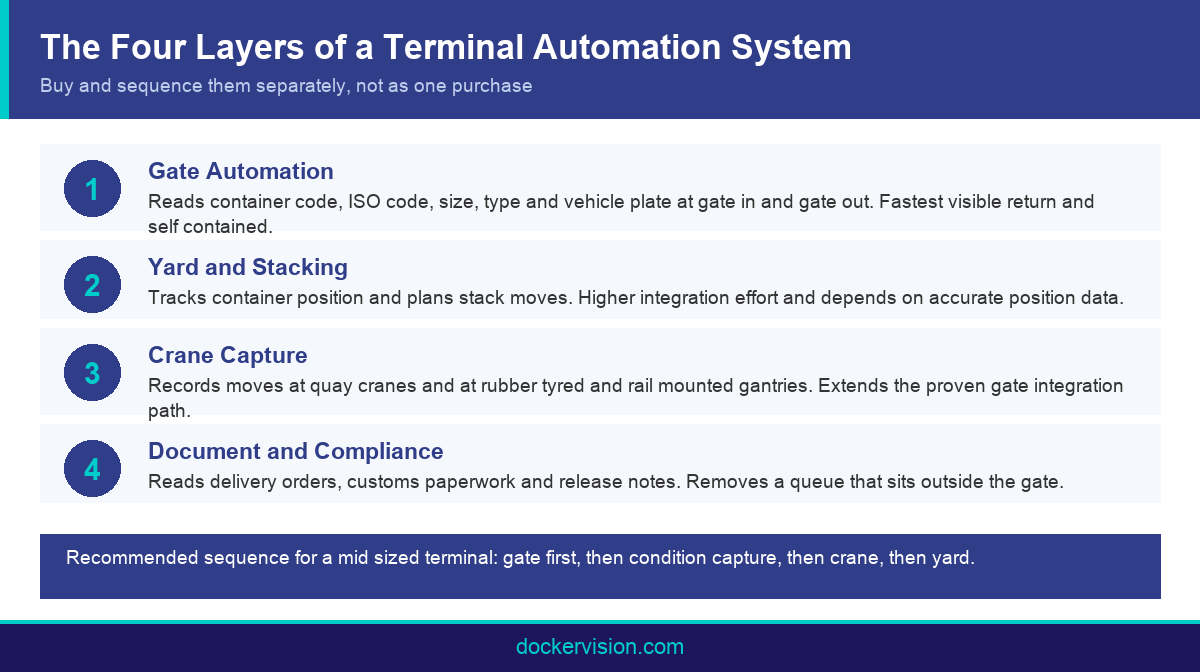
The phrase covers four distinct layers that terminals often merge when scoping a project. Treating them as a single purchase is the most common reason budgets inflate and timelines slip. Each layer solves a different problem, carries a different cost profile, and returns value on a different timescale.
Understanding the layers lets a terminal buy a terminal automation system in sequence rather than all at once. That distinction matters more than any technology choice. The operational disruption of automating everything simultaneously is what typically forces a programme to stall halfway, at the point where the terminal has absorbed most of the cost and realised almost none of the benefit.
A useful test when scoping is to ask which layer would still deliver value if the others were cancelled tomorrow. For most terminals the answer is gate automation, because it addresses a bottleneck that exists every hour of every shift and because its benefit does not depend on any other layer being present. Layers that only pay back once something else is finished belong later in the sequence, whatever their theoretical value.
Gate Automation
Gate automation reads container identification codes, ISO codes, size and type, and vehicle plates as trucks enter and leave. Terminals feel this change first, because manual gate clerking is slow, error prone and difficult to staff during peaks. It is also self contained, which means it can be proven without disturbing yard or quay operations. Docker Vision covers this layer through automatic container code recognition, and the same camera positions can later feed damage and compliance checks without additional hardware. The operational case against manual gates is set out in more detail in the analysis of why high throughput terminals cannot rely on manual gate operations.
Yard and Crane Automation
Yard automation tracks container position and plans stacking moves. Crane automation captures moves at the quay crane and at rubber tyred and rail mounted gantries. Both layers deliver genuine value, but they demand more integration effort and a longer commissioning window than gate automation does. Yard intelligence in particular depends on accurate position data, which means it works best once earlier layers have established a reliable data foundation. Attempting yard automation first is a common sequencing mistake.
Document and Compliance Automation
Document automation reads delivery orders, customs paperwork and release notes. It removes a queue that sits outside the terminal gate rather than inside it, which makes it valuable for terminals where customs friction rather than gate throughput is the binding constraint. Terminals in that position often find document processing delivers faster relief than yard automation, at lower cost and with no equipment implications at all.
Why Commodity Cameras Changed the Economics
For two decades, terminal automation implied civil works. Recognition depended on line scan cameras mounted in purpose built portals, which meant foundations, power distribution, lane closures during construction, and a capital request large enough to need board approval. That single technical constraint priced most mid sized terminals out of automation entirely, and it explains why the published case studies are dominated by very large ports.
Deep learning removed the constraint. Modern recognition models are trained on large volumes of imperfect real world imagery, including rain, glare, shadow, rust, dents and partially obscured markings. They learn to read despite those conditions rather than requiring their absence. Once a model tolerates imperfect input, the expensive hardware that existed purely to guarantee perfect input becomes optional.
Docker Vision runs on standard IP and CCTV cameras rather than specialist line scan hardware, which removes the largest single capital item from a gate project. The practical consequence is that many terminals can reuse cameras they already own, after a survey confirms positioning and lighting are adequate. This is the difference between a project that needs a capital cycle and one that fits inside an operating budget.
It also changes which terminals can realistically automate. A facility handling around two hundred thousand containers a year was previously too small to justify portal construction. The same facility can now scope a software deployment. The trade offs between upgrading an existing site and building for automation from scratch are covered in the retrofit versus greenfield comparison.
There is a second order effect worth noting. Because a software deployment can be reversed far more easily than a concrete portal, the decision itself carries less risk. A terminal that trials recognition on two lanes and decides against extending has lost a modest sum and gained a clear answer. A terminal that has poured foundations has no such option, which is why the older model concentrated automation among operators who could absorb being wrong.
What Drives the Cost of a Terminal Automation System
Terminals frequently request a terminal automation system price before defining a scope, then discover that the quotes they receive cannot be compared. This is rarely vendor evasiveness. It is that each vendor has silently assumed a different scope, and the resulting numbers describe different projects.
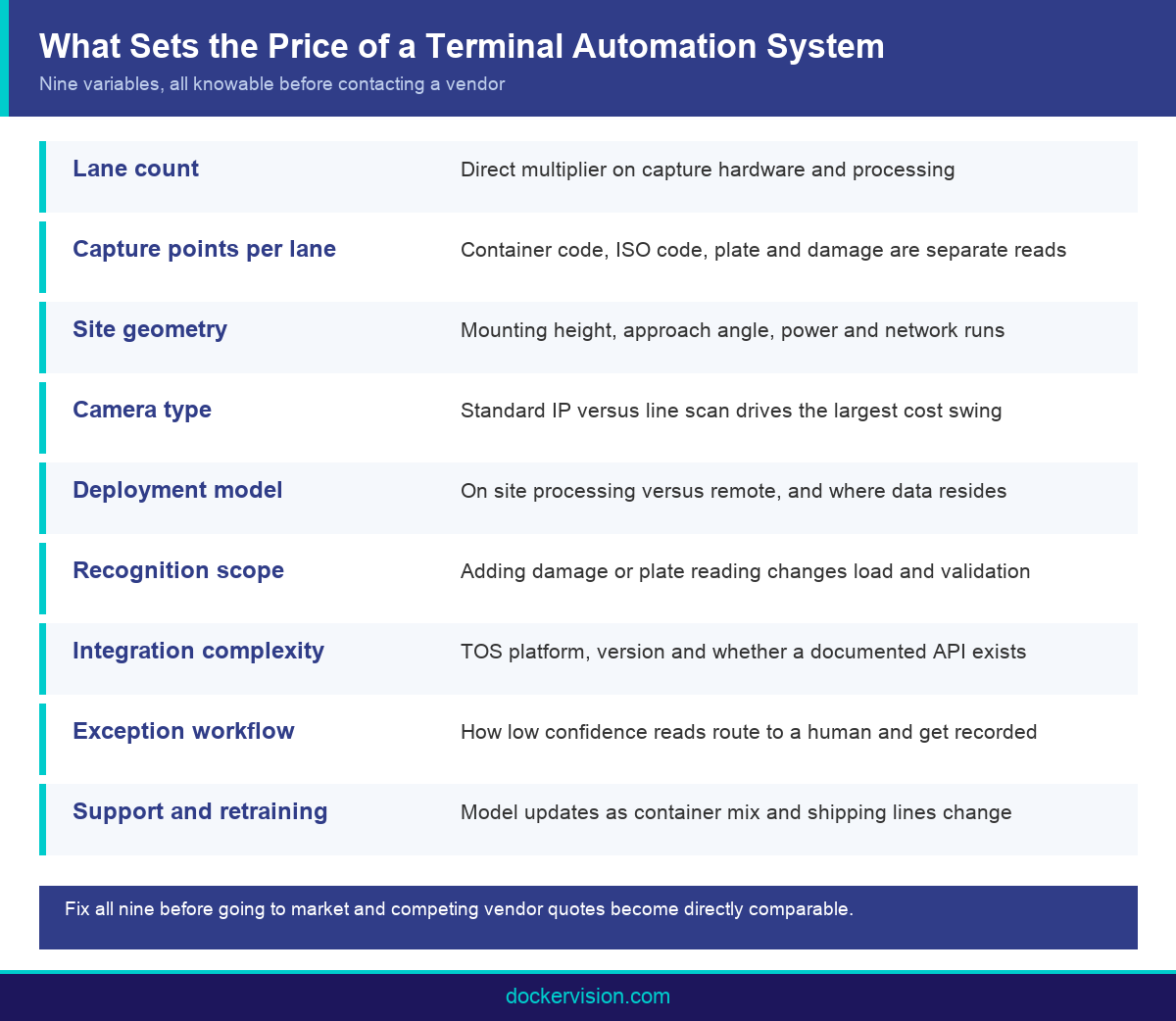
A small set of variables determines the figure. Lane count is the most direct multiplier, since each gate lane needs its own capture positions and processing allocation. Capture points per lane matter next, because reading a container code, an ISO code, a vehicle plate and a damage view are four separate captures rather than one. Site geometry follows, covering mounting height, approach angle and whether clean power and network already reach the required positions.
Camera type carries the widest cost spread of any variable, for the reasons described above. Deployment model matters because on site processing and remote hosting have different infrastructure implications. Integration complexity depends on your terminal operating system, its version, and whether a documented interface exists. Exception handling design and ongoing model retraining complete the list.
Software licensing is rarely the dominant line in any of this. A full breakdown sits in the terminal automation cost guide, but the summary above is enough to scope a first conversation with any vendor and to recognise when a quote has assumed something you did not intend.
The Costs Terminals Forget to Budget
Three recurring items are routinely left out of first estimates. The first is model retraining, which is not optional. Your container mix changes as shipping lines come and go, and recognition accuracy drifts quietly if the model is never updated. Budget for it as an ongoing service rather than treating accuracy as a one time acceptance event.
The second is the internal effort of parallel running. During the period when automation runs alongside the manual process, your team is doing both, and that cost is real even though no invoice arrives for it. The third is camera maintenance access. A camera that cannot be reached safely will eventually be a dirty camera, and a dirty camera reads badly regardless of the model behind it.
Making Competing Quotes Comparable
Write every variable onto a single page and fill in the values before approaching any vendor. Lane count, capture points, existing camera inventory, camera type preference, deployment model, recognition scope, operating system and version, exception workflow and support expectations. Send the same page to every bidder and require them to price against it rather than against their own assumptions.
This single document converts a set of incomparable estimates into a genuine tender, and it doubles as the scope appendix for the formal procurement described later in this guide. A vendor who cannot or will not quote against a fixed scope has told you something useful before you have spent anything.
Building the Business Case Without Guesswork
A credible business case for terminal automation solutions rests on four measurable effects. Each can be estimated from data your terminal already holds, which means a first pass model requires no vendor involvement and belongs to you rather than to a supplier.
Labour Reallocation and Turnaround Time
Start with gate clerking hours rather than headcount. Count the hours currently spent keying container numbers, checking documents and resolving mismatches, then annualise from rostering data. Docker Vision states that automatic container code recognition reduces manual labour by up to ninety percent at the point of capture, so apply a conservative fraction of that and value it at fully loaded hourly cost. Truck turnaround time is the second stream, and it converts into gate capacity or avoided peak overtime depending on your situation, and it is usually the second largest stream in a terminal automation system business case.
Error Cost and Claim Avoidance
Error cost is consistently underestimated because it is distributed across budgets. One mistyped container number can produce a misplaced box, a wasted crane move, a delayed release and an unhappy customer. Estimate your rate from correction logs and attach an average handling cost. Claim avoidance is the fourth stream: when a container leaves damaged and nobody can prove when the damage occurred, the terminal usually absorbs it. Automatic condition capture changes that position, as the damage detection analysis explains.
What the Evidence Says About Automation and Productivity
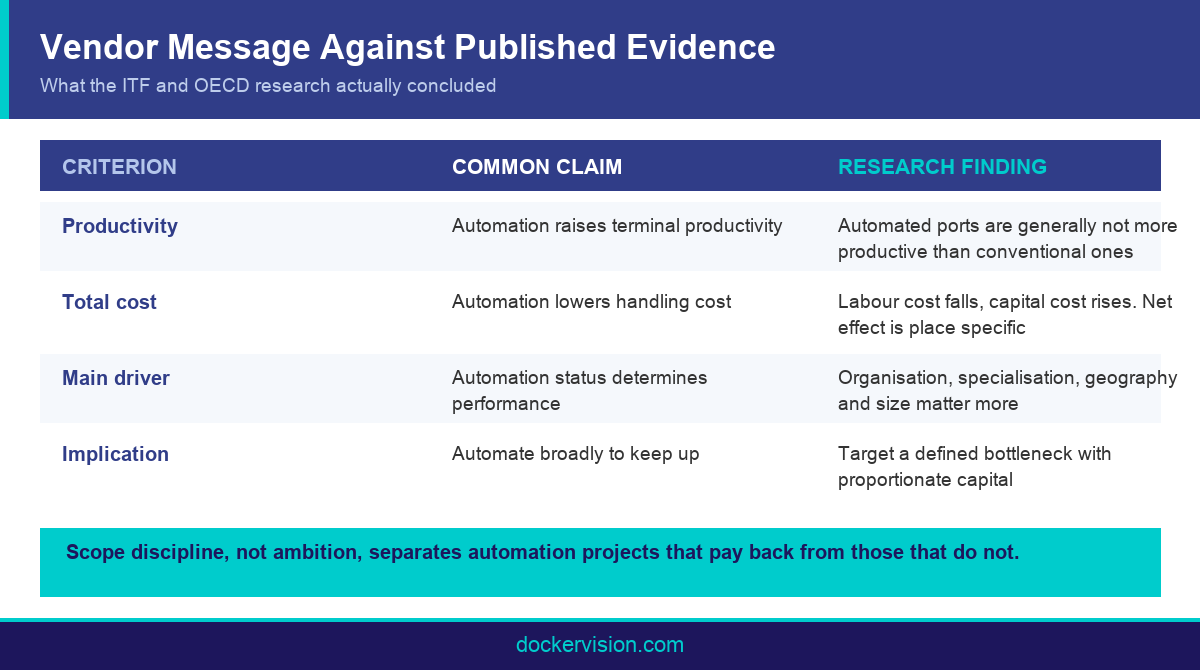
This is where an honest guide has to part company with vendor messaging. The most cited independent study of the sector, published by the International Transport Forum and the OECD, found that automated ports are generally not more productive than conventional ones. It also found that port organisation, specialisation, geography and size are stronger determinants of performance than automation status.
The mechanism is not mysterious. Highly automated equipment operates to a fixed cycle. It is consistent and safe, but it does not improvise, and an experienced operator handling an unusual situation can often beat a system that must fall back to a defined exception path. Consistency is genuinely valuable, particularly for safety and planning, but consistency is not the same thing as speed.
The study also observed that automation reliably reduces labour cost while raising capital cost, and that whether total handling cost falls is place specific. In a market with lower labour costs, a high capital automation programme can fail to pay back while a low capital one succeeds comfortably. The industry body PEMA reaches similar operational conclusions in its container terminal automation information paper.
None of this argues against automating. It argues for scope discipline. Terminals that target a specific measurable bottleneck tend to succeed. Terminals that automate broadly because competitors are doing so tend to produce exactly the disappointing results the research describes. The full review of the productivity evidence examines the findings and their limits in detail.
Integration and Deployment: The Part That Decides Success
Automation only creates value when its output reaches the system that runs the terminal. A recognition engine that reads a container perfectly and writes to a screen nobody watches has changed nothing at all. Integration with the terminal operating system is therefore the component that determines whether the project succeeds.
Ask precisely which fields the vendor writes back, in what format, at what frequency, and what happens when the operating system is unavailable. Ask how exceptions are handled when recognition confidence is low. A well designed system routes uncertain reads to a human with the image attached, records both the image and the decision, and feeds the correction back into future retraining. A poorly designed one guesses silently, which is worse than not automating.
Docker Vision integrates with any terminal operating system through API based deployment. The mechanics are described in the TOS integration overview, which walks through how a container moves from camera to operating system. Whichever vendor you select, insist on a specific field list rather than a general compatibility claim.
Deployment architecture matters alongside integration. Processing images on site rather than shipping them to a remote service reduces latency and keeps operational data inside the terminal perimeter, which is frequently a procurement requirement rather than a preference. The reasoning is set out in the on premise deployment discussion, and it applies to every layer of a terminal automation system rather than to the gate alone.
Procurement: Writing Requirements That Protect the Terminal
Most disputes in automation projects trace back to a requirement nobody wrote down. Accuracy is the classic example. A vendor quoting ninety eight percent and a vendor quoting ninety five percent may be measuring completely different things, and without a defined measurement method the higher number is not merely unhelpful but actively misleading.
A defensible specification states the accuracy target, the conditions under which it is measured, the sample size, who adjudicates a disputed read, and what remedy applies if the target is missed. It should also define the exception rate you will tolerate, quoted separately from accuracy. A system that reaches a high accuracy figure by referring a third of traffic to a human has not automated the task, it has relocated it.
Specify deployment and data residency explicitly, since retrofitting those requirements after signature is expensive. Require image retention with a stated period, because retained gate images are what allow you to defend a damage claim raised months after the container left your terminal. Include a retraining obligation, since accuracy drifts as new shipping lines and container types enter your gate stream.
The requirements checklist provides a reusable tender structure, and the accuracy service level guide covers how to write and test the recognition target specifically. The existing guide to questions to ask a port automation company complements both.
Failure Modes and a Realistic Sequence
Automation projects rarely fail because the algorithm underperforms. They fail for operational reasons that are entirely predictable and therefore preventable. Over scoping is the most common: a terminal attempts gate, yard, crane and document automation in one programme, and the integration burden exceeds what the team can absorb alongside normal operations.
Camera placement is the second failure mode. Recognition quality depends heavily on angle, lighting and mounting height, and a badly sited camera will underperform regardless of model quality. The camera infrastructure guide covers the placement rules. Data mapping gaps come third, where terminals discover during commissioning that their operating system expects fields the recognition layer was never asked to supply.
Staff resistance is fourth, and it is usually a communication failure rather than a genuine objection. Gate clerks who understand they are moving to exception handling rather than being replaced tend to become the system’s most valuable users, because they are the people who spot edge cases first and report them accurately.
For a terminal handling around two hundred thousand containers a year, the lowest risk sequence begins at the gate, which is self contained and measurable within weeks. Extend to condition capture using cameras already installed, then to crane capture once the integration path is proven, and leave yard and stacking intelligence until last because they depend on the accurate position data the earlier phases establish. Docker Vision states an implementation window of two days to go live for gate recognition, reflecting a containerised software installation rather than a construction programme. Whatever vendor you choose, ask what must be true on site before that clock starts, because that is where real timelines are won or lost.
One further discipline separates successful programmes. Define, before you begin, what would cause you to stop. A terminal that has agreed in advance which measurements would justify halting an extension is far more likely to make a rational call than one discovering mid programme that it has committed too far to reverse. Write those thresholds down alongside the acceptance criteria.
Conclusion
A terminal automation system is not a single product and should not be bought as one. The terminals that succeed define a specific bottleneck, write measurable requirements, sequence the work so each phase proves itself before the next begins, and stay honest about what the independent evidence actually says. Start at the gate, insist on a defined accuracy method, and confirm exactly how results reach your operating system. To scope a terminal automation system against your own throughput and lane configuration, talk to the Docker Vision team about a site specific assessment.
Frequently Asked Questions
What is a terminal automation system?
It is a set of technologies that capture and process container terminal events automatically, covering gate, yard, crane and document layers. Most terminals adopt the layers separately rather than as one purchase.
How long does a terminal automation system take to implement?
It depends on the layer. Docker Vision states two days to implement and go live for gate recognition, because deployment is containerised software. Yard and crane automation involving civil works take considerably longer.
Does port automation reduce terminal staff numbers?
It changes roles more than it removes them. Gate clerks typically move to exception handling and quality control. Docker Vision reports up to ninety percent less manual effort at the point of data capture.
Is automation only viable for very large ports?
No. Commodity camera based recognition removed the capital barrier that once limited automation to large terminals. Facilities handling around two hundred thousand containers a year are now a practical target.
What accuracy should a container recognition system achieve?
Docker Vision publishes more than ninety five percent accuracy. The figure matters less than the measurement method, so define test conditions and sample size before comparing vendor claims.
Will a terminal automation system work with our existing TOS?
It should. Docker Vision integrates with any terminal operating system through APIs. Confirm which fields are written back and how low confidence reads are routed. See these real world examples.
Do we need to replace our cameras?
Often not. Systems built for standard IP and CCTV feeds can reuse existing cameras where positioning and lighting are adequate. A site survey confirms whether repositioning is needed.
What is the difference between OCR and RFID at the gate?
RFID reads tags that must be fitted and maintained. Optical recognition reads the container markings themselves and needs no tagging. This comparison of both approaches covers when each suits.
How should we measure whether automation succeeded?
Track truck turnaround time, gate throughput per hour, exception rate and data error rate against a baseline. Capture that baseline before deployment, because it cannot be reconstructed later.
Does automation guarantee higher terminal productivity?
No. Independent research found automated ports are not automatically more productive. Gains depend on scope discipline and local conditions rather than on automation by itself.

Leave A Comment