
General Cargo Terminal Operating System and Automation Fit
- Posted On: October 7, 2026
- Post Comments: 0
Container terminal software is designed around a standard unit, and most terminals in the world do not only handle standard units. A general cargo terminal operating system has to cope with steel coils, project cargo, bagged commodities and vehicles alongside boxes, which changes what the software must model. This article explains those differences and which automation genuinely transfers to a multipurpose berth, and how a recognition layer plugs into the platform you already run.
Key Takeaways
- Container platforms model a standard unit in a slot. General cargo platforms have to model varied shapes, weights and storage rules, which is a fundamentally different data problem.
- Multipurpose terminals need cargo tallying, tonnage based billing and flexible storage areas that pure container products handle awkwardly or not at all.
- Gate identity automation transfers well, because vehicles and containers arriving at a multipurpose terminal still need identifying and recording.
- Yard positioning transfers poorly for irregular cargo, which is why multipurpose operators should sequence gate automation first and treat the yard separately.
Why General Cargo Breaks Container Assumptions
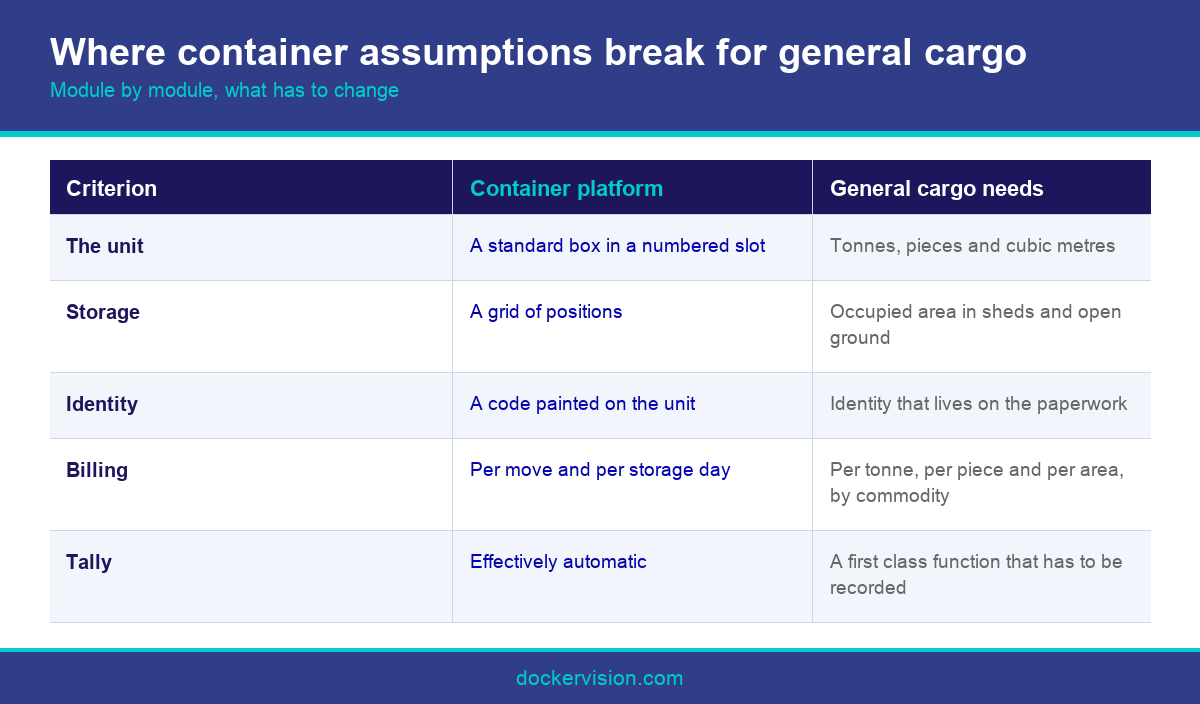
A container platform can assume a great deal. The unit is one of a small number of standard sizes, it stacks predictably, it is identified by a code painted on it, and its position can be expressed as a slot reference. Every module in the product rests on those assumptions.
General cargo removes all of them. Break bulk cargo arrives as steel plate, timber, machinery and bagged commodities, in shapes that do not stack, quantities measured by weight or piece count, and identity that exists on paperwork rather than on the item.
Storage becomes an area problem rather than a slot problem. A consignment of pipe occupies a region of a shed with a shape and a footprint, not a coordinate, and the software has to reason about available area and access rather than about a grid of positions.
Billing changes too. Container terminals bill by move and by storage day against a known unit. Multipurpose terminals bill by tonne, by cubic metre, by piece and by area occupied, often with different tariffs for different commodities and customers.
Tallying becomes a first class function. Somebody has to count what came off the vessel and record condition, and that tally is the commercial record. In a container operation the equivalent is automatic. In general cargo it is a person with a clipboard, or a system designed to replace one.
None of this makes general cargo harder to run. It makes it differently shaped, and a platform built purely around containers will either lack these functions or bolt them on awkwardly, which is why multipurpose operators need to check the fit rather than assume it.
The mismatch is easy to miss during a demonstration, because container workflows look impressive and general cargo is shown briefly at the end. Insist on the reverse order. Ask to see a bagged commodity discharged, tallied, stored and billed before anyone opens the vessel planning module, and judge the product on how comfortable that sequence looks.
What a Multipurpose Platform Has to Provide
Flexible cargo modelling comes first. The system needs to represent a consignment that is measured in tonnes, another measured in pieces and another in cubic metres, and to keep all three in the same inventory without forcing them into a container shaped record.
Area based storage management is second. Rather than allocating slots, the software allocates space in sheds and open areas, tracks what is occupied, and helps a planner see where a large irregular consignment can physically go without blocking access to something else.
Tally and condition recording is third. Every piece landed needs recording, ideally with condition noted and photographed at the point of discharge, because that record is what settles a claim about damage that may not be raised for months.
Multi tariff billing is fourth. Different commodities, different customers and different service types all carry different rates, and the billing engine has to handle tonnage, piece and area based charging simultaneously without a spreadsheet appearing alongside it.
Vehicle and equipment management is fifth. Multipurpose berths use forklifts, reach stackers, mobile cranes and trailers in combinations that change by cargo type, so the dispatch model has to be more flexible than a container terminal equipment module usually is.
Finally, container handling still has to be present, because most multipurpose terminals handle boxes as well. The product has to do both properly rather than treating one as an afterthought, which is exactly what to probe during evaluation.
A useful shorthand is to ask which half of the product the vendor built first. Platforms that grew from container operations tend to model general cargo as an exception, and platforms that grew from general cargo sometimes treat containers as just another commodity. Neither is disqualifying, but it tells you where the rough edges will be.
Which Automation Transfers and Which Does Not
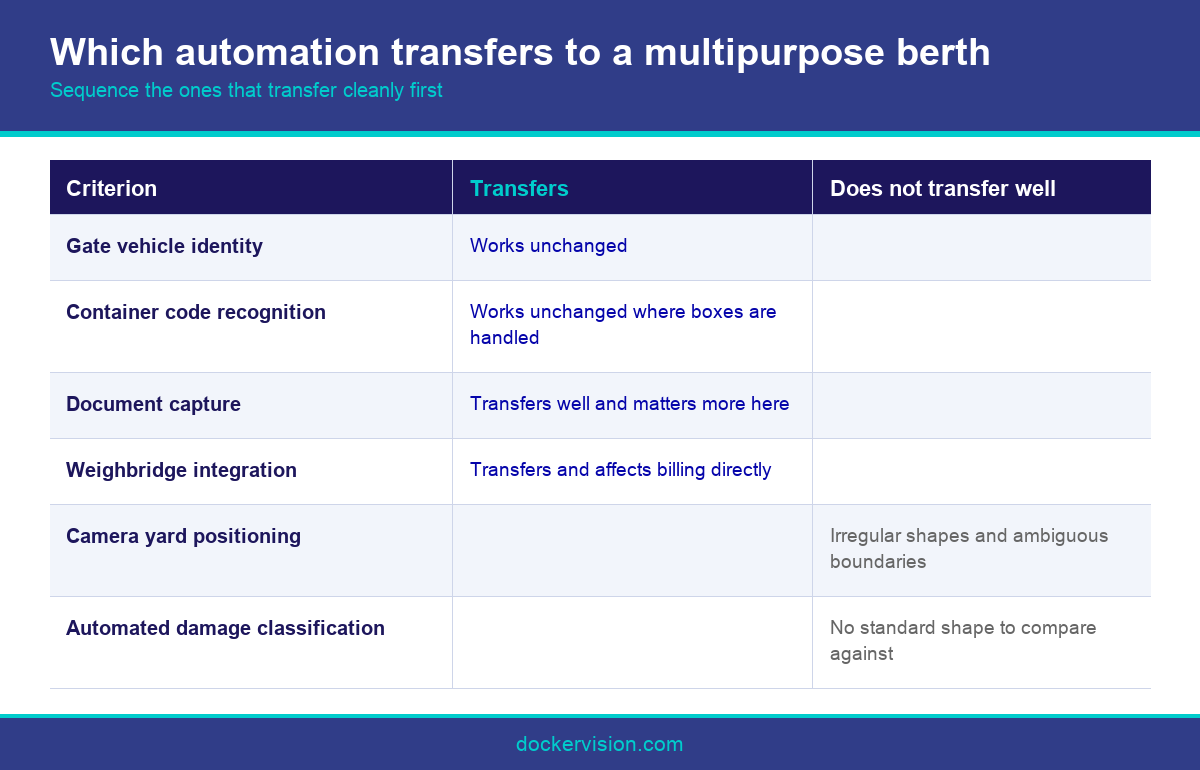
Gate identity automation transfers almost completely. Trucks arriving at a multipurpose terminal still need identifying, and vehicle number plate recognition works the same way it does at a pure container gate. Where containers are also handled, code recognition applies unchanged.
Document capture transfers well too. Multipurpose operations are paperwork heavy, with delivery orders, weighbridge tickets and customs documents that arrive as paper and have to become data. That is a recognition problem the client has already written about at length.
Weighbridge integration transfers and matters more here than in a container operation, because tonnage is a billing basis rather than a safety check. Automating the link between vehicle identity, weight and consignment removes a common source of revenue leakage.
Yard positioning transfers poorly. Camera derived location works well for standardised units in regular stacks and much less well for irregular cargo in open areas, where the shape, orientation and boundaries of a consignment are all ambiguous.
Damage detection transfers partially. Container damage detection compares against a known shape, which general cargo does not have. What does transfer is systematic photographic capture at discharge and at the gate, which supports a claim even without automated classification.
The practical conclusion is to sequence gate and document automation first at a multipurpose terminal, since both transfer cleanly and both produce measurable benefit. Our article on automated document processing covers the paperwork side.
Evaluating a Platform for a Mixed Terminal
Ask to see a live multipurpose reference site rather than a container reference with general cargo described as available. The difference between a module that exists and a module that is used every day by a comparable operator is where most disappointment in this category originates.
Test the awkward consignment during evaluation. Take a real piece of project cargo from your own records, with its actual dimensions and handling constraints, and ask the vendor to model it end to end from booking through storage to delivery.
Check the billing engine against your real tariff sheet, not a simplified version. Multi commodity, multi customer, multi basis charging is where platforms quietly fail, and the failure shows up as a spreadsheet that finance maintains alongside the system forever.
Ask how containers and general cargo coexist in the same inventory and the same yard view. A planner who has to switch between two screens to understand one berth will make worse decisions than one looking at a single picture.
Confirm the interface story is as open for general cargo events as for container events. Vendors sometimes expose comprehensive container interfaces and much thinner general cargo ones, which constrains exactly the automation a multipurpose terminal would want to add later.
Finally, decide the sequence deliberately. Gate and document automation give the fastest measurable return at a multipurpose terminal and work with whatever platform you already run, which makes them the right first step. Our note on choosing an automation company covers how to compare vendors.
Conclusion
A general cargo terminal operating system has to model shapes, weights and areas rather than units and slots, and a platform built purely for containers will handle that awkwardly. Evaluate on a live multipurpose reference, test your own difficult consignment, and check the billing engine against your real tariff. Then automate the gate and the paperwork first, because both transfer cleanly. Ask Docker Vision what would apply at your berth.
Frequently Asked Questions
What is a general cargo terminal operating system?
It is terminal software built to handle cargo that is not standardised into containers, including break bulk, project cargo and bagged commodities. It models weight, piece count and occupied area rather than a grid of container slots.
Can a container platform handle general cargo?
Some can, through additional modules, but the underlying data model assumes a standard unit in a slot. Ask to see a live multipurpose reference site rather than accepting that the capability is listed as available in the product.
What is the hardest part of multipurpose terminal software?
Billing, usually. Multi commodity and multi customer charging by tonne, by piece and by occupied area at the same time is where platforms quietly fail, and the failure appears as a permanent spreadsheet that finance maintains alongside the system forever.
Does gate OCR work at a multipurpose terminal?
Yes. Vehicle number plate recognition works identically at a multipurpose gate, and where containers are also handled the code recognition applies unchanged. Gate identity is the automation that transfers most cleanly to a mixed cargo operation.
Does camera based yard positioning work for break bulk?
Poorly. Vision derived location relies on standardised shapes sitting in regular stacks. Irregular cargo in open storage areas has ambiguous boundaries and orientation, so positioning is far less reliable than it is for standard containers.
What about damage detection on general cargo?
Automated classification transfers only partially, because there is no standard shape to compare each item against. Systematic photographic capture at discharge and at the gate still supports a claim months later, even without automated classification behind it.
Which automation should a multipurpose terminal do first?
Gate identity and document capture. Both transfer cleanly from container practice, both work with whatever platform you already run today, and both produce a measurable operational result within weeks rather than quarters of implementation effort.
Why does weighbridge integration matter more here?
Because tonnage is a billing basis here rather than only a safety check. Linking vehicle identity, recorded weight and consignment automatically removes a well known source of revenue leakage that manual ticket handling tends to introduce.
What should we ask a vendor about interfaces?
Ask whether general cargo events are exposed as fully as container events are. Thin general cargo interfaces constrain exactly the automation you would most want to add later. Our rail OCR explainer shows what full event coverage makes possible.

Leave A Comment