
Best Terminal Operating Systems in 2026: A Neutral Guide
- Posted On: September 30, 2026
- Post Comments: 0
Search for the best terminal operating system and you will find vendor pages and little else, because almost nobody in
this market is neutral enough to publish a comparison. Docker Vision can, since it sells no platform and
integrates with all of them. This guide sets out how the tiers genuinely differ, which products belong to each, and a scoring framework a mid
sized terminal can run on its own numbers in an afternoon.
Key Takeaways
-
There is no best terminal operating system in the abstract. There is a best fit for a given move volume, staffing
level, growth curve and integration requirement. -
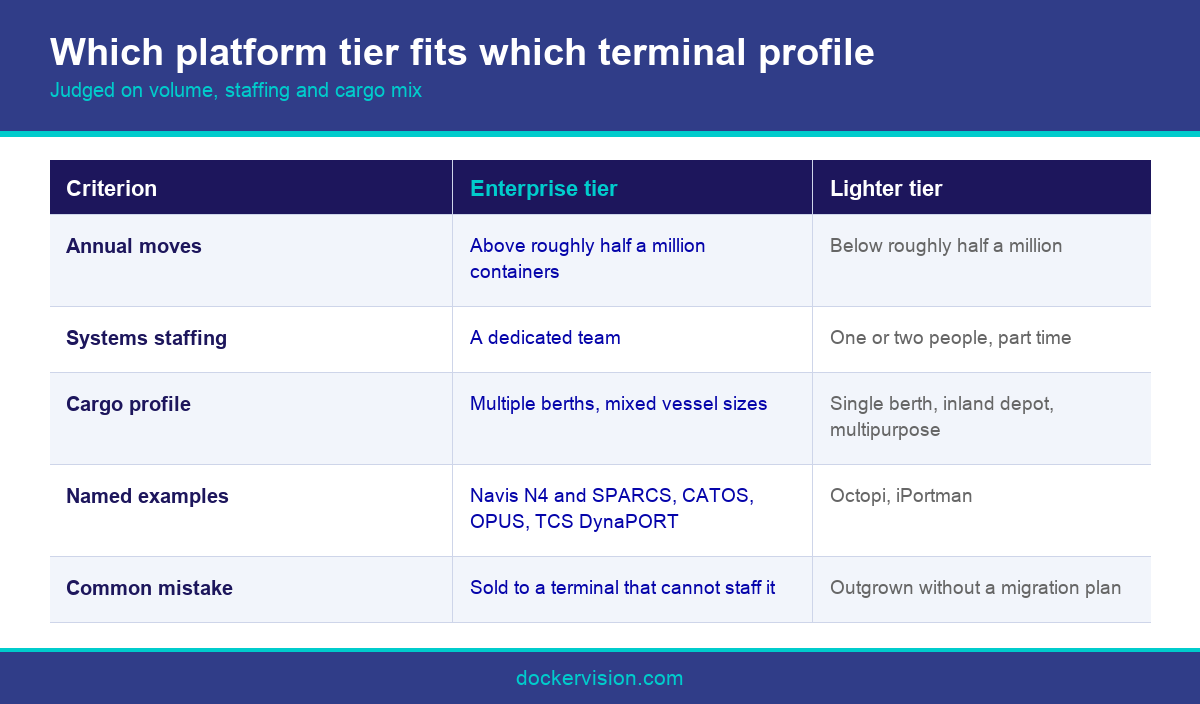
The enterprise tier includes Navis N4 and SPARCS, CATOS, OPUS and TCS DynaPORT. The lighter tier includes Octopi and
iPortman. Both tiers contain good products and both are routinely sold to the wrong buyer. -
Interface openness deserves more weight than any planning feature, because it determines the cost of every
automation decision you make for the next decade. -
Score fit, not features. A weighted framework using your own volumes beats a feature matrix, because features you
never configure are worth nothing.
Why There Is No Single Best Platform
The question assumes terminals are interchangeable and they are not. A transhipment hub moving four million containers
with a dedicated systems department has almost nothing in common operationally with an inland container depot moving
eighty thousand with one IT manager who also fixes printers.
Volume changes what optimisation is worth. At very high move counts, a few percent of crane productivity is worth
millions a year, which justifies sophisticated planning and the team needed to tune it. At modest volumes the same
module produces a rounding error and costs the same to licence.
Cargo mix changes the requirement too. A pure container terminal has different needs from one handling
break bulk cargo alongside boxes, and a rail served
inland depot needs intermodal features that a marine terminal never touches.
Regulation is the third variable. Terminals in India integrate with port community systems and customs interfaces that
a product designed around North American practice has never seen. That compliance work is either already done or it
becomes your project.
The fourth is your team. This is the variable buyers weigh least and regret most. A platform that assumes three full
time administrators will be badly run by an operator who has one, and badly run software produces worse outcomes than
well run simpler software.
So the honest answer to which platform is best is that it depends on four numbers you already have: annual moves,
growth rate, systems headcount and cargo mix. Everything in the rest of this guide is about turning those into a
decision.
The Enterprise Tier and Who It Suits
Navis N4 is the reference product in this tier and the one most likely to appear on a shortlist. It succeeded SPARCS
as the flagship, carries deep vessel and yard optimisation, and has by far the largest installed base and integration
ecosystem in the container terminal world.
CATOS and OPUS occupy similar ground with strong positions in Asia and the Middle East. Both are mature, both handle
large volumes, and both bring the same characteristic as N4: capability that rewards a team able to configure and
maintain it properly.
TCS DynaPORT, developed by Tata Consultancy Services, is the enterprise option built in India. It is a multipurpose
platform covering containerised and non containerised cargo, configurable for manual, semi automated and fully
automated operations, and it exposes open APIs for ERP, reefer monitoring and equipment control systems. TCS reports
more than eighty terminals running it across India, the Middle East, Asia Pacific, the UK and the US, including
Adani’s CT4 container terminal at Mundra and the Tilbury2 terminal run by Forth Ports on the Thames. For an operator
that wants enterprise scale from a vendor with Indian port deployments behind it, it belongs on the shortlist.
What you are buying at this tier is optimisation and scale. Sophisticated stowage planning, yard strategies that adapt
to congestion, equipment dispatch that keeps machines busy, and the ability to run a very large operation without the
planning function becoming the bottleneck.
What you are paying for is not only licence cost. It is implementation, which runs long. It is configuration, which is
specialist. It is upgrades, which need testing. And it is the people, because none of the above happens by itself and
consultants are expensive.
The tier suits terminals above roughly half a million containers a year, terminals with genuine planning complexity
such as multiple berths and mixed cargo, and terminals inside a group that has standardised on a platform across sites
and wants consistency more than local fit.
It suits mid sized independent terminals much less often than it is sold to them. If your shortlist contains only
enterprise products, ask why, and ask whoever assembled it what a lighter product would fail to do at your actual
volumes.
The Lighter Tier and Where It Wins
Octopi is the best known product in this tier, built deliberately for smaller and mid sized terminals with
subscription pricing and a short implementation. It gives up some optimisation depth in exchange for being operable by
a small team, which for many operators is exactly the right trade.
iPortman comes from the Indian market and carries strong local compliance and port community integration, which
removes a category of work that an imported product would leave with you. For terminals in India that alone can decide
the choice.
The characteristic advantage of this tier is time to value. Implementation is measured in weeks rather than quarters,
configuration is achievable in house, and the subscription model means you are not capitalising a licence you might
regret in three years.
The characteristic risk is the ceiling. These products are engineered for a volume band and behave differently at its
upper edge, particularly in yard planning under congestion. A terminal on a steep growth curve should test that
boundary before signing rather than after.
The tier suits terminals under roughly half a million containers a year, inland depots, multipurpose facilities and
any operator whose real constraint is people rather than software capability. It also suits terminals that intend to
automate the gate and yard layers separately.
That last point matters. If the automation layer is independent, a lighter platform loses much of its apparent
disadvantage, because the data quality that drives good decisions is coming from the recognition layer rather than
from the planning module.
A Scoring Framework You Can Run Yourself
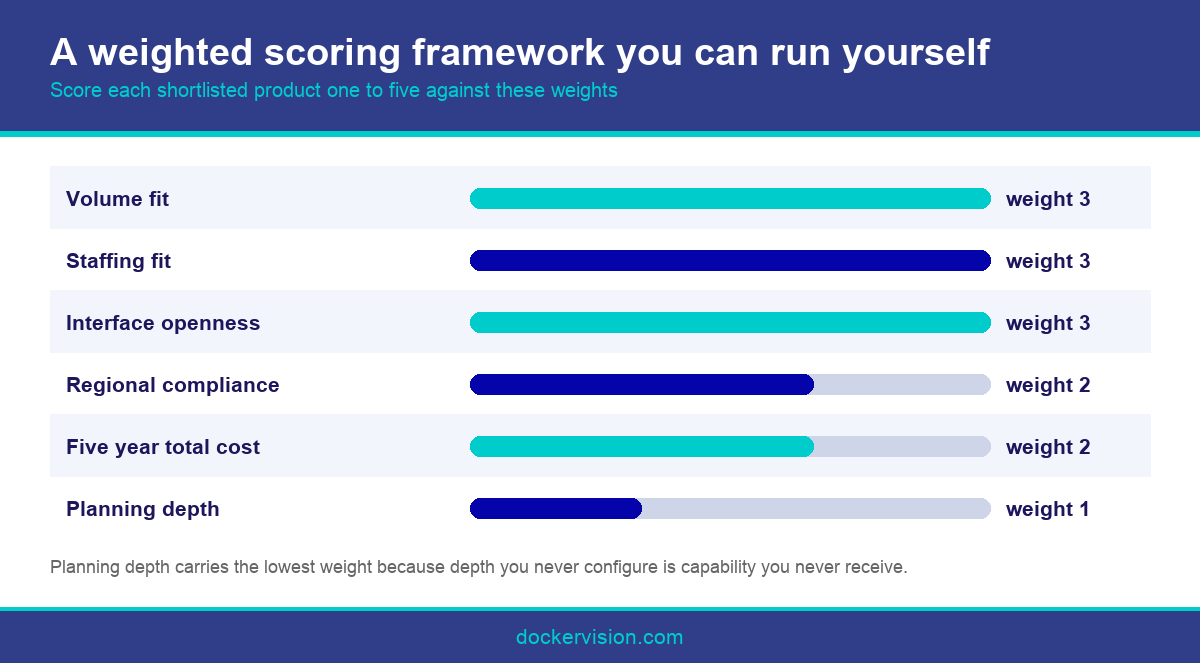
Use six weighted criteria and score each shortlisted product from one to five. Volume fit at weight three, staffing
fit at weight three, interface openness at weight three, regional compliance at weight two, total cost over five years
at weight two, and planning depth at weight one.
Volume fit means the product is designed for your move count plus three years of realistic growth, not your ten year
ambition. Score five if a named reference site of your size exists, and score two if the vendor can only describe how
it would work in principle.
Staffing fit asks how many administrators the product assumes and how that compares with what you will actually
provide. Be honest here. Scoring this optimistically is how terminals end up with expensive software running in its
default configuration three years later.
Interface openness is scored on what your team can read and write without vendor involvement, whether it is
documented, and whether it costs extra. This carries a heavy weight because it determines the price of every future
automation decision, including ones you have not thought of.
Regional compliance covers customs, port community and statutory reporting for your jurisdiction. Five year cost
includes licence, implementation, configuration, upgrades and the internal people time, which is the line most
evaluations leave out and most finance teams later discover.
Planning depth deliberately carries the lowest weight, which surprises people. It is the criterion vendors present
most and the one that predicts satisfaction least, because depth you never configure is capability you never receive.
Read our note on
what to ask before you appoint a supplier
before you shortlist.
Conclusion
The best terminal operating system is the one sized to your volume, operable by your team, open at its interfaces and
compliant in your jurisdiction. That is a different product for a transhipment hub and for an inland depot, and any
comparison that ignores the difference is selling rather than advising. Score fit on your own numbers, weight
interface openness heavily, and keep your automation layer independent.
Talk to Docker Vision about what your gate data would look like on any
of them.
Frequently Asked Questions
Which is the best terminal operating system in 2026?
There is no single answer. Enterprise products such as Navis N4, CATOS, OPUS and TCS DynaPORT suit large complex
terminals, while Octopi and iPortman suit smaller and mid sized ones. Fit to volume and staffing decides the outcome,
not feature count.
Is Navis N4 too big for a mid sized terminal?
Often, yes. N4 rewards an operator with dedicated systems staff and genuine planning complexity. A terminal under half
a million containers a year with one IT manager usually pays for depth it will never configure or use.
What makes Octopi different from the enterprise products?
It is engineered for smaller operations, with subscription pricing, a short implementation and configuration that a
small team can handle in house. It trades some optimisation depth for being genuinely operable without a dedicated
systems department behind it.
Why does iPortman come up in Indian tenders?
Because it was built around Indian port community and customs integration, so the statutory and compliance work is
already done. For a terminal in India that removes a substantial and often underestimated slice of the implementation.
How much weight should interface openness carry?
A lot. It sets the cost of every automation decision for the next decade. A documented interface your own team can
call without vendor involvement is worth a material price premium over a closed or separately licensed one.
Should we choose the platform before or after automating the gate?
Automate the gate first wherever you can. Recognition works with the platform you already run, and the measured data
it produces makes any later selection far better informed than a vendor workshop or an internal estimate ever would
be.
Do these platforms all integrate with OCR systems?
Most do, through an interface, a message queue or file exchange. What varies is how open the interface is and whether
it is separately chargeable, which is exactly why openness deserves heavy weight in scoring.
What is the most common selection mistake?
Buying for ambition rather than operation. Terminals size for the volume they hope to reach in ten years, then run
enterprise software with a two person team, and the advanced modules sit switched off for the whole contract.
How long does a platform implementation take?
Enterprise implementations commonly run two to four quarters once configuration and testing are included. Lighter
products can be live in a matter of weeks. Our article on
secure on premise deployment
shows how differently automation layers behave.

Leave A Comment