
ANPR Camera Price in India: What Actually Drives the Cost
- Posted On: November 2, 2026
- Post Comments: 0
Ask three suppliers for an ANPR camera price and you will get three numbers that are hard to compare. One quote covers a camera body, another bundles recognition software, and a third prices a full gate with barrier control. This guide explains what sits behind each figure, why marketplace listings in India vary so widely, and how to build a budget you can defend. It is written for facility managers, parking operators and terminal teams who need a number before they need a vendor.
Key Takeaways
- An ANPR camera price only means something once you know what it includes: the camera, the recognition software, installation, or the whole lane.
- Listings on Indian B2B marketplaces in October 2026 ran from roughly Rs 8,500 to Rs 55,000 for a camera alone, so the spread is about scope and specification, not haggling.
- Software that reads plates from cameras you already own can move most of the budget from hardware to licences and setup, which changes the total cost of ownership over five years.
What Does an ANPR Camera Cost in India Today?
There is no single list price, because the market sells three different things under one name. The first is a camera body with an infrared illuminator and a lens suited to reading plates. The second is a camera with recognition firmware built into it. The third is a complete lane package with camera, software, barrier interface and installation.
When we reviewed public listings on Indian B2B marketplaces in October 2026, single cameras described as ANPR units were listed from about Rs 8,500 to Rs 55,000. Software and system licences sold separately were listed at around Rs 45,000 to Rs 75,000. Those are asking prices, not negotiated ones, and they rarely state what accuracy the seller will stand behind.
The useful question is therefore not what one camera costs. It is what a working lane costs, meaning a lane that reads plates reliably at your speeds, in your lighting, and passes the result to the system that opens the barrier or records the visit.
Number Plate Recognition Camera Price: Dedicated Unit vs Software on Existing CCTV
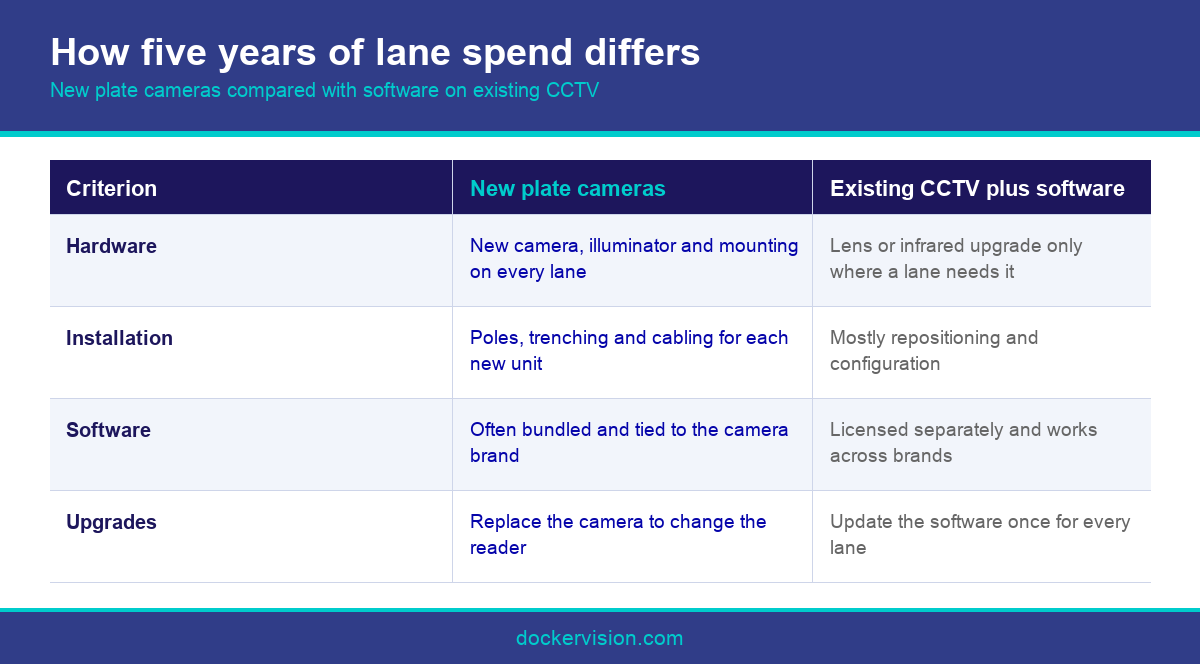
A dedicated plate camera bundles optics, infrared and recognition in one housing, so the number plate recognition camera price looks high but needs little else. Software that runs on standard IP cameras reverses that: the camera can be one you already own, and the money goes into licences, configuration and sometimes a better lens.
Docker Vision takes the second route. Its recognition runs on standard CCTV feeds, which is the same approach behind its container gate product and explains why ordinary IP cameras beat line scan rigs at the gate.
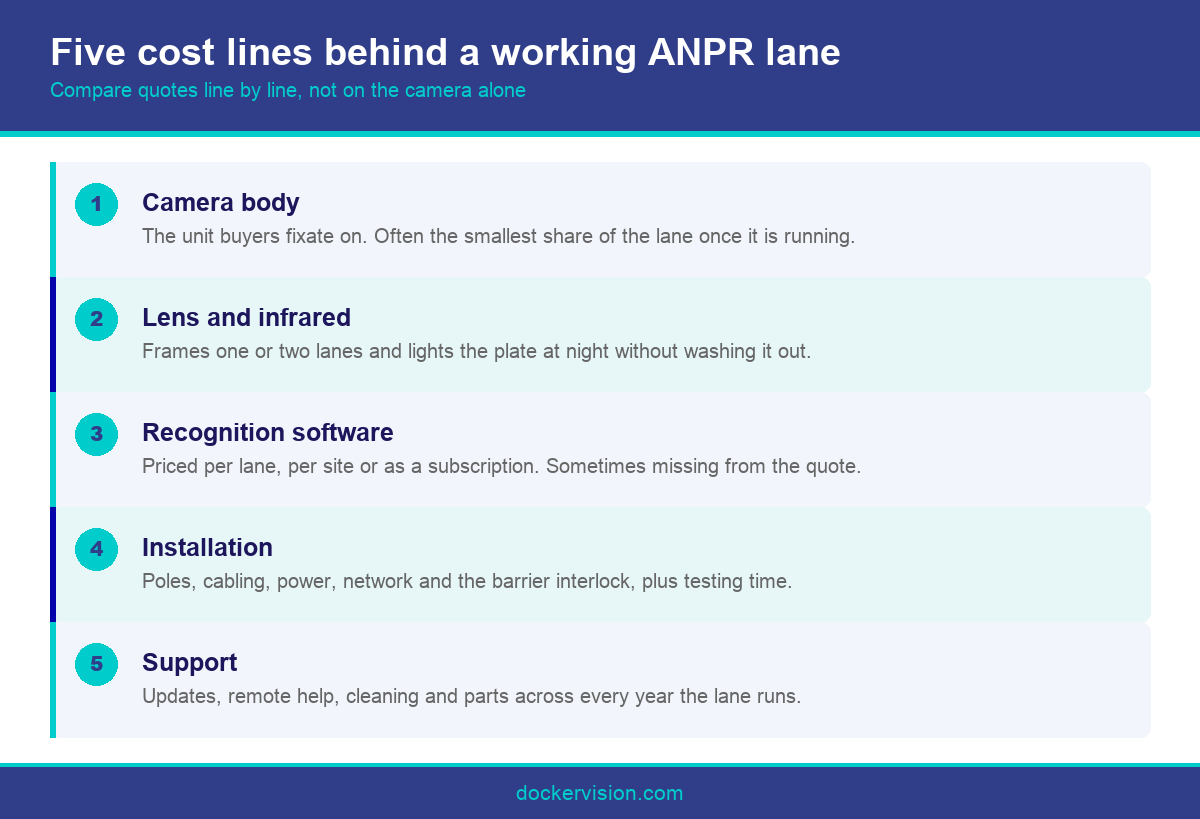
ANPR Camera Cost, Line by Line: Camera, Lens, IR, Software, Installation
Break any quote into five lines and the comparison becomes honest. The camera body is the line buyers fixate on, yet it is often the smallest share once a lane is running. A camera that cannot freeze a moving plate at night is cheap for exactly one day.
Lens and infrared come next. Plates are read best when the lens frames one or two lanes and the illuminator lights the plate without blowing it out. Then comes software, priced per lane, per site or as a subscription. Installation covers poles, cabling, power and the barrier interlock. Support covers updates, remote help and replacement parts.
The ANPR camera cost you should carry into a business case is the sum of all five, spread across the years you expect to run the lane. That is the same discipline as a total cost of ownership review for any other piece of site equipment.
Why License Plate Recognition Camera Price Listings Range So Widely
Three things explain most of the spread. Resolution and sensor quality decide whether a plate is still legible at the edge of the frame. Shutter speed and infrared power decide whether it is legible at night or at speed. And whether recognition is included decides whether you are buying a camera or a working reader.
A low license plate recognition camera price usually means a general CCTV camera relabelled for plates, with no recognition included and no accuracy promise. A high one may include an onboard engine, a warranty and support. Neither is wrong, but they are not the same product, and comparing them on price alone is how sites end up paying twice.
Indian conditions add their own pressure. Mixed plate styles, two row plates, glare from wet roads and dust all punish weak optics, which is why performance in fog, rain and glare deserves a test before any order is placed.
How Indian Conditions Change the Budget
Specifications written for European car parks assume uniform plates, steady light and orderly lanes. Indian sites rarely offer all three. Plates vary between older painted styles, high security registration plates and two row formats on two wheelers, and many lanes carry cars, trucks and motorcycles together.
That variety affects the budget in two ways. It raises the bar for the recognition software, which must cope with fonts, spacing and dirt that a template based reader never saw. It also raises the bar for the camera, which must keep plates sharp when a motorcycle slips past a car at an angle.
Weather adds a third pressure. Monsoon rain, dust in the dry months and glare from wet roads all reduce read rates if the lens, housing and illuminator were not chosen for them. A camera that reads every plate in a dry afternoon demo can lose a noticeable share of reads in a wet evening rush.
The practical answer is to budget for testing before buying. Ask each supplier to read plates from your own footage, captured at your busiest hour and in your worst light. A short paid pilot on one lane costs far less than replacing hardware across a site, and it gives you a measured accuracy figure to write into the contract.
Decide early who owns the result. If the camera vendor, the software vendor and the barrier installer are different companies, agree in writing which of them answers for a missed read. Otherwise every fault turns into a debate about whose equipment is to blame, and the lane stays unreliable while the debate runs.
Planning Five Years of Spend, Not One Purchase
A lane runs for years, so judge it over years. Add the upfront lines, then add annual licences, expected repairs and the staff time the lane saves or still needs. A cheaper camera that forces a guard to key in every third plate is the expensive option by the second year.
Reusing existing cameras is the largest single lever. Where a site already has IP cameras at its entry and exit, software can often read plates from those feeds after a lens or lighting adjustment, so the hardware line shrinks to fittings and the spend moves to software and setup.
Remember the cost of doing nothing as well. Manual entry at a busy gate ties up staff on every shift, and handwritten or keyed records are slow to search when an incident needs investigating.
Ask every supplier for the same three things: the lanes included, the accuracy they will commit to in your conditions, and the yearly cost after the first year. The eight features worth checking before you buy make a useful scoring sheet for that conversation.
Conclusion
An ANPR camera price is only the first line of a longer sum. Compare quotes on what a working lane costs, test accuracy in your own lighting and plate mix, and price the years after installation, not just the day of it. If your site already runs IP cameras at its gates, ask what it would cost to read plates from them first. Talk to Docker Vision about a lane level estimate for your site.
Frequently Asked Questions
What is a typical ANPR camera price in India?
Public listings in October 2026 ranged from about Rs 8,500 to Rs 55,000 for a camera alone. The figure that matters is the cost of a working lane, which adds software, installation, lighting and support to the camera body.
Does the ANPR camera cost include the recognition software?
Often it does not. Many listings price the camera body only, with recognition sold as a separate licence. Ask every supplier to state whether software, updates and support are included, and for how many lanes.
What is a realistic number plate recognition camera price for a two lane gate?
Budget for two reading points, one per lane, plus software, cabling and barrier integration. If existing IP cameras already cover both lanes, the hardware line can fall to lens and lighting adjustments, with most spend going to software and setup.
Why does one license plate recognition camera price differ so much from another?
Sensor quality, shutter speed, infrared power and whether recognition is included explain most of the gap. A low price usually buys a general camera; a higher one may include an onboard engine, warranty and support.
Is the ANPR camera price in Kerala different from other states?
Hardware prices are broadly national, but installation, travel and support terms vary by location. Ask for site visit and service response commitments in writing, since those drive the long term cost more than the camera itself.
Can I use my existing CCTV instead of buying new ANPR cameras?
Frequently, yes. Software can read plates from standard IP camera feeds if the camera frames the lane well and has enough resolution and light. See how a camera feed becomes a recorded event for the general principle.
How long does an ANPR camera last?
Outdoor cameras commonly run for several years when they are housed, powered and cleaned properly. Plan for lens cleaning, firmware updates and the occasional illuminator replacement, and include those costs in the yearly budget rather than treating them as surprises.
What should an ANPR quote always state?
Lanes covered, accuracy committed in your lighting and plate mix, software terms, installation scope, support response times and yearly costs after the first year. A quote missing any of these cannot be compared fairly with another.

Leave A Comment