
ANPR Camera Performance in Fog, Rain, Glare and Night
- Posted On: October 22, 2026
- Post Comments: 0
A plate that is easy to read at noon can vanish at midnight. Fog, monsoon rain, dust and oncoming headlights all degrade the image an ANPR camera depends on. For ports, rail yards and logistics depots that run around the clock, those conditions are routine, not rare. This guide explains what each condition does to plate recognition, which camera and AI choices help, and how to test performance before rollout, building on our earlier look at gate camera requirements.
Key Takeaways
- An ANPR camera needs both the right optics and the right AI model to read plates through fog, rain, glare and darkness.
- Night vision ANPR relies on infrared assisted imaging, which lights the plate without dazzling drivers.
- All weather vehicle identification should be proven in a pilot during your worst season, not only in fair conditions.
Why Weather and Light Challenge Every ANPR Camera
Plate recognition is only as good as the frame it receives. Weather and light change that frame in ways a basic camera cannot handle.
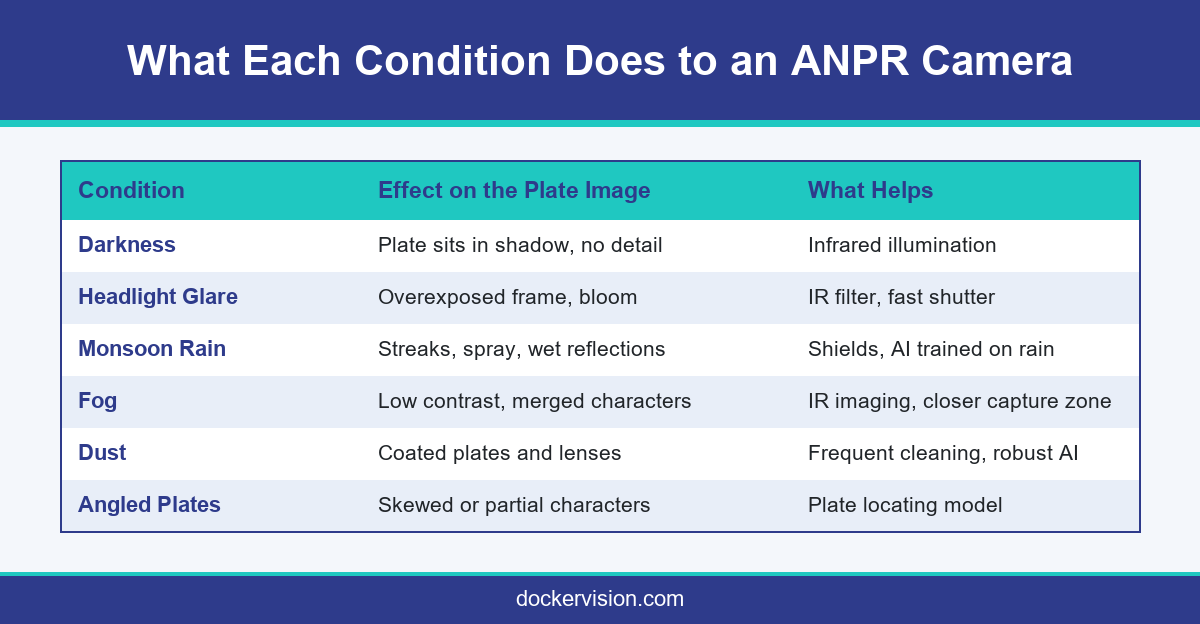
Rain streaks and spray blur characters. Fog lowers contrast until letters merge with the plate background. Dust coats plates and lenses alike, especially at busy truck gates. At night, oncoming headlights overexpose the image while the plate itself sits in shadow. Reflective plates can also bounce strong light back and wash out characters. Each of these failures leads to missed reads, manual overrides and disputes at the gate. Docker Vision built its ANPR to work in real world Indian road conditions, including dust, fog, rain, headlight glare and night driving, which mirrors what many terminals across South Asia and the Middle East face daily.
The cost of these failures is easy to underestimate. A gate that loses even a small share of night reads creates a steady queue of manual checks during the hours when staff numbers are lowest. Over a monsoon season, that becomes a measurable drag on throughput.
Some locations face harsher conditions than others. Coastal container terminals deal with sea fog, salt spray and heavy monsoon rain. Inland container depots and rail terminals often see dust from unpaved yards and heavy trucks. Highway toll plazas and city roads face constant headlight glare at night. Gates that run 24 hours a day face all of these at different times. For each site, list the worst conditions by season, then match camera hardware, lighting and maintenance plans to them. That simple exercise makes vendor comparisons far more concrete.
How Night Vision ANPR Uses Infrared to Read Plates
Infrared imaging is the core of reliable night vision ANPR. It lets the camera see the plate clearly while the scene stays dark to the human eye.
Infrared illuminators light the plate at a wavelength drivers cannot see, so there is no dazzle at the gate. Most registration plates are retroreflective, so infrared light returns strongly from the plate surface and makes characters stand out. Combined with short exposure times, this freezes motion and cuts headlight bloom. Infrared number plate recognition then hands a high contrast frame to the AI model. Docker Vision uses infrared assisted imaging for total darkness, harsh glare and monsoon conditions. That approach keeps reads steady across shift changes, when lighting often shifts fastest and gate volume peaks.
Lens choice and shutter settings matter as much as the illuminator. A narrow field of view keeps the plate large in the frame, while fast shutter speeds stop motion blur from moving trucks. Wide dynamic range helps when a bright sky or floodlight sits behind the vehicle.
Infrared also helps in daylight. Strong sun from a low angle can cast shadows across the plate or create glare on reflective paint. An infrared pass filter cuts much of that visible light, so the plate looks similar at dawn, noon and dusk. Consistent images give the AI model an easier, more predictable task.
What AI Adds Beyond Camera Hardware
Good optics produce a usable frame. Deep learning turns a difficult frame into a confident read, even when the plate is not perfect.
Older rule based OCR expected clean, front facing plates. Modern AI models are trained on thousands of real images, so they locate plates that are dirty, angled or partly obscured. They also adapt to regional plate styles, fonts and colour schemes, which matters at gates that see vehicles from many states or countries. Each read carries a confidence score, so low confidence events can be flagged for review rather than silently accepted. Processing at the edge keeps reads flowing when connectivity is weak during storms. This is the same AI foundation behind Docker Vision’s container yard management capabilities, applied to vehicles instead of boxes.
Model training is the other half of the equation. A model trained only on clear daytime plates will struggle at a coastal gate in heavy rain. Ask vendors what share of their training data covers night, rain, fog and dust, and whether they can fine tune on images from your own lanes.
Confidence scores also make continuous improvement possible. Reads that fall below the threshold can be reviewed, corrected and fed back into training. Over months, the model learns the plate styles, mud patterns and lighting quirks of each lane, so accuracy tends to improve as the system sees more of your traffic.
How to Test an ANPR Camera Before Rollout
A structured pilot shows how a camera performs in your real conditions. It also gives you numbers to hold a vendor to.
Run the pilot on at least one busy lane for several weeks, ideally across a period that includes night shifts and bad weather. Compare every automatic read with a verified record, such as gate transactions or a manual sample. Track read rate, average confidence score and the share of reads that needed staff review. Break results down by time of day and weather, because averages hide the hard cases. Agree acceptance targets before the pilot starts, using the same approach described in our port automation RFP checklist. The result is evidence, not a promise.
Share the pilot results with operations, security and IT together. Operations cares about queue time, security about missed vehicles and IT about uptime and data flow. Agreeing on one scorecard avoids debates after rollout and makes it clear when a lane is ready to scale to the rest of the site.
Placement and Maintenance Tips for All Weather Vehicle Identification
Even the best ANPR camera underperforms if it is mounted badly or left uncleaned. A few site practices protect accuracy all year.
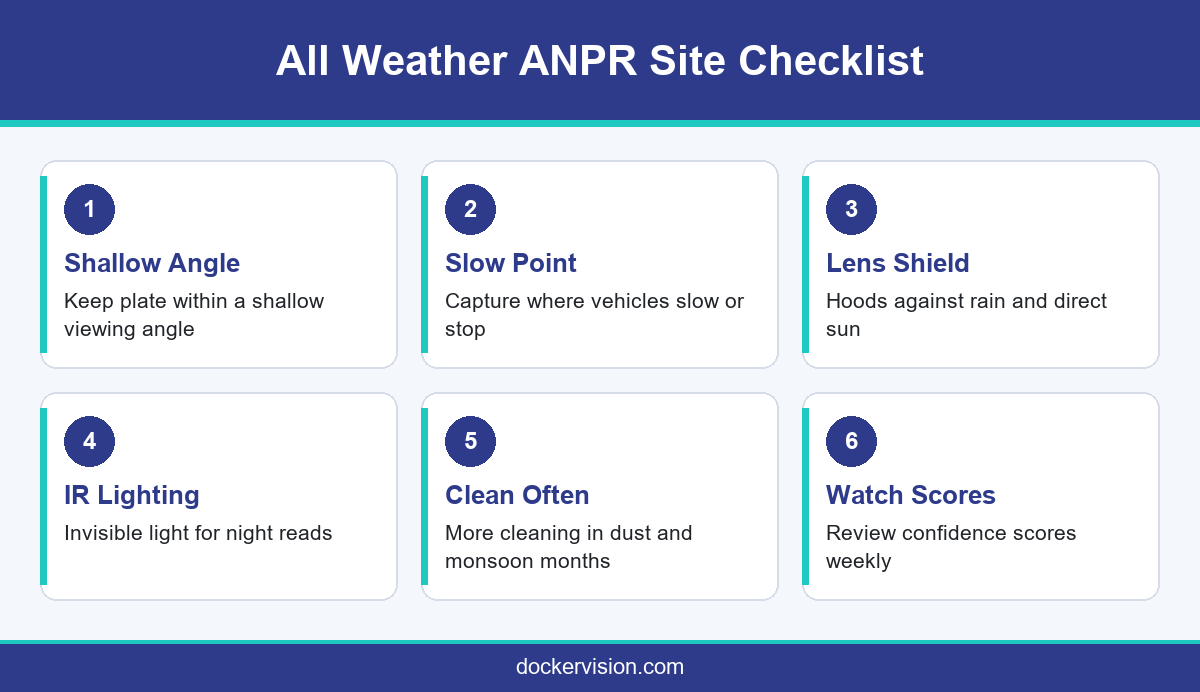
Mount cameras so the plate fills enough of the frame, with a shallow vertical and horizontal angle. Keep the capture zone at a point where vehicles slow down, such as a barrier or speed hump. Add hoods or shields to reduce rain and direct sun on the lens. Schedule lens cleaning more often during dusty and monsoon months. Review confidence scores weekly to spot cameras that are drifting. Finally, check readings against the Indian vehicle registration plate formats and any foreign plates your gates receive. These steps support all weather vehicle identification and keep manual checks to a minimum.
Power and housing deserve the same attention. Cameras exposed to salt air near the quay need corrosion resistant housings, and illuminators need a stable power supply to avoid flicker. Plan for spare units at critical lanes so a single failure does not stop the gate.
Document each camera’s settings after commissioning. If a lens is replaced or a pole is moved, the record makes it easy to restore the original view and keep the ANPR camera reading at the same standard as on day one.
Conclusion
An ANPR camera that works only in good weather is not fit for a port or logistics gate. Reliable performance comes from infrared assisted imaging, AI models trained on real plates, careful placement and routine maintenance. Test any solution during your hardest season and measure reads by confidence score, not by sight. Docker Vision designs its ANPR for dust, fog, rain, glare and darkness, and connects every read to your gate workflow. Contact Docker Vision to plan a pilot at your site.
Frequently Asked Questions
Can an ANPR camera read plates at night?
Yes. An ANPR camera with infrared illumination can read plates in complete darkness. Infrared light reflects strongly from retroreflective plates, producing a high contrast image the AI model reads without dazzling drivers. Reads stay consistent across every shift.
How does rain affect number plate recognition?
Rain blurs characters, adds glare from wet surfaces and reduces contrast. Shields, short exposure times, infrared lighting and AI models trained on wet weather images all help maintain reliable reads. Pilot testing during the wet season confirms real results.
Does headlight glare stop ANPR from working?
Strong headlights can overexpose a basic camera. ANPR cameras manage glare with infrared filters, fast shutter speeds and wide dynamic range, so the plate stays readable even when headlights face the lens. Lens hoods also limit stray light.
What is infrared number plate recognition?
Infrared number plate recognition uses invisible infrared light to illuminate plates and a camera tuned to that wavelength. It improves reads at night and in poor light without adding visible lighting at gates. It is standard for gates that run all night.
Can ANPR read dirty or damaged plates?
AI models can locate and read many plates that are dirty, angled or partly obscured. Severely damaged plates may still fail, so systems flag low confidence reads for staff review instead of guessing. Staff then confirm the plate before entry.
Where should an ANPR camera be mounted at a gate?
Mount it where vehicles slow down, with a shallow angle to the plate and enough resolution across the lane. A site survey defines height, distance and lens choice for each lane. Cameras near barriers usually perform best.
Does fog affect ANPR accuracy?
Dense fog lowers contrast and can reduce read rates. Infrared imaging, closer capture zones and AI trained on low visibility images help. Pilot testing in foggy months shows real performance before rollout. Plan extra review during peak fog months.
Can ANPR and container OCR share the same cameras?
Some sites combine plate and container reading at one gate, though camera angles often differ. Docker Vision pairs ANPR with AI powered gate automation so truck and container are verified together. That saves a second check at the gate.

Leave A Comment