
Tuas, Rotterdam and Yangshan: Fully Automated Port Lessons
- Posted On: November 26, 2026
- Post Comments: 0
Three terminals dominate the global automation conversation, and the images they produce set expectations that most operators cannot meet. Looking at what a fully automated port actually achieved, including where the results disappointed, is far more useful than admiring the photographs. This article covers what each one demonstrates and what transfers to a terminal that will never be rebuilt from scratch, and sits alongside our account of the flagship yards.
Key Takeaways
- All three were greenfield or effectively greenfield projects, which is the single most important fact about them and the least transferable.
- The published evidence on productivity is mixed. Several automated terminals took years to match the move rates their manual predecessors achieved.
- Where automation reliably delivered was consistency, safety and labour cost, not raw speed, and framing a business case around speed is where most disappointment originates.
- What transfers is the informational discipline rather than the machinery: accurate identity, known position, defined exceptions and heavy measurement.
What Each One Actually Demonstrates
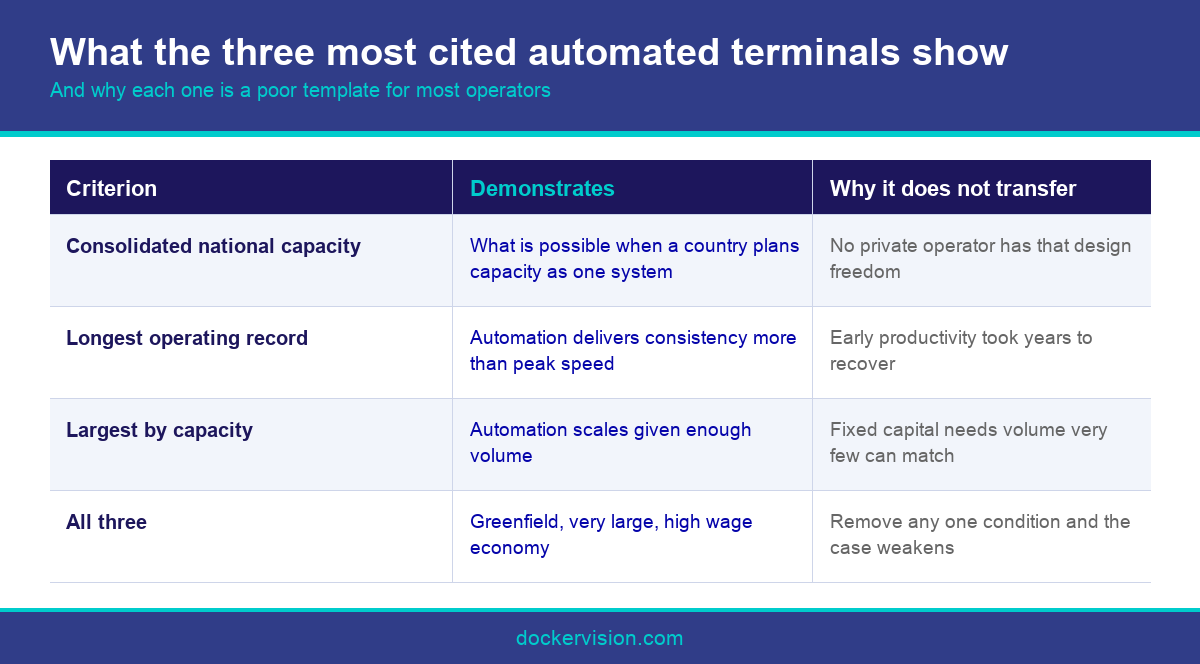
Tuas in Singapore is the most ambitious consolidation of terminal capacity anywhere, built to replace several existing facilities with a single highly automated port. It is a national infrastructure project on a scale no private operator would attempt, which is precisely what makes it a poor template.
What it demonstrates is what becomes possible when a country can plan terminal capacity as one system. Berth allocation, yard layout, equipment fleet and connectivity are all designed together, and the resulting efficiency comes as much from that coherence as from any individual technology.
Rotterdam pioneered automated container handling and has the longest operating record of the three, which makes it the most useful source of evidence about what automation does over time rather than at launch. Its early terminals took considerably longer to reach expected productivity than planned.
What Rotterdam demonstrates most clearly is that automation delivers consistency rather than peak speed. Automated equipment does not tire, does not vary between shifts and does not have a bad Monday, and over a year that reliability is worth more than a higher instantaneous move rate.
Yangshan is the largest automated terminal by capacity and demonstrates that automation scales. Its deep water location and dedicated connectivity mean it was designed as a whole system too, and its scale spreads the fixed capital across a volume very few facilities can match.
Read together, the three show that a fully automated port has been achieved where a facility could be designed as a system, at very large scale, in a high wage economy. Take away any one of those three conditions and the case weakens considerably, which is the situation most terminals are in.
Where the Published Evidence Is Less Flattering
The marketing account of automated terminals emphasises throughput. The research account is more careful. Work published by the International Transport Forum examining container port automation found that automated terminals are not reliably more productive than well run conventional ones.
The finding that surprises people most is the recovery period. Several automated terminals took years to regain the move rates they achieved before automating, because the transition involves relearning an operation as well as installing equipment, and that relearning was consistently underestimated.
The cost picture is similarly nuanced. Capital costs ran higher than forecast at several facilities, and while operating labour fell as expected, maintenance and systems costs rose in ways that business cases had not fully anticipated. The net saving was real and smaller than promised.
Where the evidence is consistently positive is safety and consistency. Removing people from areas where heavy equipment operates reduces incidents, and automated handling produces predictable cycle times that make planning easier even when the average is not faster.
The honest summary is that automation is a good answer to expensive labour, scarce land and a need for predictability, and a poor answer to a general wish to be faster. Terminals that automated for the first three reasons were largely satisfied, and terminals that automated for speed were not.
This matters for anyone building a case today. Stating plainly which of those benefits you are buying, and which you are not, is what makes a business case survive contact with a finance director who has read the same research.
What Transfers to a Terminal That Cannot Be Rebuilt
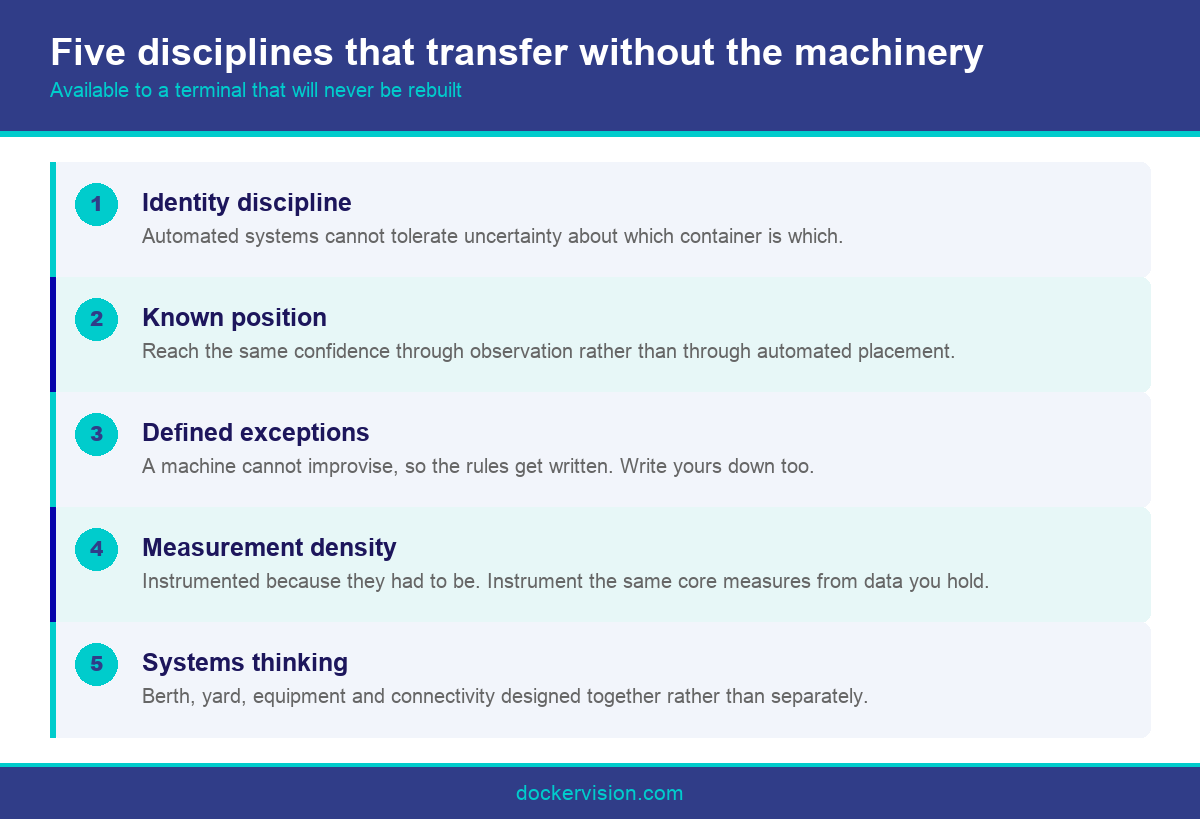
The first transferable element is identity discipline. Automated terminals cannot tolerate uncertainty about which container is which, because no operator is present to notice an error. That standard is achievable in any terminal for a small fraction of the cost of automated handling.
The second is known position. Automated yards know where every container is because the machine placed it and reported. A conventional yard can reach comparable confidence through observation, which is the cheap route to the same underlying benefit and does not require rebuilding anything.
The third is defined exceptions. An automated system must be told what to do when something is out of place, because it cannot improvise. Writing those rules down for a manual terminal captures most of the operational benefit, survives staff turnover and costs only the time to think it through.
The fourth is measurement density. Automated terminals are heavily instrumented because they have to be, and the resulting data drives continuous improvement. Any terminal can instrument the same core measures from data it already holds, which is where an improvement programme should begin.
The fifth is systems thinking. What made Tuas and Yangshan work was designing berth, yard, equipment and connectivity together rather than optimising each separately. A terminal that cannot rebuild can still plan its next three changes as one system rather than three projects.
Together these five deliver a real share of the benefit at a small fraction of the capital, and none of the work is wasted if structural automation is ever justified later. Our note on unmanned yard blocks covers where that boundary sits.
How to Use These Examples in a Business Case
Use them for direction rather than for numbers. The productivity and cost figures published about these facilities reflect their labour markets, their scale and their design freedom, and importing any of those numbers into a case for a mid sized terminal elsewhere will not survive scrutiny.
Name the benefit you are actually buying. If the case rests on labour cost, say so and model it against your own wage bill. If it rests on consistency or claim avoidance, model that instead. Cases that list every possible benefit convince nobody who has read the research.
Include the transition cost honestly. The recovery period at automated terminals is the most consistently underestimated item in the published record, and a case that budgets for a dip in performance during transition is more credible than one that assumes a clean step change.
Compare against the incremental option explicitly. The relevant alternative to a structural project is rarely doing nothing. It is spending a fraction of the capital on identity, observation and equipment health, and that comparison belongs in the paper rather than outside it.
Cite the research rather than the marketing. A case that acknowledges the ITF findings and explains why your situation differs is far stronger than one that ignores them, because the finance function will find them eventually and would rather find them in your paper.
Then set measurable expectations. Whatever you build, define what success looks like in numbers before you start, so that the result is assessable rather than arguable. Our guide to appointing a supplier covers how to hold a vendor to those numbers.
Conclusion
The world’s most automated terminals were greenfield projects at enormous scale in high wage economies, and the published evidence shows they bought consistency, safety and labour cost rather than raw speed. What transfers to everyone else is the discipline rather than the machinery: accurate identity, known position, defined exceptions, dense measurement and systems thinking. Ask Docker Vision how much of that you could reach this year.
Frequently Asked Questions
What makes a port fully automated?
Automated handling from quay to yard with no operator in the cab, coordinated by a control system that plans, dispatches and monitors moves. In practice most facilities described this way still have people in remote control and exception handling roles.
Are automated terminals faster than manual ones?
Not reliably. Published research including work by the International Transport Forum has found that automated terminals are not consistently more productive than well run conventional ones, and that several of them took years to regain their previous move rates.
What did automation reliably deliver at these terminals?
Consistency, safety and lower operating labour cost. Automated equipment does not tire or vary between shifts, and removing people from areas where heavy machinery is working reduces safety incidents both measurably and durably over time.
Why did the recovery period take so long?
Because automating an operation means relearning it as well as installing equipment. Exception handling, control tuning and staff transition all took longer than planned, and that relearning was consistently underestimated in the original business cases.
Can an existing terminal be converted to full automation?
Rarely without major disruption. Automated handling needs a specific layout, power distribution, surface tolerances and separation from manual traffic, none of which can realistically be installed while those blocks continue handling containers on a working terminal.
What should a smaller terminal copy from these examples?
Identity discipline, known container position, written exception rules, dense measurement and planning changes as one system rather than as separate projects. All five are affordable, and none of the work is wasted if you automate structurally later on.
Should we cite these terminals in our business case?
For direction, not for numbers. Their labour markets, their scale and their design freedom differ so much from yours that importing their published figures will not survive scrutiny from anyone who has read the underlying research.
What is the most common business case mistake?
Promising speed. Automation buys consistency, safety and lower labour cost far more reliably than it buys raw throughput, and a case built on becoming faster is the one most likely to disappoint everyone who approved it.
What is the realistic alternative to structural automation?
Spending a fraction of the same capital on identity, observation and equipment health. That comparison belongs inside the business case rather than outside it. See our crane productivity explainer for what that kind of programme delivers.

Leave A Comment