
Avoiding TOS Lock In: A Terminal Operating Company Guide
- Posted On: September 25, 2026
- Post Comments: 0
Very few terminals change their operating platform, and the reason is rarely satisfaction. A terminal operating
company usually stays because the cost of leaving has accumulated quietly into every adjacent system until moving
became unthinkable. This article explains how that accumulation happens, what it costs when the platform stops
fitting, and the four decisions that keep an exit affordable without ever having to use it, starting with
keeping the recognition layer separate from the platform.
Key Takeaways
-
Lock in is built from four things: bundled automation, undocumented interfaces, data held in proprietary formats and
process knowledge that lives only in one product. -
Bundled gate automation looks like a discount and behaves like a switching cost, because a later platform change
also replaces cameras, accuracy baselines and gate process. -
The option to leave has value even if you never use it, because vendors price differently for customers who
genuinely could. -
Four decisions preserve it: keep automation independent, insist on documented interfaces, own your data in open
formats, and document process outside the product.
How Lock In Actually Accumulates
It rarely starts with a bad decision. It starts with a series of individually sensible ones. The platform vendor
offers a gate module at a good price during the implementation, so you take it. The integration is simplest through a
proprietary route, so you use it. Reporting is easiest inside the product, so it lives there.
Three years later, the gate cameras are configured through the platform, the yard reports are built in its report
writer, the billing rules exist only as configuration, and four staff know how to operate it and nothing else. None of
that was a mistake, and together it is a wall.
The wall has a price, and the price is paid whether or not you ever try to climb it. A vendor who knows the customer
cannot realistically leave prices renewals accordingly, and support urgency follows the same logic. This is not
malice, it is how commercial relationships work.
It also constrains operational choices. A terminal that wants to add a capability finds that the only supported route
is the platform vendor own module, which may be adequate, expensive, or not available for another two versions. The
lack of alternatives is the cost.
The most damaging form is the invisible one. Terminals that have stopped comparing because comparison feels pointless
lose the ability to know whether they are well served. Market awareness fades and the first real check comes during a
crisis, which is a bad time to discover the options.
None of this argues for changing platforms frequently. Stability is genuinely valuable. It argues for staying because
the platform fits, and knowing that it does, rather than staying because leaving has become impossible.
The Four Sources and What Each Costs
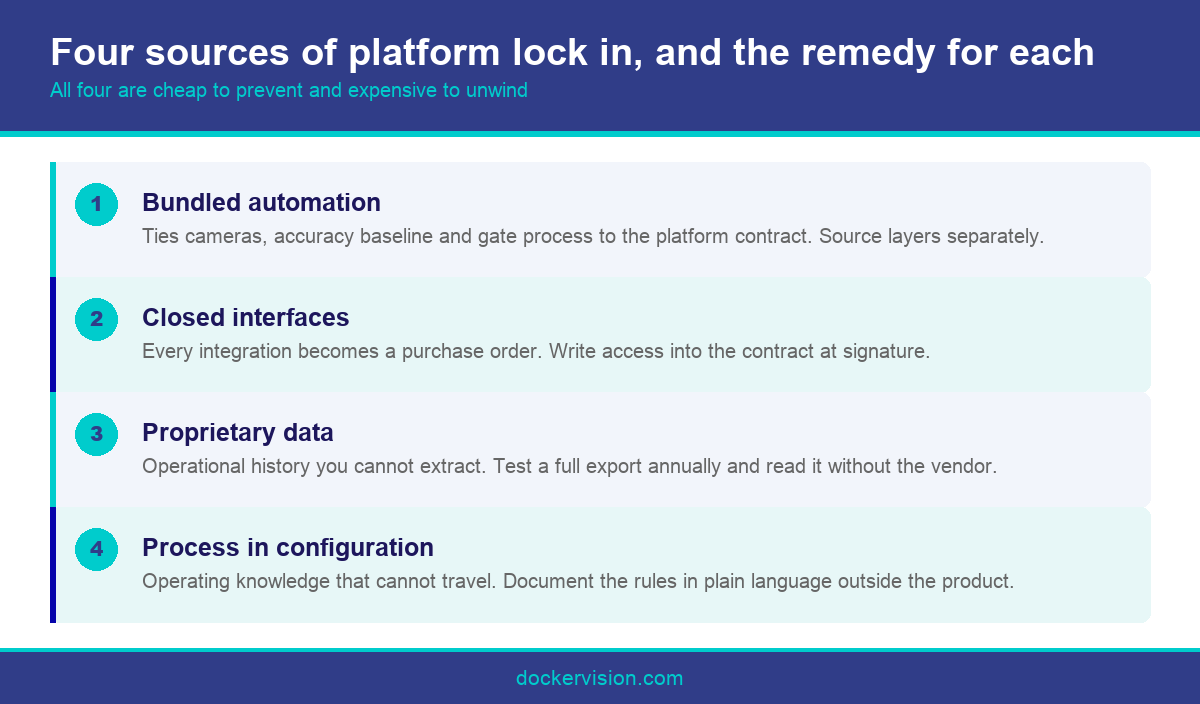
The first source is bundled automation. Gate recognition sold as a platform module ties your camera estate, your
accuracy baseline and your gate process to the platform contract. Changing platform then means changing all four at
once, which converts a software migration into an operational one.
The second is undocumented or licensed interfaces. If your own team cannot read and write operational data without
vendor involvement, every integration becomes a purchase order. Over a decade this quietly determines which automation
projects happen and which are abandoned as too expensive.
The third is data format. Operational history held in proprietary structures with no supported export is the most
fundamental lock, because a terminal cannot leave a system that holds its record hostage. An
open standard
export path is what prevents that, and it has to be agreed in writing before signature rather than requested
afterwards.
The fourth is process knowledge. When the only description of how your terminal works is the configuration inside one
product, that knowledge cannot be carried anywhere. Staff turnover then compounds it, because new people learn the
product rather than the operation.
Each of these has a different remedy, which is useful. Bundling is fixed by sourcing layers separately. Interfaces are
fixed at contract time. Data format is fixed by periodic export tests. Process knowledge is fixed by documenting
outside the product.
None of the remedies is expensive if applied early, and all of them are expensive if applied late. That asymmetry is
the practical argument for treating exit cost as a design consideration at selection rather than a problem to solve
when the fit stops working.
Why an Independent Automation Layer Is the Strongest Protection
Of the four remedies, keeping the automation layer independent does the most work, because it is the one that removes
physical and operational coupling rather than only contractual coupling. Cameras, calibration and gate procedure stay
where they are regardless of what happens to the platform.
It also protects continuity during a migration. A terminal whose recognition sits outside the platform can run the
gate normally while the planning system is cut over, which removes the most stressful element of a change and
materially reduces the risk of a bad weekend.
There is an accuracy argument too. A recognition layer chosen on its own merits will usually outperform one bundled as
a secondary product, because the vendor competes on recognition rather than including it to win a platform deal.
And there is an evidence argument. An independent layer produces measurements about your gate that are not filtered
through the platform, which is exactly the data you need if you ever want to hold a platform vendor to a performance
conversation.
Docker Vision is neutral by construction rather than by policy, since it has no platform to sell. The engine
integrates with whichever system you run, and if you replace that system the recognition layer stays in place. The
mechanics are described in
how the engine plugs into an existing platform.
The test to apply to any bundled offer is one question. What happens to this automation if we change platform in four
years. If the answer means buying it again, the discount you were offered is being funded out of your own future
flexibility.
Four Decisions That Keep the Exit Open
The first decision is to source the automation layer separately, with its own contract, its own support relationship
and its own accuracy commitment. This costs slightly more at purchase and saves a great deal at every subsequent
decision point for as long as the terminal operates.
The second is to write interface access into the platform contract explicitly. Which interfaces, documented to what
standard, callable by whom, at what cost. A vendor who resists this at contract stage will resist it much harder
afterwards, when you have no leverage left.
The third is to test data extraction annually. Do a full export, open it, and confirm you can read it without the
vendor. Terminals that do this discover format problems while they are cheap. Terminals that do not discover them
during a migration, when they are not.
The fourth is to document your operating processes outside the product, in plain language, and keep the document
current. This costs a few days a year and is the difference between carrying your operational knowledge to a new
system and rediscovering it.
Together these four cost very little and change the shape of every future negotiation. They also improve the
relationship with the incumbent vendor, because a customer who could leave and chooses to stay is a better customer to
have and both sides know it.
The goal is not to leave. Most terminals should not, and platform stability has real operational value. The goal is
that staying remains a decision rather than a consequence. Our overview of
what to ask before you appoint a supplier
sets out the questions.
Conclusion
A terminal operating company gets locked in through ordinary decisions taken one at a time, and the cost shows up
years later as renewals it cannot contest and projects it cannot justify. Sourcing automation separately, writing
interface access into the contract, testing extraction annually and documenting process outside the product together
cost very little and keep every future decision open.
Speak to Docker Vision about
a recognition layer that stays yours.
Frequently Asked Questions
What is TOS vendor lock in?
It is the accumulated cost of leaving a terminal operating platform, built out of bundled automation, closed
interfaces, proprietary data formats and process knowledge held only inside the product. It grows quietly through
ordinary decisions rather than one bad one.
Is bundled gate automation cheaper?
It usually looks cheaper at purchase and behaves as a switching cost afterwards. A later platform change would also
mean replacing cameras, accuracy baselines and gate process, so the saving is funded out of your future flexibility.
Why does the option to leave matter if we never use it?
Because vendors price and support differently for customers who genuinely could leave. The option improves renewal
terms and escalation urgency even when you have no intention of exercising it, which makes it worth preserving
cheaply.
How do we test whether we can extract our data?
Request a full export annually, open it without vendor assistance and confirm the operational history is readable and
complete. Terminals that test this find format problems while they are cheap rather than during a migration.
What should the contract say about interfaces?
It should name which interfaces exist, the standard they are documented to, who may call them and what they cost.
Vagueness at contract stage becomes a purchase order for every future integration you might want to run.
Does an independent automation layer cost more?
Slightly more at purchase and considerably less across a decade, because it keeps every subsequent decision
independent. It also usually performs better, since the vendor competes on recognition rather than bundling it to win
a platform deal.
Can we migrate platforms without stopping the gate?
Yes, provided recognition sits outside the platform. The gate keeps reading throughout the cutover and results are
simply repointed at the new system, which removes the single highest risk element of a terminal system migration
weekend.
How do we document process outside the product?
Write the operational rules in plain language and keep the document current, covering gate handling, exception routes,
billing logic and yard policy. A few days a year of effort makes that knowledge portable rather than trapped in
configuration.
Should we change platform if we feel locked in?
Not necessarily, because platform stability has real operational value. Fix the lock first by separating the layers
and securing interface access, then decide on fit with the pressure removed. Our
overview for competitive terminals
covers the wider picture.

Leave A Comment