
Parking Management Software: Features That End Gate Queues
- Posted On: November 9, 2026
- Post Comments: 0
Parking management software decides whether a car park entry feels instant or feels like a toll booth on a bad day. The barrier, the camera and the kiosk are all visible, but the software behind them sets the rules, keeps the records and calculates what each visitor owes. This guide walks through the features that actually shorten queues, how vendors price them, and what to ask before you sign. It is written for operators of malls, offices, hospitals and gated campuses.
Key Takeaways
- The features that shorten queues are the ones that remove a human step: plate based entry, automatic charging at exit and instant blacklist checks.
- Good parking management software keeps a complete, searchable log of every entry and exit, which is as valuable to security teams as it is to billing.
- Pricing comes in three shapes, per lane, per site and subscription, and the cheapest one depends on how many lanes you run and how fast you expect to grow.
Smart Parking Solutions: Where the Software Ends and the Hardware Begins
Most smart parking solutions are sold as a bundle, which hides a simple split. Hardware senses and moves: cameras, boom barriers, kiosks and displays. Software decides: who may enter, what they owe, which vehicles must be stopped, and what gets recorded.
That split matters because hardware is hard to change once installed, while software can be replaced or upgraded. Choosing software that works with the cameras and barriers you already have keeps your options open and stops a single supplier from owning the whole lane.
Docker Vision builds on that principle. Its plate reading runs on existing CCTV feeds, and the same approach to plugging into the systems a site already runs is how its container products integrate with terminal platforms.
The Five Features That Actually Shorten Queues
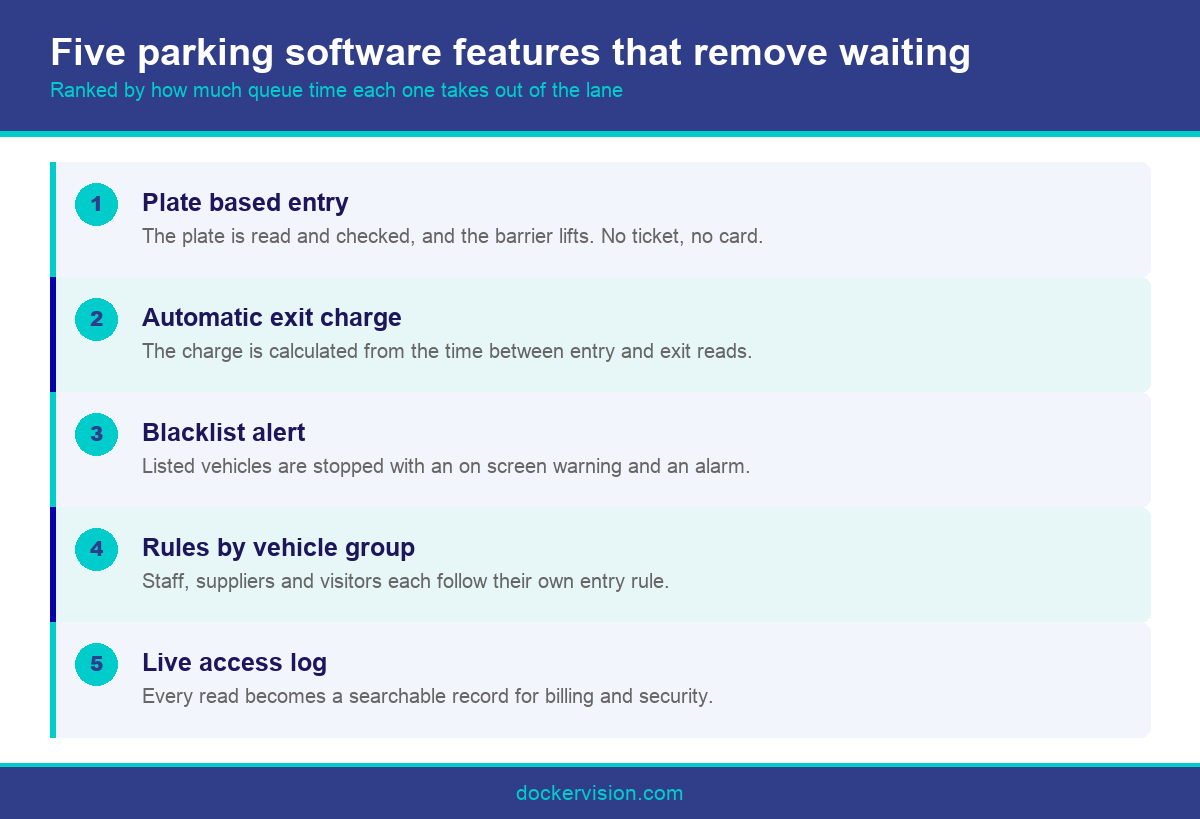
Queues form when a lane waits for a person. Every feature worth paying for removes one of those waits, and the list below is ordered by how much waiting each removes at a typical gated entry.
Plate based entry and exit
The camera reads the plate, the software checks it and the barrier lifts. No ticket is printed and no card is tapped. Docker Vision’s ANPR parking flow captures and verifies the plate with a time stamp at entry, which removes the need for manual ticketing or RFID cards altogether.
Automatic charges and instant blacklist alerts
At exit the plate is read again and the charge is calculated from the time between the two reads. When a listed vehicle arrives, the barrier stays down and the system raises a warning and an alarm, so a guard deals with one car rather than checking every car.
Live access logs
Every read becomes a searchable record with time, lane and plate. Billing disputes, incident reviews and monthly occupancy reports all draw on the same log, which is why it deserves as much attention in a demo as the barrier does.
Getting Staff, Suppliers and Visitors Through the Same Gate
Most sites serve several kinds of driver through the same lanes. Staff expect to drive straight in. Suppliers arrive on schedules and need access to service areas. Visitors pay, and some vehicles must be refused. Good software handles all four with rules rather than with a guard deciding car by car.
Each group can also be handled at a different speed. Registered staff and suppliers can pass on a plate match alone, while visitors start a timed session that ends with a charge at the exit. Listed vehicles are stopped before the barrier moves, with an alert to the security desk.
Rules should be easy for the operator to change. A new tenant, a contractor for one week or a temporary ban should take minutes to set up, not a support ticket. Ask to see the rule screen in the demo, and ask who on your team will be trained to use it.
Clear signs at the entry also help. Drivers who know that no ticket is needed approach the barrier with confidence instead of stopping to look for a machine.
Exceptions are where queues return. A visitor whose plate is unreadable, a staff member in a borrowed car, or a delivery vehicle with a damaged plate all need a fast fallback, such as an intercom, a QR code or a guard override that is logged like every other entry.
ANPR Software Price: Per Lane, Per Site or Subscription
Vendors price recognition in three common ways. A per lane licence charges for each reading point, which suits small sites with two or three lanes. A site licence covers every lane at one address, which suits large car parks with many entries. A subscription spreads the cost over months, often with updates and support included, in the style of software as a service.
The ANPR software price you see first is rarely the one you pay over five years. Ask what happens when you add a lane, whether updates are included, and what support costs after the first year. A cheap per lane price can become expensive for a site that plans to grow.
Questions to Ask in a Parking Software Demo
Demos are designed to impress, so steer them. Bring a short clip from your own entry at a busy hour and ask the supplier to run it. Watch how many plates are read, how long the barrier takes to respond, and what appears on screen when a plate cannot be read.
Then look past the barrier. Ask to export a day of entries and exits, search for one plate across a month, and change a charging rule while you watch. These are the tasks your team will perform every week, and they reveal whether the software was built for operators or only for the sales meeting.
Finally, ask about the boring things that decide the next five years: where data is stored, how updates are delivered, what happens during a network outage, and how quickly support responds when a lane stops. Parking management software that answers these clearly is usually the one that keeps working after the installer leaves.
Write the answers down and score every supplier on the same sheet. A comparison built on your own footage and your own tasks is far more reliable than one built on brochures, and it gives the final decision a record that finance and security teams can both follow.
Smart Parking System Cost: The Five Budget Lines
Smart parking system cost breaks into five lines: reading hardware, barriers and kiosks, software licences, installation and integration, and yearly support. Sites that already own cameras and barriers carry only the last three, which can change the business case entirely.
Integration is the line most often underestimated. Connecting the software to payment, to a building access system or to a visitor management tool takes configuration and testing. Insist that the quote names each integration and who is responsible for it.
Hidden costs also sit in payment handling. Card terminals, digital wallets and reconciliation with your accounts system each add work, so check which payment methods the software supports today and which ones would need a separate project later.
Finally, weigh the cost against what the lane saves: staff hours at the booth, lost tickets, revenue leakage and the security value of a reliable log. The same thinking applies to any gate project, and a payback model you can run on your own numbers is a useful template.
Conclusion
The best parking management software is the one that removes waiting from your lanes without locking you into one supplier’s hardware. Look for plate based entry, automatic charging, blacklist alerts and a complete log, then compare pricing models over five years rather than one. Docker Vision’s ANPR parking solution reads plates from existing CCTV and passes clean events to the systems you already run. Ask Docker Vision for a walkthrough of the flow at your site.
Frequently Asked Questions
What does parking management software do?
It decides who may enter, records every entry and exit, calculates charges, and raises alerts for listed vehicles. It sits between the cameras, barriers and kiosks and the billing or security systems a site already uses.
Are smart parking solutions in India software, hardware or both?
Usually both, sold as a bundle. The hardware senses and moves, while the software decides and records. Choosing software that works with existing cameras and barriers keeps upgrade costs down and avoids depending on one supplier.
How is ANPR software price usually quoted?
Per lane, per site or as a subscription. Per lane suits small sites, site licences suit large car parks, and subscriptions spread cost and often include updates. Always compare the five year total, not the first invoice.
What makes up smart parking system cost beyond the software licence?
Reading hardware, barriers and kiosks, installation and integration, and yearly support. Integration with payment or access systems is the most underestimated line, so ask each supplier to name every integration in the quote. Running costs recur every year as well.
Can parking software work without tickets or RFID cards?
Yes. Plate based entry reads the vehicle at the barrier and checks it against the rules, so no ticket or card is needed. Charges are calculated at exit from the time between the two plate reads.
How does a blacklist alert work at a car park?
When a plate on the list is read, the barrier stays closed and the system raises an on screen warning and an alarm. Staff then deal with that one vehicle instead of checking every arrival by hand.
Is a car park access log useful for security teams?
Very. A searchable log of every plate, lane and time supports incident reviews and audits. The principle is the same one that helps terminals with stopping unauthorised vehicles at the gate. Agree retention periods and access rights before the first search.
How long does it take to deploy plate based parking software?
Where cameras and barriers already exist, the work is mostly configuration, integration and testing, so it can be fast. New poles, cabling or barriers add civil work and lengthen the project accordingly. A pilot lane shortens the full rollout.

Leave A Comment