
Container Automation for Yard Capacity Without New Concrete
- Posted On: October 29, 2026
- Post Comments: 0
When a yard feels full, the instinct is to find more land. Very often the terminal already has the capacity and cannot use it, because uncertainty forces planners to hold space in reserve and poor placement wastes what remains. Container automation recovers a meaningful share of that hidden capacity without pouring anything. This article explains where the space is hiding, how to get it back, and why competitive terminals invest here first.
Key Takeaways
- Terminals hold slack because their inventory is uncertain, and the size of that reserve is a direct function of how much they trust their own records.
- Stack height, mixed dwell times and reefer power layout each waste capacity in ways that are invisible on a utilisation report.
- Recovering fifteen percent of usable capacity is a realistic target for a terminal that has never systematically addressed data quality and allocation policy.
- Paving is the most expensive option and should be the last one, because it also increases the area that has to be managed accurately.
Where Yard Capacity Actually Disappears
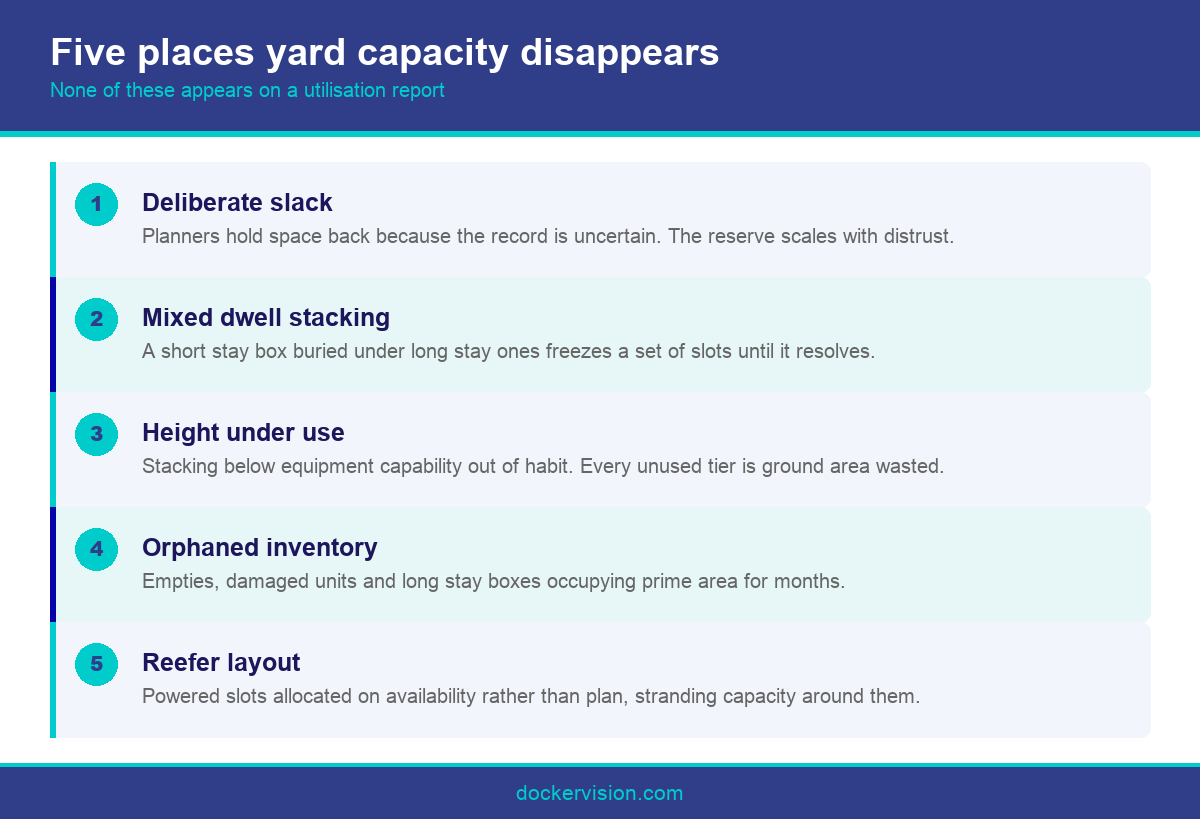
The first loss is deliberate slack. Planners leave room because they know the record is imperfect, and a yard run at genuine capacity with uncertain inventory becomes unworkable the first time a box is not where it should be. That reserve is rational, invisible on any report, and directly proportional to how much the record is trusted.
The second is mixed dwell stacking. A container leaving tomorrow buried under three that leave next month is not just a future reshuffle, it is a set of slots that cannot be used efficiently until the situation resolves. Yards with no dwell based grouping policy accumulate these situations across every block.
The third is height under use. Most yards stack below what their gantry equipment can reach, sometimes for good reasons and often out of habit inherited from an earlier machine generation. Each unused tier is ground area paid for and not used, and nothing ever forces the question.
The fourth is orphaned inventory. Empties, damaged units and long stay containers accumulate in corners, and because they are nobody urgent problem they occupy prime area for months. A terminal that has never audited its long stay population is usually surprised by both the count and the location.
The fifth is reefer layout. Powered slots are a constrained resource and are frequently allocated on availability rather than on plan, which strands non powered capacity around them and forces refrigerated boxes into positions that generate additional handling on both entry and exit.
None of these appear as a line in a utilisation figure, which is why a terminal can report seventy percent occupancy and still feel completely full. Proper capacity utilisation measures slots that could have been used, not merely slots occupied, and the difference between the two is the capacity this article is about.
Why Accurate Inventory Releases Space Directly
The reserve that planners hold is a hedge against being wrong, so the size of the hedge falls as confidence rises. This is the most direct link between data quality and physical capacity in a terminal, and it is also the one least likely to appear in a business case because nobody has ever measured the reserve explicitly.
You can measure it, approximately. Ask planners what occupancy level they will not exceed, and then ask what they would be comfortable with if they were confident every container was exactly where the record said. The gap between those two numbers, applied to your slot count, is capacity you already own and are choosing not to use.
Accurate inventory also removes the blocking effect of lost containers. A box that cannot be found occupies its recorded slot in the system and its actual slot in reality, so a single unresolved discrepancy sterilises two positions until somebody reconciles it, and terminals rarely count how many of those exist at any moment.
It changes stacking confidence too. Planners stack lower when they expect to have to dig, because burying a box you might have to search for is worse than burying one you can retrieve predictably. Confidence in retrieval is what makes a taller stacking policy operationally acceptable.
And it enables tighter grouping. Dwell based allocation only works if you know what is actually in each stack, so a yard with uncertain inventory cannot execute the policy that would reduce its reshuffles, which is the loop that keeps mid sized terminals stuck at their current performance.
This is why container automation aimed at capacity should begin with identity and observation rather than with layout. The physical yard is rarely the binding constraint. Confidence in what is in it usually is, and confidence is considerably cheaper to buy than concrete.
Five Ways to Recover Space Without Paving
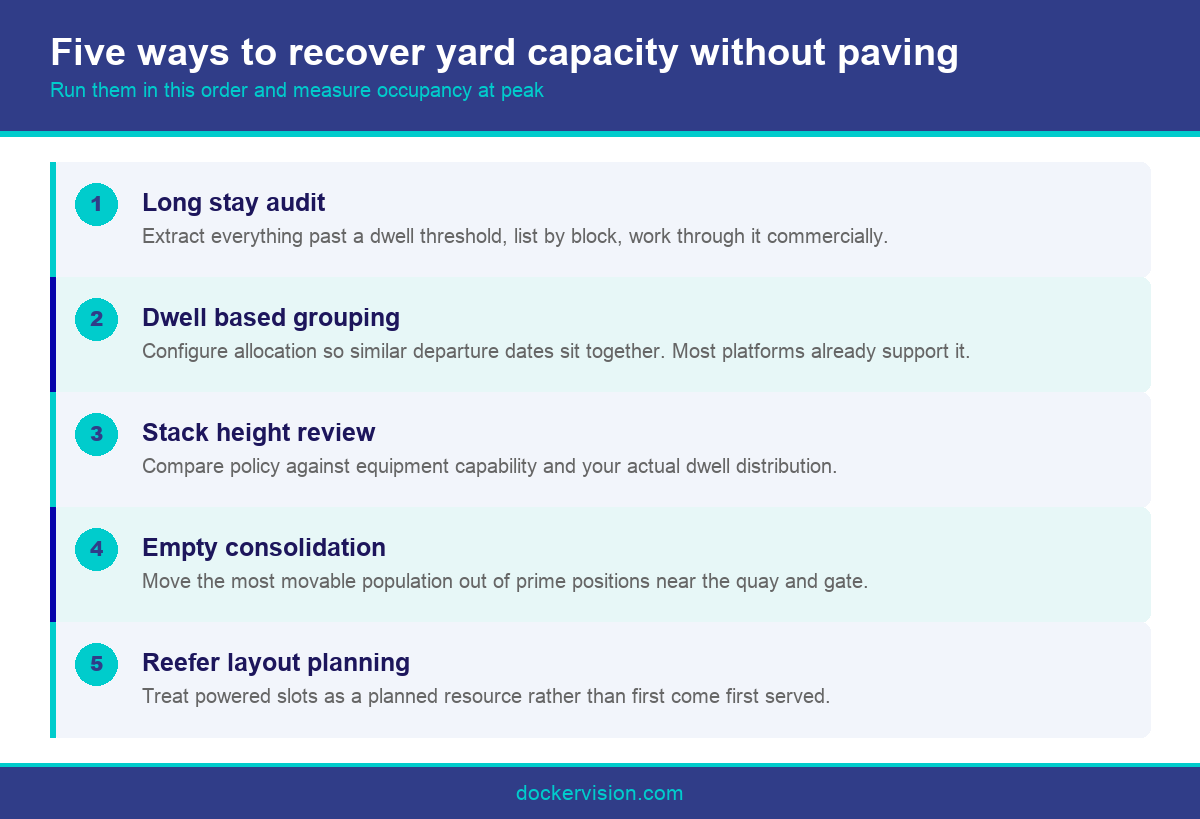
The first is a long stay audit. Extract every container that has been in the yard beyond a threshold you choose, list them by block, and work through the list commercially. Terminals routinely recover whole rows this way, and the exercise costs an afternoon of analysis plus some customer conversations.
The second is dwell based grouping. Configure allocation so that containers with similar expected departure sit together, which reduces both reshuffles and the number of stacks that are effectively frozen while a long stay box sits on top of short stay ones. Most platforms already support this.
The third is a stack height review. Compare your current policy against equipment capability and your actual dwell distribution rather than against habit. Where retrieval confidence supports it, one additional tier across a block is a substantial capacity gain for no capital at all.
The fourth is empty consolidation. Empties are the most movable population in the yard and the easiest to relocate to lower value area, and a policy that keeps them out of prime positions near the quay or the gate frees exactly the space that is under most pressure at peak.
The fifth is reefer layout planning. Treat powered slots as a planned resource with its own allocation logic rather than as first come first served, which reduces the stranded non powered capacity that clusters around reefer areas and cuts the handling those containers generate.
Run these five in order and measure occupancy at peak before and after. A terminal that has never addressed any of them can reasonably expect to recover in the region of fifteen percent of usable capacity, which for most operators is several years of growth bought without a construction project.
When Paving Really Is the Answer
Sometimes it is. A terminal that has already fixed identity, tightened allocation, reviewed stack height and cleared long stay inventory, and is still running at peak occupancy that constrains service, genuinely needs more area. The point of the preceding sections is to make sure that conclusion is earned rather than assumed.
When you do expand, the same disciplines apply to the new area. A larger yard is harder to keep accurate, not easier, because the same number of staff now manage more positions and the consequences of a lost container are worse. Expansion without data quality moves the problem rather than solving it.
Design the new area around observation from the start. Camera positions, sightlines and slot markers are far cheaper to get right during construction than to retrofit afterwards, and a block designed to be observable is a block that stays accurate with much less effort for its whole life.
Consider what the area is for. Expansion aimed at absorbing peak variability has different requirements from expansion aimed at growth, and dedicating new area to empties or long stay inventory frequently releases better positioned existing space for the traffic that actually needs proximity to the quay.
Sequence the construction against operations carefully. Building while handling containers is disruptive, and terminals frequently discover that the capacity lost during construction offsets a meaningful part of the first year benefit, which is a cost that belongs in the case rather than in the surprise column.
And keep measuring afterwards. The five metrics that told you the yard was full should be the same five that tell you the expansion worked, as our guide to the yard layer sets out, otherwise you will be having the same conversation again in three years with no evidence of what changed.
Conclusion
Most terminals that feel full are not. They are holding slack against uncertainty, stacking below capability, mixing dwell times and storing long stay inventory in prime positions. Container automation attacks the first of those directly, and policy attacks the rest. Work through all five before costing any concrete, and measure occupancy at peak to prove what you recovered. Ask Docker Vision about a capacity review of your existing yard.
Frequently Asked Questions
How much capacity can a terminal recover without paving?
A terminal that has never systematically addressed data quality, allocation policy, stack height and long stay inventory can reasonably target around fifteen percent of usable capacity, which for many operators is several years of growth.
Why do planners leave space empty when the yard is busy?
Because they are hedging against inventory uncertainty. A yard run at genuine capacity becomes unworkable the first time a container is not where the record says, so the reserve is rational and proportional to how much the record is trusted.
Does a utilisation report show wasted capacity?
No. Utilisation counts slots used rather than slots that could have been used, so a terminal can report seventy percent occupancy and still feel full. The gap between those two figures is where the recoverable capacity is hiding.
What is a long stay audit?
It is an extract of every container that has exceeded a dwell threshold you choose, listed by block and worked through commercially. It costs an afternoon of analysis plus customer conversations, and frequently recovers whole rows of prime area.
Should we simply stack higher?
Only where retrieval confidence supports it. Higher stacks save ground area and generate more reshuffles, so review the policy against your own dwell distribution and current equipment capability rather than against a habit inherited from older machines.
How does inventory accuracy create physical space?
It shrinks the reserve planners hold against being wrong, and it stops lost containers sterilising two slots at once, one recorded and one actual. Both effects release area without any construction or equipment purchase at all.
Where should empty containers be stored?
Away from prime positions near the quay and the gate. Empties are the most movable population in the yard, so a policy that relocates them to lower value area frees exactly the space that comes under most pressure during peak.
When is expanding the yard the right answer?
When identity, allocation policy, stack height and long stay inventory have all been addressed and peak occupancy still constrains service. At that point the need is real, and the same disciplines should be designed into the new area.
Does a bigger yard need more automation?
Yes, generally. More positions managed by the same number of staff makes accuracy harder and lost containers more costly. Design camera sightlines and slot markers in during construction, as our guide to choosing an automation partner recommends.

Leave A Comment