
Port Automation in India and Key Growth Markets
- Posted On: November 5, 2026
- Post Comments: 0
Port automation in India is discussed as though it were a single decision, and it is not. A transhipment terminal on the Kerala coast, a river port handling mixed cargo and an inland container depot in the north face different constraints, different labour economics and different policy pressure. This guide sets out where Indian terminals actually stand, how the comparison markets differ, and what a mid sized operator should do first, against the backdrop of how modern container terminals have changed.
Key Takeaways
- Indian terminals are broadly at the semi automated stage, with gate and crane recognition far more widespread than automated yard handling.
- Policy is a genuine driver here rather than background noise. Maritime India Vision 2030, Sagarmala and the National Logistics Policy all push measurable efficiency targets.
- India’s labour economics favour retrofit automation over full greenfield automation, which is a different conclusion from the one northern European terminals reached.
- For a mid sized Indian terminal the sequence that pays is identity at the gate, then yard observation, then equipment health, with structural automation considered last.
Where Indian Terminals Actually Stand
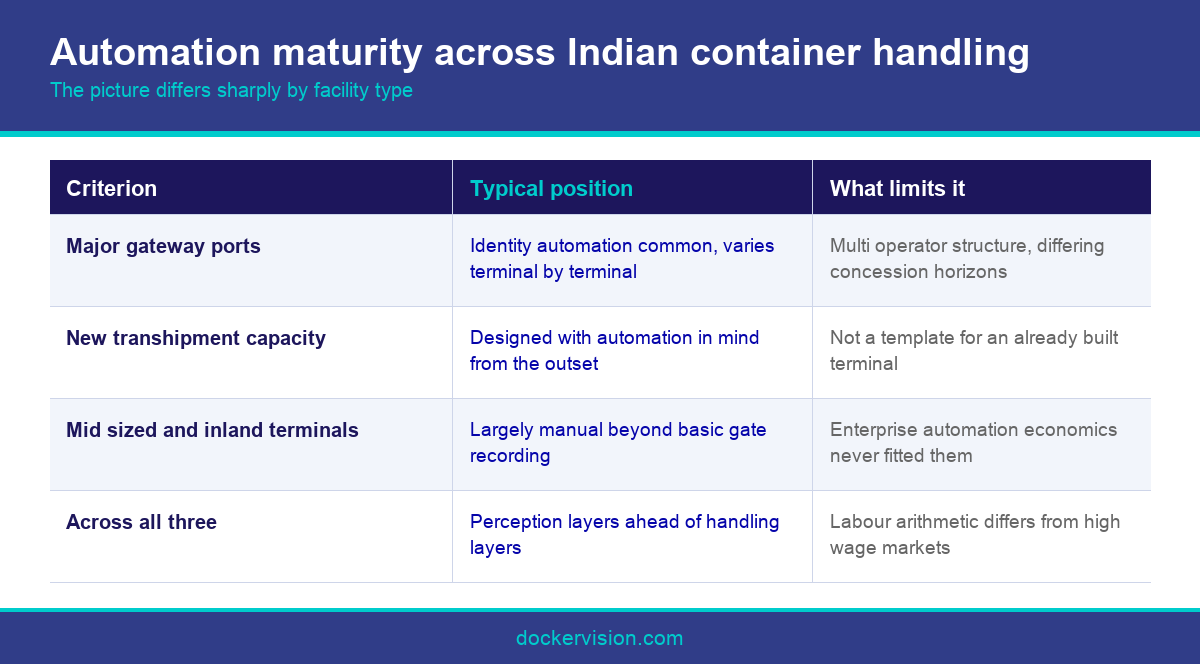
India’s container handling is concentrated in a small number of large facilities and spread across a long tail of smaller ones, and the automation picture differs sharply between the two. Understanding that split is the first step in reading any national statement about port modernisation.
The major gateway ports
Jawaharlal Nehru Port remains the largest container gateway in the country and has been the reference point for terminal modernisation for two decades. Its terminals are operated by several different companies, which means automation maturity varies within a single port rather than across it.
That distinction matters when reading national comparisons. A statement that a port has adopted a technology usually means one terminal inside it has, and a truck moving between two berths at the same port can meet a fully automated gate at one and a clipboard at the other on the same morning.
Mundra has grown into the largest commercial port in India by cargo volume and is the clearest example of privately funded infrastructure setting the pace. Investment there has gone into scale, depth and connectivity as much as into automation, which is itself instructive about where the returns have been.
For an operator reading this as a benchmark, the lesson is that capital went first to the constraints that limited throughput, and automation followed rather than led. That is the same logic a mid sized terminal should apply, even though the constraints it faces will be different ones and the sums involved very much smaller.
Vizhinjam and the transhipment ambition
Vizhinjam is the most significant recent development, a deep water transhipment terminal on the Kerala coast built specifically to capture cargo that has historically been transhipped through Colombo, Singapore and Jebel Ali rather than handled in India.
Its importance for this discussion is that it was designed with automation in mind rather than retrofitted, which makes it the closest Indian analogue to the greenfield automated terminals of northern Europe and east Asia, and a useful benchmark for what is achievable domestically.
Its wider significance is competitive. Transhipment cargo moving through an Indian terminal rather than a foreign one changes the economics of every connecting service, which is why the facility is discussed in national terms rather than as one operator’s investment decision.
The wider network
Chennai, Kattupalli and Cochin each carry container traffic alongside other cargo, and the smaller ports and inland depots that surround them handle a large share of national volume in aggregate while individually operating at a scale where enterprise automation has never been affordable.
This long tail is where most of the practical opportunity sits. These are terminals with real volume, real congestion at peak and genuine cost pressure, and they are precisely the operators that full automation economics were never designed for.
They also share a specific characteristic. Their constraint is rarely lifting capacity and almost always information: which box is where, which truck is waiting for what, and which paperwork has not cleared. That is a perception problem rather than a mechanical one, and it is considerably cheaper to solve.
Policy Drivers That Actually Matter
Maritime India Vision 2030 is the headline framework and sets efficiency, capacity and connectivity ambitions for the sector out to the end of the decade. Its practical effect on a terminal operator is that performance measures which used to be internal are now discussed in national terms.
The Sagarmala programme focuses on port led development, connectivity and modernisation, and has channelled substantial investment into port infrastructure and the road and rail links around it. For a terminal, that changes the volume outlook as much as the technology outlook.
The National Logistics Policy tied these threads together by targeting logistics cost as a share of the economy, which is a blunt but useful instrument. Terminal dwell time and truck turn time are both components of that cost, and both are directly addressable by automation.
What matters operationally is that these frameworks create measurable expectations. Turn times, dwell and berth productivity are increasingly published and compared, which turns a terminal’s performance from a private matter into a competitive one.
They also change the funding conversation. Modernisation aligned with a national programme is easier to justify internally and sometimes easier to finance, which is a practical reason for framing an automation case in those terms rather than purely in operating cost.
There is a reporting consequence too. Terminals increasingly have to produce operational data for authorities and customers alike, and a facility whose gate records are keyed by hand finds that reporting burden heavier and its numbers harder to defend than one whose records were captured automatically at the point the truck arrived.
The caution is not to confuse policy ambition with terminal readiness. National targets do not change the arithmetic at a specific berth, and a terminal that automates because a policy document exists rather than because its own numbers support it will be disappointed in the usual way.
The useful way to use policy is as a volume signal rather than as a technology instruction. Connectivity investment changes how much cargo will arrive and how quickly it must be cleared, and that forecast belongs in your capacity plan whether or not you automate anything at all this year.
Why India Favours Retrofit Over Greenfield Automation
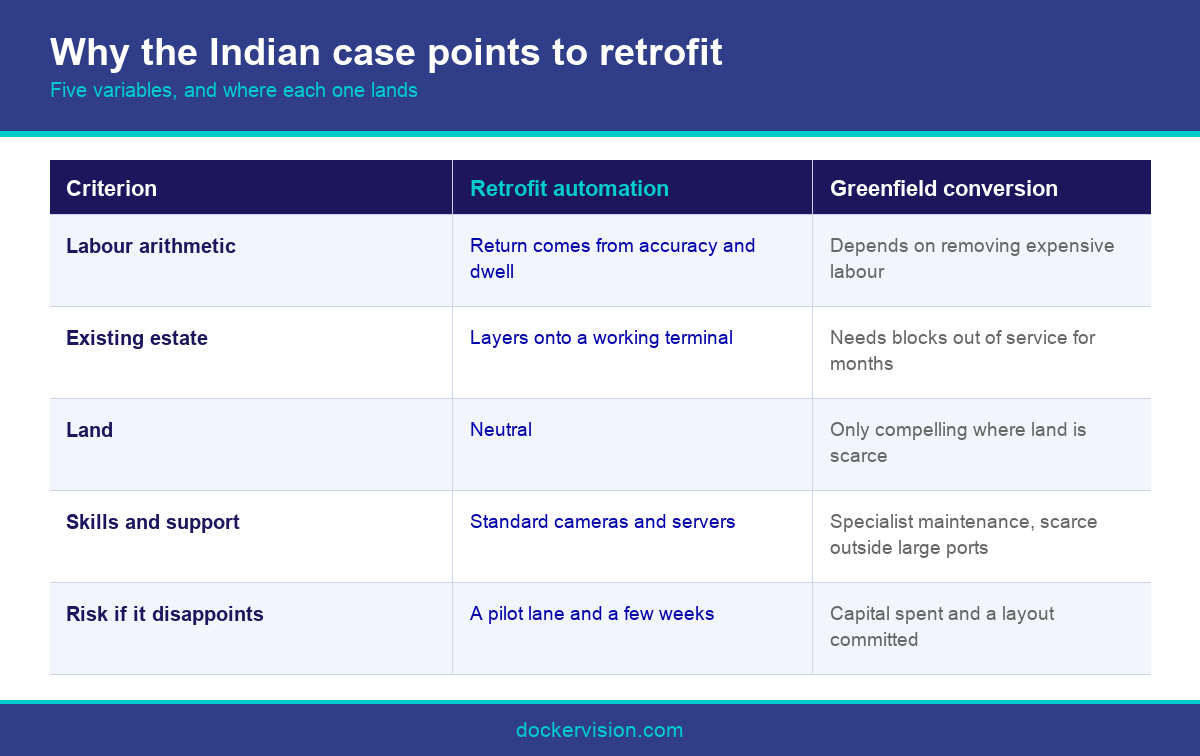
The central variable in automation economics is labour cost, and India differs from the markets where full automation was pioneered. Where a European terminal automated primarily to remove expensive labour, an Indian terminal automating for the same reason finds a much weaker case.
That does not mean automation does not pay here. It means the return comes from somewhere else: accuracy, throughput, dwell reduction, claim avoidance and the ability to handle peaks without proportional staffing increases. Those are all real and they are all addressable without rebuilding a yard.
Land is the second variable and it cuts both ways. Some Indian terminals are severely land constrained and would benefit from the density automation allows. Others have room to expand at costs that make density much less compelling than it is in a European port city.
The third variable is the existing estate. Most Indian container capacity is already built and working, and converting an operating yard to automated handling means taking blocks out of service for extended periods. Retrofit automation that layers onto existing operations avoids that entirely, which is the argument our piece on what competitive terminals invest in makes at greater length.
The fourth is skills and support. A retrofit layer that runs on standard cameras and standard servers can be supported by the IT capability a terminal already has. A full automated yard needs specialist maintenance that is scarce and expensive outside the largest facilities.
The fifth is risk appetite. A retrofit that fails costs a pilot lane and a few weeks. A structural conversion that disappoints has already consumed capital, taken blocks out of service and committed the operation to a layout, which is why the two decisions deserve very different levels of evidence before approval.
Put together, these push Indian terminals toward automating perception rather than motion. Read the containers accurately, know where they are, understand equipment condition, and leave the lifting to the machines and operators already doing it well.
This is a more defensible position than it first appears. Perception automation is reversible, incremental and cheap to pilot, and it produces the measured data that any later structural decision will need. A terminal that starts here has bought itself both an improvement and an option, which is unusual in capital projects.
How the Comparison Markets Differ
Indian terminals are routinely compared with regional benchmarks, and the comparisons are only useful if the underlying differences are understood. Four markets come up most often, and each reached its position through a different combination of constraints.
Singapore and the Gulf
Tuas represents the most ambitious consolidation of terminal capacity anywhere, built as a single automated facility to replace a set of older ones. It is a national infrastructure project as much as a commercial terminal, which is why it is a poor template for a private operator anywhere.
DP World at Jebel Ali and the wider Gulf terminals have automated selectively and invested heavily in digital services around the terminal rather than only inside it. That emphasis on the interface with customers is the more transferable lesson for Indian operators.
Gulf terminals also operate in a labour market closer to India than northern Europe is, which makes their selective approach a better guide than the wholesale automation of high wage ports. What they automated and what they deliberately did not is the interesting part.
Australia, the UK and the US
Australian terminals including those at Port Botany automated earlier than most and in a high wage environment, which is the classic case for the technology. Their experience is also where much of the published evidence about slow productivity recovery comes from.
The UK and US picture is more mixed, with Felixstowe and the larger North American terminals adopting selectively rather than wholesale, often against significant workforce negotiation. That negotiation history is itself a lesson worth reading before starting.
The pattern across all four markets is that automation followed a specific binding constraint, whether that was land, labour or throughput. None of them automated because the technology existed, and the ones that came closest to doing so are the ones with the most difficult published results.
The Labour Question, Handled Honestly
Any discussion of port automation in India that ignores employment is not worth reading. Terminals are significant local employers, port work carries social and political weight, and a proposal that pretends otherwise will fail at the first serious conversation.
The honest position is that automation changes work more than it removes it, and that the change is real. Gate clerks who key container numbers do less keying. Crane operators in automated yards move to control rooms. Maintenance requirements rise as the equipment becomes more instrumented.
The evidence from automated terminals elsewhere supports a redeployment story more than a displacement one, but with an important caveat: the redeployment only happens where it was planned and funded. Where it was assumed, the outcome has been considerably worse and considerably more contested, and the disputes that followed are still shaping negotiations in those ports today.
For a retrofit programme the picture is gentler, because perception automation removes tedious data entry rather than physical roles. A gate clerk whose job becomes exception handling rather than typing is doing more skilled work, which is a defensible position to take publicly.
The practical advice is to plan the transition explicitly and early. Name the roles that change, describe what they become, fund the training, and involve the workforce before the technology arrives rather than after it has been installed and switched on.
Terminals that do this find adoption faster as well as calmer, because the people who understand the gate best are the ones who find the edge cases the system needs to handle. Our note on why manual gates stop scaling covers the operational side of that change.
There is a commercial argument for the same approach. A gate team that trusts the system reports problems instead of working around them, and a team that does not will quietly key entries manually and leave you with an expensive system and unchanged data quality. Adoption is part of the engineering, not a communication exercise bolted on afterwards.
What a Mid Sized Indian Terminal Should Automate First
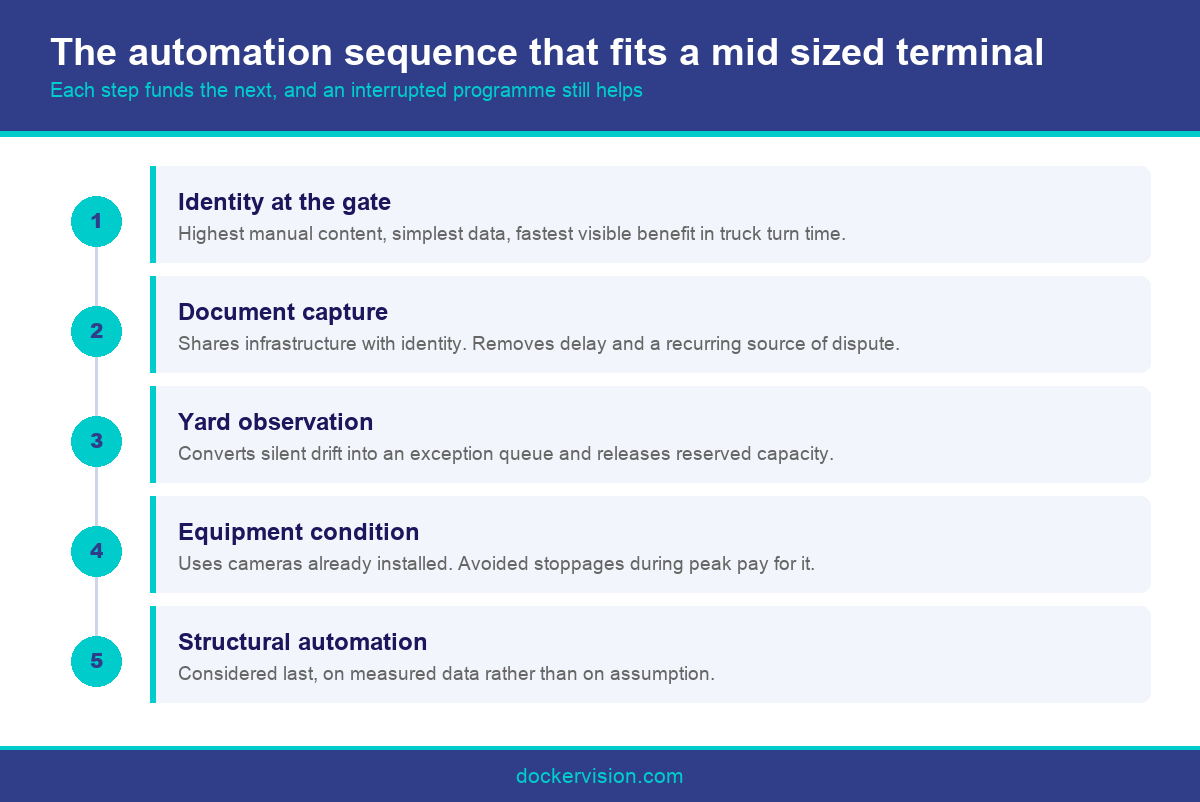
Start with identity at the gate. It is the highest manual content, the simplest data, the fastest measurable benefit and the least disruptive installation. Truck turn time improves within weeks and the accuracy gain propagates into every downstream process.
Second, add document capture. Indian terminal operations remain paperwork intensive, and converting delivery orders, customs paperwork and interchange receipts into data removes both delay and a recurring source of dispute, as our piece on automated document processing describes.
Third, add yard observation. Once identity is reliable, an independent check on where containers physically sit converts silent drift into a manageable exception queue and releases capacity that planners were holding in reserve against uncertainty.
Fourth, consider equipment condition. Terminals running ageing cranes in a hot, humid, saline environment have a maintenance problem that is worth instrumenting, and cameras installed for recognition can contribute to that without a separate sensor programme.
This step is often deferred and should not be. Equipment failure during a vessel window is among the most expensive events a terminal experiences, and the marginal cost of using camera feeds you have already paid for to watch component condition is small compared with the value of one avoided unplanned stoppage in peak season.
Fifth, and only then, evaluate structural automation. By this point you will have accurate data, measured benefits and a realistic view of where the remaining constraint sits, which is exactly the evidence a capital case needs and almost never has.
Each step in that sequence funds the next, which matters at operators where capital is scarce and has to be justified against alternatives. It also means an interrupted programme still leaves the terminal better off than it started.
It is worth writing the sequence down as a plan with expected measures at each stage, even if only the first stage is funded. A board that can see where a programme goes approves the first step more readily than one presented with an isolated purchase, and the measures give you something to report against when the second step is proposed.
Procurement, Funding and Local Realities
Procurement at Indian terminals frequently involves a tender process with defined technical specifications, and the quality of those specifications determines the quality of the outcome. A specification written around a specific vendor architecture excludes better options without anyone intending it.
Write accuracy requirements as measurable outcomes rather than as hardware descriptions. A specification demanding line scan cameras is describing an implementation. A specification demanding a stated recognition rate on your own traffic, verified during acceptance, is describing a result.
Budget for the local environment. Heat, humidity, monsoon rain, dust and salt all affect camera housings, network equipment and server rooms, and a design that works in a temperate climate needs checking rather than assuming for a coastal Indian terminal.
Ask specifically about enclosure ratings, condensation handling and how the vendor deals with a camera that fogs at dawn during monsoon. These are unglamorous questions and they separate suppliers who have deployed in this climate from those describing what should work in principle.
Consider connectivity honestly. Many Indian terminals have adequate but not flawless links, which is a strong argument for processing at the edge so that operations continue during an outage and data forwards automatically when the link returns.
Data residency is the related question. Terminals handling cargo for regulated customers or working under customs supervision are frequently required to keep operational imagery inside their own network, which is a further argument for on site processing rather than a cloud service, as our note on secure on premise deployment sets out.
Factor in support geography. A vendor with people in India responds differently from one with people in another time zone, and for a system sitting on the critical path of every truck transaction that difference shows up on the first bad night rather than in the contract.
Finally, insist on a phased commercial structure. Pay for a proven lane before committing to a terminal wide rollout. Any vendor confident in their technology will accept that, and any who will not has told you something useful, as our guide to appointing a supplier explains.
Write the acceptance test into the contract in the same spirit. Define the sample, the measurement method and the threshold before installation begins, using your own traffic rather than a curated set, so that acceptance becomes an arithmetic exercise rather than a negotiation at the end of a project when both sides are already tired.
Conclusion
Port automation in India is not a smaller version of what happened in Rotterdam or Singapore. Labour economics, an already built estate and a long tail of mid sized terminals all point toward automating perception rather than motion, in a sequence that begins at the gate and funds itself as it goes. Policy provides the pressure and the volume outlook, and the arithmetic still has to work at your own berth. Ask Docker Vision for a market specific briefing.
Frequently Asked Questions
How automated are Indian ports compared with global leaders?
Broadly semi automated. Gate and crane recognition are considerably more widespread than automated yard handling, and only the newest facilities were designed around automation rather than having it retrofitted onto an existing and already operating layout.
Which Indian port is furthest ahead on automation?
The most recently built deep water transhipment capacity was designed with automation in mind from the outset, which makes it the closest domestic analogue to greenfield automated terminals elsewhere. Older gateway ports vary terminal by terminal.
Does Maritime India Vision 2030 require terminals to automate?
It sets efficiency, capacity and connectivity ambitions rather than mandating any specific technology. The practical effect is that turn time and berth productivity are now compared publicly, which turns an individual terminal’s performance into a competitive matter.
Why does full automation pay less well in India?
Because the classic case rests on removing expensive labour, and Indian labour economics are different. The return here comes from accuracy, dwell reduction, claim avoidance and peak handling, all of which retrofit automation delivers without a rebuild.
What should an Indian mid sized terminal automate first?
Identity at the gate, then document capture, then yard observation, then equipment condition. Each step funds the next, and an interrupted programme still leaves the terminal measurably better off than it was when it started.
How should the workforce question be handled?
Explicitly and early. Name the roles that change, describe what they become, fund the training and involve the gate team before installation. Terminals that plan redeployment rather than assuming it see faster adoption and fewer disputes.
Does the Indian climate affect automation equipment?
Yes. Heat, humidity, monsoon rain, dust and salt all affect camera housings, network gear and server rooms. A design proven in a temperate climate needs verifying against local conditions rather than assuming, particularly at a coastal Indian terminal.
Should we write hardware into the tender specification?
No. Specify measurable outcomes instead, such as a recognition rate verified on your own traffic during acceptance. Specifying particular camera types describes an implementation and quietly excludes better options that nobody actually intended to rule out.
Is connectivity a problem for automated terminals in India?
It can be, which is why processing on site matters here. Reads should continue during a link outage and forward automatically once connectivity returns. Our explainer on peak season volume handling covers what that resilience is worth.
How should an Indian terminal structure the commercial deal?
In phases. Pay for one proven lane before committing to any terminal wide rollout, with acceptance measured on your own traffic rather than a curated sample. See AI in real terminal operations for what proven deployments look like.

Leave A Comment