
Yard Inventory Reconciliation: Closing the TOS Reality Gap
- Posted On: October 22, 2026
- Post Comments: 0
Every terminal has a moment when a container cannot be found. The record says one thing, the yard says another, and somebody walks the rows until the box appears. That gap between container yard software and physical reality opens continuously and closes only when somebody makes it close. This article, part of our wider yard series, explains how to run a reconciliation that is worth the labour it consumes, and how to stop the gap reopening the following week.
Key Takeaways
- Reconciliation is the process of comparing what the system believes is in the yard against what is physically there, and correcting the record where they differ.
- A full physical count is expensive and out of date within hours, which is why most terminals run one rarely and live with accumulating drift in between.
- Targeted reconciliation, driven by where discrepancies are statistically likely, recovers most of the accuracy for a fraction of the labour a full count consumes.
- Continuous observation changes the economics completely, because the gap is detected as it opens rather than discovered months later during a count.
Why the Gap Opens and Keeps Opening
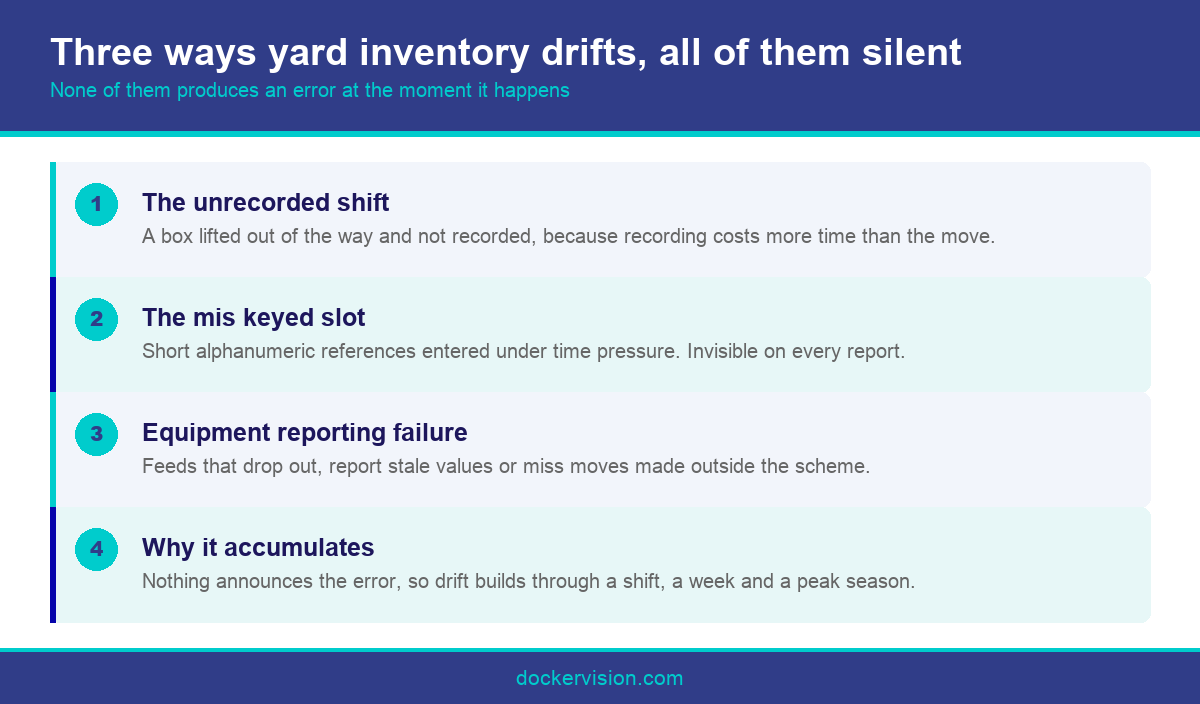
The operating record is built from reported moves. Every time a machine sets a container down, somebody or something confirms the position, and the platform updates. If that confirmation is missing, delayed or wrong, the record and the yard part company, and nothing in the system is designed to notice. The record simply carries on being confidently incorrect.
The commonest cause is the unrecorded shift. An operator lifts a box out of the way to reach another, intends to put it back, and the shift ends before that happens. No dishonesty and no carelessness is involved. The workflow simply does not make recording a temporary move worth the interruption at working pace, so it does not get recorded.
The second cause is the mis keyed slot. Position references are short alphanumeric strings entered under time pressure, and transposition is inevitable at volume. This is the same class of error that stocktaking exists to catch in any warehouse, except that a container yard is larger and the count is far more expensive to run.
The third is equipment reporting failure. Position feeds from handling equipment drop out, report stale values or miss moves made by a machine outside the scheme. Terminals relying entirely on equipment reporting inherit each gap directly, with no independent check that would reveal it.
What all three share is silence. None produces an error, an alert or a reconciliation exception at the moment it happens, so drift accumulates through a shift, a week and a peak season. The first symptom is almost always a retrieval that takes far longer than it should, and even then the cause is usually recorded as congestion.
That silence is the reason reconciliation exists as a separate discipline. In a system where errors announce themselves you fix them as they occur. In a yard, somebody has to go looking for errors that have no intention of announcing themselves, and the only question is how efficiently that search can be organised.
Running a Reconciliation That Earns Its Cost
A full physical count is the traditional answer and it is expensive. Walking every row, recording every container and comparing the result against the system consumes a shift of labour at least, ties up equipment for the awkward positions, and produces a snapshot that begins decaying the moment the count finishes and the yard starts working again.
Targeted reconciliation is usually the better investment. Instead of counting everything, count the places where discrepancies are statistically likely: the blocks worked hardest, the rows with the most mixed dwell times, the areas where last quarter found the most errors, and anything that has been repositioned more than twice in a week.
Prioritise by consequence as well as by likelihood. A discrepancy on a container due to leave in three days matters far more than one on an empty that has been in the same corner for a month, so weight the target list by expected retrieval date rather than treating every slot in the yard as equally worth verifying.
Record the outcome properly. Every discrepancy found should be logged with its type, its block and its likely cause, because that log is what tells you where to look next time and whether the underlying process is improving. A reconciliation that only corrects the record teaches you nothing about why it was wrong.
Correct it in the container yard software rather than in a spreadsheet. This sounds obvious and is frequently violated under time pressure, and a correction that never reaches the operating record leaves the yard exactly as it was, with the added disadvantage that somebody now believes it has been fixed.
Finally, size the effort against what drift costs you. If search events and unproductive moves are costing a measurable amount each month, a monthly targeted count is easy to justify. If they are not, a quarterly one may be enough, and the honest answer is that most terminals have never done the arithmetic in either direction.
Making Reconciliation Continuous Instead of Periodic
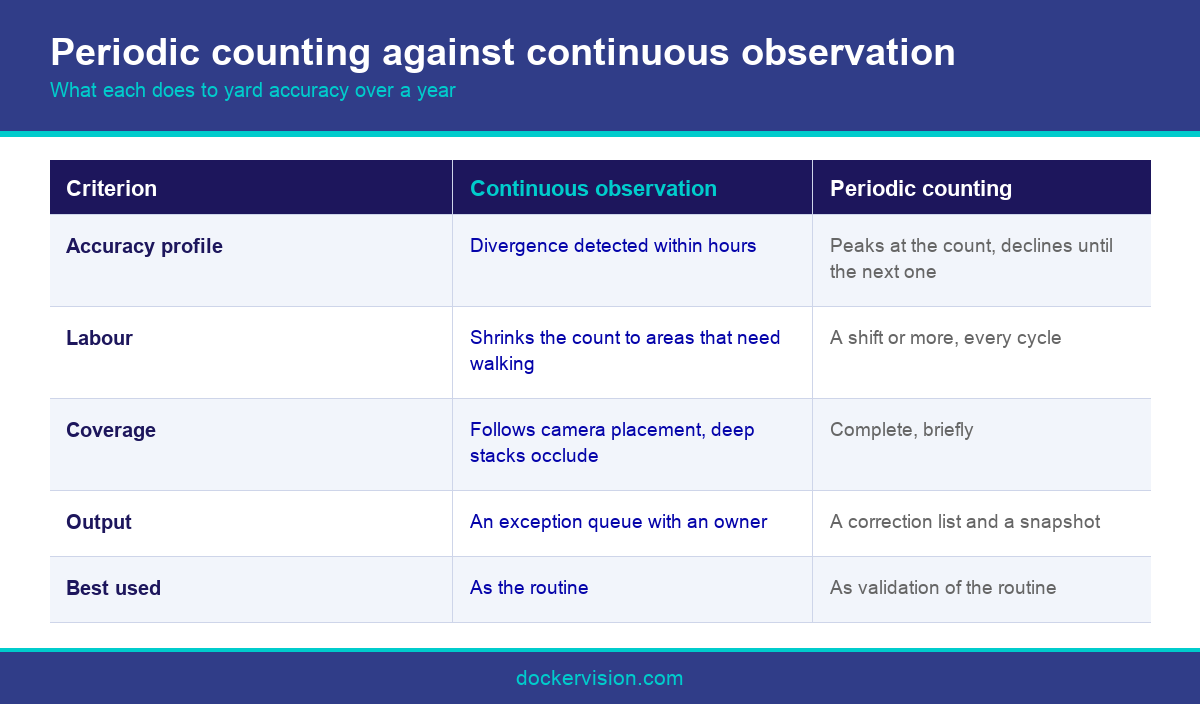
The structural problem with any count is that it is a snapshot. Accuracy peaks at the moment the count ends and declines steadily until the next one, which means the yard picture is least reliable for most of the year, and specifically least reliable during the busy periods when reliability matters most and counting is hardest to schedule.
Continuous observation inverts that. If something is watching where containers physically are, a divergence between the record and reality is detected within hours rather than months, and it arrives as an exception on a queue rather than as a surprise during a retrieval that a customer is waiting for.
Cameras already installed for gate and crane recognition can contribute here. A camera that reads a container code also knows where and when it saw that code, which produces a stream of sightings, and a sighting that contradicts the recorded position is precisely the exception a yard planner needs to see that morning.
Sightings do not replace counting outright, and any vendor who says otherwise is overselling. Coverage follows camera placement, deep stacks create genuine occlusion, and some parts of a yard will remain unobserved. What sightings do is shrink the count to the areas that genuinely need walking, which is where the labour saving comes from.
The queue matters as much as the detection. A discrepancy that appears on a dashboard nobody owns changes nothing at all, so route exceptions into the operating platform as work with an assignee and a target time, exactly as our guide to plugging into an existing platform describes for gate events.
Terminals that make this shift describe the change in the same way. The dramatic search events stop, the periodic count becomes a verification rather than a discovery exercise, and yard planning recommendations start being followed because the planners have stopped assuming the underlying picture is wrong.
Preventing the Gap From Reopening
Start at the gate. A container that entered under a mis keyed number is wrong in the record from its first second in the terminal, and no amount of yard discipline will correct an identity error that was made at the boundary. Automated identity capture is the single most effective preventive measure available and it is also the cheapest.
Then reduce the number of manual entries inside the yard. Every point where a person types a slot reference under time pressure is a point where transposition happens, so selecting from a list, scanning a position marker or confirming a system proposal all beat free text entry by a wide margin in every terminal that has measured it.
Make temporary moves recordable in seconds rather than in minutes. Operators do not skip recording because they are careless, they skip it because the interaction costs more time than the move itself. A one action confirmation on the machine terminal removes most of that gap without any change to the underlying process.
Publish accuracy as an operational metric, by block and by shift. Teams respond to numbers they can see and cannot influence indirectly, and a visible accuracy figure converts inventory quality from an abstract data concern into something the yard team recognises as part of doing the job properly.
Close the loop on causes rather than only on symptoms. If one block generates a disproportionate share of discrepancies every month, the answer is probably physical, such as poor sightlines, an awkward layout or a marker that is hard to read from the cab, and correcting that removes the errors permanently rather than repeatedly.
Finally, connect the effort back to the money. Reconciliation is easy to deprioritise because its benefit is invisible when it works, so keep reporting search events, unproductive moves and truck wait alongside the accuracy figure, as our note on handling peak season volumes recommends for every yard metric.
Conclusion
Yard inventory drifts silently, which is why it needs a deliberate process rather than good intentions. Target your counts where discrepancies are likely and consequential, log causes rather than only corrections, and move toward continuous observation so the gap is detected as it opens. Then prevent it at the gate, where identity errors are cheapest to stop. Ask Docker Vision about a reconciliation review using your existing cameras.
Frequently Asked Questions
What is yard inventory reconciliation?
It is the process of comparing what the operating system believes is in the yard against what is physically present, then correcting the record where the two differ. It exists because yard drift never announces itself through an error or alert.
How often should a terminal reconcile its yard?
It depends on what drift costs you. If search events and unproductive moves are measurably expensive, a targeted monthly count is easy to justify. Quarterly may suffice for slower yards, but most terminals have never done the arithmetic.
Is a full physical count worth the labour?
Rarely, as a routine. It consumes a shift or more, ties up equipment and produces a snapshot that starts decaying immediately. Targeted counting driven by likelihood and consequence recovers most of the accuracy for a fraction of the effort.
How do we decide which blocks to count?
Prioritise the blocks worked hardest, rows with mixed dwell times, areas where the last count found most errors, and containers due to leave soonest. Weighting by expected retrieval date matters as much as weighting by error likelihood.
Can cameras replace a physical stocktake?
They shrink it rather than replace it. Camera sightings detect divergence continuously, but coverage follows placement and deep stacks create occlusion, so a periodic physical check remains how you validate whatever observation system you deploy.
What is a sighting in this context?
A sighting is an observation of a specific container at a specific place and time, produced when a camera reads its code. Sightings that contradict the recorded position are the exceptions worth putting in front of a planner each morning.
Why do operators not record temporary moves?
Because the recording interaction costs more time than the move itself at working pace. Making confirmation a single action on the machine terminal removes most of that gap without changing the underlying operational process at all.
Where do most inventory errors actually originate?
At the gate, more often than terminals expect. A container that entered under a mis keyed number is wrong from its first second, and no amount of yard discipline can correct an identity error made at the boundary.
How should discrepancies reach the yard team?
As assigned work in the operating platform with an owner and a target time, rather than as a line on a dashboard that nobody has been made responsible for. Our explainer on reading a container in realtime covers how those events get routed.

Leave A Comment